Musca domestica
Common House Fly
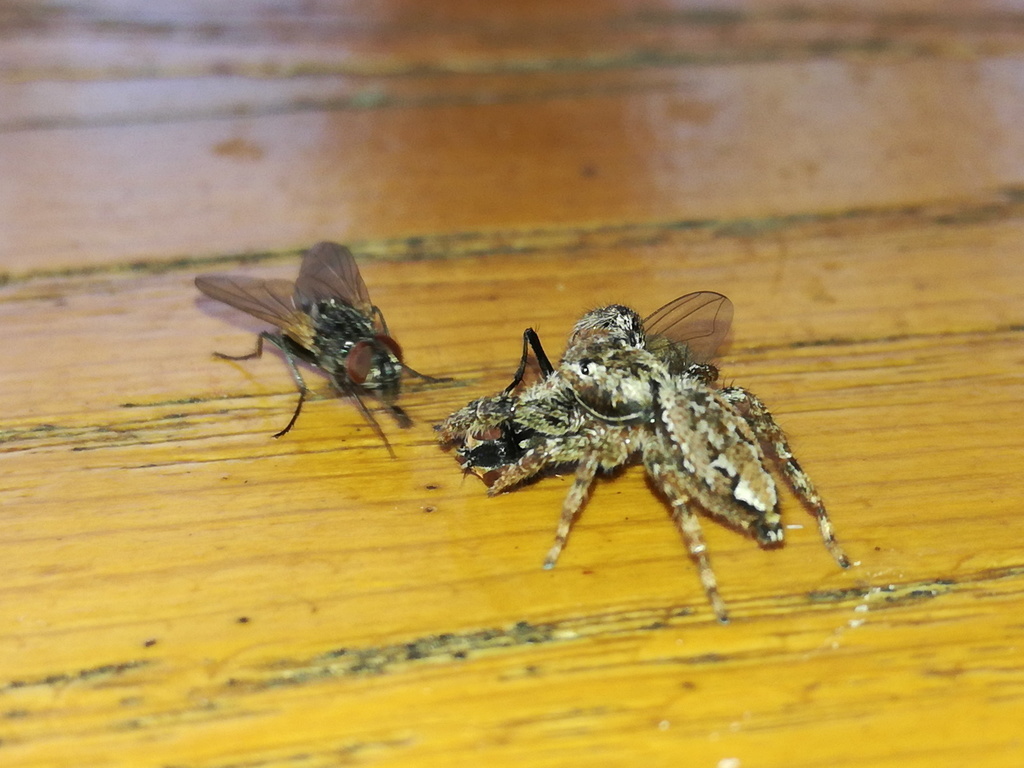
no rights reserved · CC0
Family: Muscidae · Class: Insecta · Order: Diptera
Musca domestica (Common House Fly) is a California animal in the Muscidae family.
The common house fly is a small, robust dipteran insect measuring 4-7.5 mm (0.16-0.30 inches) in body length. Adults display a grayish coloration with four dark longitudinal stripes on the thorax. The compound eyes are large and reddish-brown, with males exhibiting holoptic eyes (touching at the top) while females have dichoptic eyes (separated). The species possesses sponging mouthparts adapted for liquid feeding, and females can be distinguished from males by their slightly larger size and broader abdomen. Wings are clear with distinct venation patterns typical of the Muscidae family. Musca domestica has achieved a cosmopolitan distribution, occurring on all continents except Antarctica. In California, the species is found throughout the state from sea level to mountainous regions, thriving in both urban and rural environments. The house fly's global distribution closely follows human settlements, as it has been inadvertently transported worldwide through commerce and travel over thousands of years. House flies inhabit diverse environments but show strong associations with human activity and organic waste. They are commonly found around livestock facilities, garbage dumps, compost piles, and food processing areas. The species thrives in warm, humid conditions and requires organic matter for larval development. Adults are frequently observed on decaying organic material, fresh manure, rotting fruit, and various food sources. They can tolerate a wide range of temperatures but are most active between 20-30°C (68-86°F). Adult house flies are primarily saprophagous, feeding on liquified organic matter through their sponging mouthparts. They regurgitate digestive enzymes onto solid food sources to dissolve nutrients before consumption. Females require protein-rich foods for egg production and are particularly attracted to animal waste and decaying matter. The species exhibits rapid reproduction, with females laying 75-150 white, oval eggs in batches on suitable organic substrates. Under optimal conditions, the complete life cycle from egg to adult takes 7-10 days, with larvae developing through three instars before pupating. Adults typically live 15-30 days, though this varies significantly with environmental conditions. House flies are strong fliers capable of traveling several kilometers, with peak activity occurring during daylight hours. Musca domestica is not listed under federal or state conservation legislation, as it is considered an abundant cosmopolitan species. Rather than requiring protection, house flies are often managed as nuisance pests due to their role as disease vectors. The species can transmit over 100 human and animal pathogens, including bacteria, viruses, and parasites, through mechanical transmission on their body surfaces and in their digestive systems. Despite their pest status, house flies play ecological roles as decomposers, breaking down organic waste, and as food sources for various predators including spiders, birds, and other insects. Population control typically involves sanitation measures, biological control agents, and targeted pesticide applications in agricultural and urban settings.
Classification
Class: Insecta · Order: Diptera · Family: Muscidae
Frequently asked questions
How is Musca domestica classified?
Musca domestica belongs to class Insecta, order Diptera, family Muscidae.
What family does Musca domestica belong to?
Musca domestica is in the Muscidae family.
What is Musca domestica?
The common house fly is a small, robust dipteran insect measuring 4-7.5 mm (0.16-0.30 inches) in body length.
Is Musca domestica found in California?
Yes. Musca domestica is recorded in California in The California Species Project's catalogue.
Related species
Other California species in the same genus, family, or bioregion.
Data from The California Species Project — 14,000+ California species with verified data from CNPS, CDFW, USFWS, and more.