Muscina levida
Dark-horned Muscina
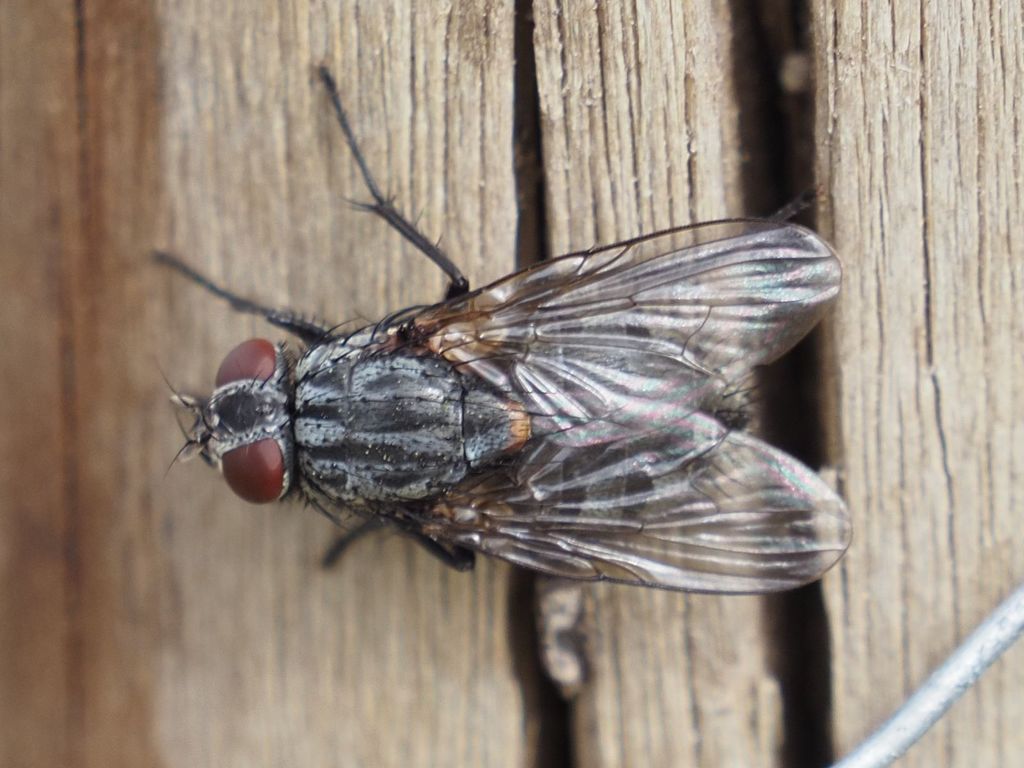
(c) Michael Knapp, some rights reserved (CC BY) · licence
Family: Muscidae · Class: Insecta · Order: Diptera
Muscina levida (Dark-horned Muscina) is a California animal in the Muscidae family.
Muscina levida is a species of fly in the family Muscidae, subfamily Muscinae, tribe Reinwardtiini. This dipteran belongs to the Calyptratae group within the order Diptera and represents one of several Muscina species found in North America. The species exhibits typical muscid characteristics, though specific morphological details distinguishing it from closely related species require microscopic examination of taxonomic features. The distribution of M. levida in North America includes populations that are part of a broader Holarctic range. According to Vikhrev and Esin (2023), most Palaearctic Muscina species discussed in their comprehensive review are also found in North America, suggesting this species has a transcontinental distribution pattern common to many muscid flies. The exact extent of the species' range within California and other western states requires further documentation through systematic surveys. Habitat preferences for M. levida have not been extensively documented in the scientific literature. Like other members of the genus Muscina, this species likely occupies a variety of environments where organic matter provides suitable breeding substrates. Muscid flies typically develop in decomposing organic material, and species within this genus are often associated with carrion, dung, and other decaying matter that supports larval development. The ecology and behavior of M. levida follow patterns typical of muscid flies. Adults are likely saprophagous, feeding on various organic substances, while larvae develop as saprophytes in decomposing material. The species presumably exhibits a multivoltine life cycle in suitable climates, with multiple generations per year depending on temperature and resource availability. Specific details regarding mating behavior, oviposition preferences, and seasonal activity patterns remain undocumented in available literature. Musc ina levida does not appear on federal or state conservation lists, and its conservation status has not been formally assessed. The species' inclusion in the U.S. Fish and Wildlife Service taxonomic database indicates recognition as part of North American fauna, but population trends and potential threats remain uncharacterized. As with many dipteran species, habitat modification and pesticide use could potentially impact populations, though the species' apparent adaptability to various organic substrates may provide some resilience. Taxonomic work by Vikhrev and Esin (2023) provides the most recent comprehensive treatment of Palaearctic Muscina species, many of which occur in North America. This research contributes to understanding the broader systematics of the genus and may facilitate more accurate identification of North American populations. However, detailed biological and ecological studies specific to North American M. levida populations remain limited, representing a significant knowledge gap for this species.
Classification
Class: Insecta · Order: Diptera · Family: Muscidae
Frequently asked questions
How is Muscina levida classified?
Muscina levida belongs to class Insecta, order Diptera, family Muscidae.
What family does Muscina levida belong to?
Muscina levida is in the Muscidae family.
What is Muscina levida?
Muscina levida is a species of fly in the family Muscidae, subfamily Muscinae, tribe Reinwardtiini.
Is Muscina levida found in California?
Yes. Muscina levida is recorded in California in The California Species Project's catalogue.
Related species
Other California species in the same genus, family, or bioregion.
Data from The California Species Project — 14,000+ California species with verified data from CNPS, CDFW, USFWS, and more.