Mustela erminea
Ermine
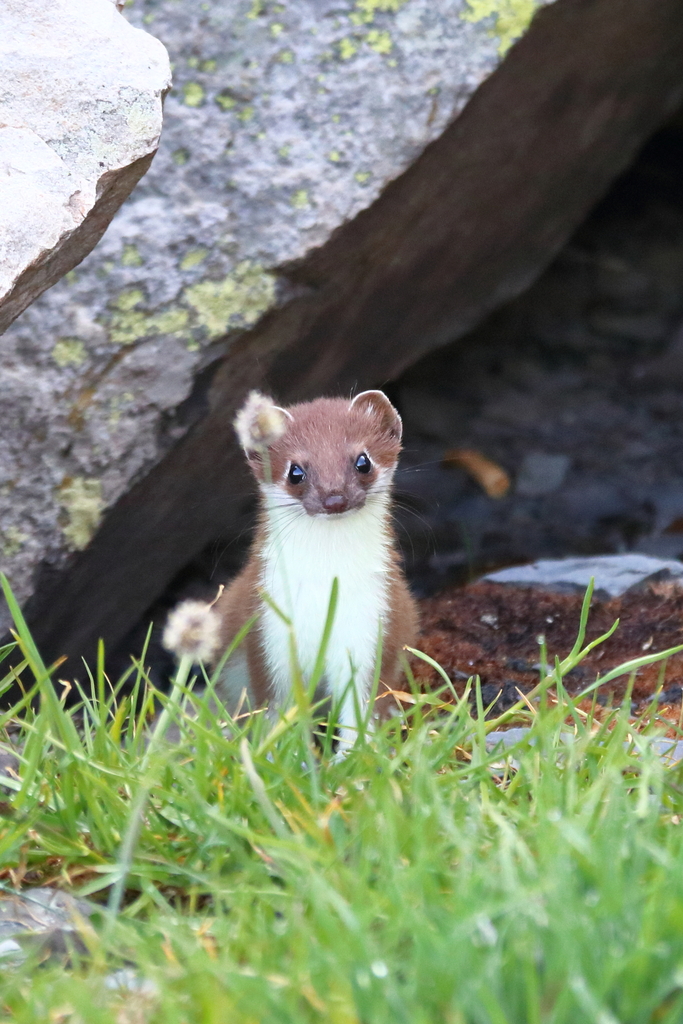
(c) Donsky, some rights reserved (CC BY) · licence
Family: Mustelidae · Class: Mammalia · Order: Carnivora
Mustela erminea (Ermine) is a California animal in the Mustelidae family.
The ermine (Mustela erminea) is a small, elongated carnivore belonging to the weasel family. Adults measure 150 to 330 mm (5.9 to 13.0 inches) in body length, with males typically 25% larger than females. The tail adds an additional 42 to 120 mm (1.7 to 4.7 inches). Body weight ranges from 25 to 340 grams (0.9 to 12.0 ounces), with considerable sexual dimorphism. The species exhibits dramatic seasonal coat changes: summer pelage is brown dorsally with white or yellowish underparts, while winter coat becomes completely white except for the distinctive black-tipped tail that remains constant year-round. Ermines occur across northern California, primarily in montane and subalpine regions of the Sierra Nevada, Cascade Range, and northern Coast Ranges. The species has a circumpolar distribution, ranging across Alaska, Canada, and northern United States, extending south along mountain ranges. In California, populations are generally found above 1,500 meters (4,900 feet) elevation, though they may occur at lower elevations in coastal areas during winter months. The species inhabits coniferous forests, alpine meadows, rocky talus slopes, and shrubland communities. Ermines prefer areas with adequate cover such as fallen logs, rock crevices, and dense vegetation. They utilize existing burrows of other mammals rather than excavating their own dens. Snow depth influences habitat selection, as ermines are well-adapted to subnivean environments and actively hunt beneath snowpack during winter months. Ermines are primarily nocturnal and crepuscular hunters, though they may be active during daylight hours in winter. Their diet consists mainly of small mammals, particularly voles, mice, shrews, and ground squirrels, which can comprise up to 80% of their diet. They also consume birds, eggs, insects, and occasionally fish. Ermines are efficient predators capable of taking prey larger than themselves. Mating occurs during late spring and early summer, with delayed implantation resulting in birth timing the following spring. Gestation lasts approximately 280 days total, including the delay period. Females produce one litter annually of 4 to 9 kits, with average litter size of 6. Young reach sexual maturity at 10 to 12 months of age. Currently, ermines have no federal or state listing status in California and are considered stable throughout most of their range. The species benefits from large home ranges and adaptability to various forest conditions. However, climate change poses potential long-term threats through habitat modification at high elevations and altered snow conditions that affect prey availability. Forest management practices that maintain structural diversity and snag retention support ermine populations by preserving prey habitat and den sites. The species serves as an important predator in montane ecosystems, helping regulate small mammal populations.
Classification
Class: Mammalia · Order: Carnivora · Family: Mustelidae
Frequently asked questions
How is Mustela erminea classified?
Mustela erminea belongs to class Mammalia, order Carnivora, family Mustelidae.
What family does Mustela erminea belong to?
Mustela erminea is in the Mustelidae family.
What is Mustela erminea?
The ermine (Mustela erminea) is a small, elongated carnivore belonging to the weasel family.
Is Mustela erminea found in California?
Yes. Mustela erminea is recorded in California in The California Species Project's catalogue.
Related species
Other California species in the same genus, family, or bioregion.
Data from The California Species Project — 14,000+ California species with verified data from CNPS, CDFW, USFWS, and more.