Mustela nigripes
Black-footed ferret
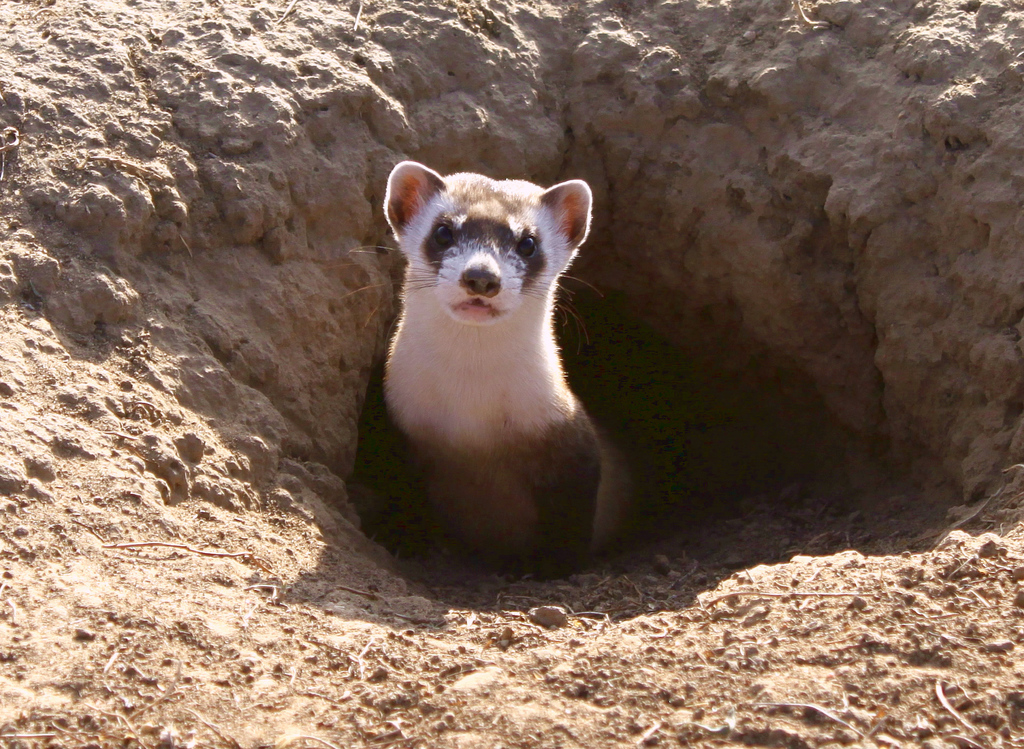
(c) USFWS Mountain-Prairie, some rights reserved (CC BY) · licence
Family: Mustelidae · Class: Mammalia · Order: Carnivora
Conservation status: Endangered
Mustela nigripes (Black-footed ferret) is a California animal in the Mustelidae family.
The black-footed ferret is a medium-sized carnivore in the mustelid family, weighing 1.4 to 2.5 pounds (0.6 to 1.1 kg) and measuring 19 to 24 inches (48 to 61 cm) in total length, including a 5 to 6 inch (13 to 15 cm) tail (USFWS 2024). It is a slender, wiry animal with distinctive black markings on the feet, legs, ear tips, and face mask, contrasting with a pale yellowish-buff body and darker guard hairs. The species is the only ferret native to the Americas and is distinguished from domestic ferrets by its larger size, longer legs, and distinctive coloration pattern. Historically, black-footed ferrets ranged from the Great Plains of Canada to intermontane regions of the interior Rocky Mountains and Southwest, with evidence suggesting they may have occurred in north-central Chihuahua, Mexico (USFWS 2019). The species was once distributed across approximately 12 states. Currently, reintroduced populations exist in Wyoming, Arizona, Colorado, Montana, South Dakota, and Utah, with several managed as experimental populations under the Endangered Species Act (USFWS 2024). Black-footed ferrets are obligate associates of prairie dog colonies, requiring short-grass prairie ecosystems where prairie dogs are abundant. They depend almost exclusively on prairie dog burrow systems for denning, shelter, and nursery sites. The species evolved as a specialist predator in these grassland communities over approximately 100,000 years, with genetic divergence from Siberian ancestors occurring 30,000 to 45,000 years ago (USFWS 2017). As solitary, nocturnal, and fossorial carnivores, black-footed ferrets are highly specialized predators with prairie dogs comprising up to 90% of their diet. They hunt at night in a zigzag pattern, typically covering 1.4 kilometers (1 mile) while searching burrow systems. Ferrets kill smaller prey with pithing bites to the head, neck, or back, while adult prairie dogs are killed in their burrows through suffocation from throat bites (USFWS 2017). Breeding occurs from March through April, with females producing litters of 3 to 4 kits after a gestation period of 41 to 43 days. The species has a high reproductive rate, allowing small populations to expand rapidly under favorable conditions. The black-footed ferret was listed as endangered under the Endangered Species Act and represents one of North America's most endangered mammals. Once thought extinct, the species was rediscovered in 1981 near Meeteetse, Wyoming. All current populations descend from 18 individuals captured from this last wild population. Through intensive captive breeding and reintroduction efforts managed by the Black-footed Ferret Recovery Program, over 300 ferrets now exist in the wild across multiple reintroduction sites (USFWS 2024). Primary threats include habitat loss from prairie dog colony reduction, sylvatic plague affecting both ferrets and their prey, and genetic bottlenecks from the small founding population. Recovery goals require securing 185,000 to 250,000 acres of suitable habitat to support viable populations.
Classification
Class: Mammalia · Order: Carnivora · Family: Mustelidae
Conservation status
Endangered
Frequently asked questions
How is Mustela nigripes classified?
Mustela nigripes belongs to class Mammalia, order Carnivora, family Mustelidae.
What family does Mustela nigripes belong to?
Mustela nigripes is in the Mustelidae family.
Is Mustela nigripes protected or of conservation concern?
Mustela nigripes carries the following status: Endangered.
What is Mustela nigripes?
The black-footed ferret is a medium-sized carnivore in the mustelid family, weighing 1.4 to 2.5 pounds (0.6 to 1.1 kg) and measuring 19 to 24 inches (48 to 61 cm) in total length, including a 5 to 6 inch (13 to 15 cm) tail (USFWS 2024).
Is Mustela nigripes found in California?
Yes. Mustela nigripes is recorded in California in The California Species Project's catalogue.
Related species
Other California species in the same genus, family, or bioregion.
Data from The California Species Project — 14,000+ California species with verified data from CNPS, CDFW, USFWS, and more.