Mustela richardsonii
American Ermine
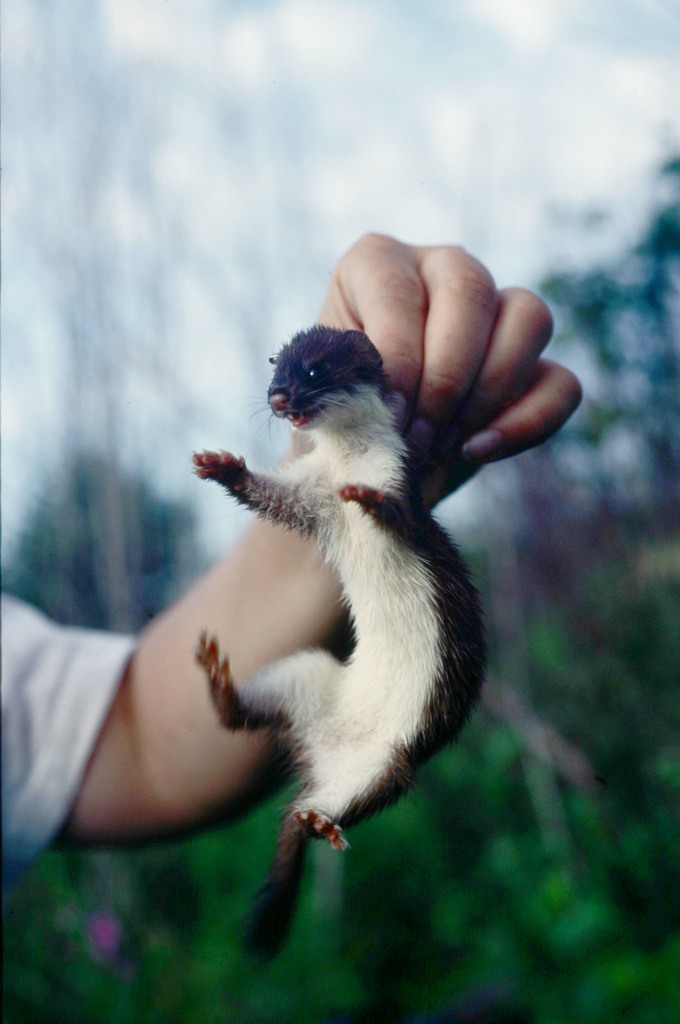
no rights reserved · CC0
Family: Mustelidae · Class: Mammalia · Order: Carnivora
Mustela richardsonii (American Ermine) is a California animal in the Mustelidae family.
The American Ermine is a small carnivorous mammal in the weasel family (Mustelidae), measuring 170-330 mm (6.7-13.0 inches) in total length with males typically larger than females. Adults weigh 25-116 grams (0.9-4.1 ounces), displaying significant sexual dimorphism. The species exhibits distinctive seasonal coat changes: summer pelage is brown dorsally with white to yellowish underparts, while winter coat becomes entirely white except for the characteristic black-tipped tail. The tail comprises approximately one-third of the total body length and serves as a distinguishing feature from other small mustelids. Historically, the American Ermine ranged across northern North America from Alaska to the northeastern United States. In California, populations occur primarily in the northern mountainous regions, including the Cascade Range and northern Sierra Nevada. According to NatureServe, the species maintains a Global Status of G5, indicating populations are secure across its range. However, California represents the southern extent of the species' distribution, where populations may be more isolated and potentially vulnerable to climate change impacts. The species inhabits diverse montane and subalpine ecosystems, including mesic subalpine woodlands, western hemlock-silver fir forests, montane shrublands, and alpine environments. NatureServe habitat associations indicate the species occurs in Northern California Mesic Subalpine Woodland and North Pacific Mesic Western Hemlock-Silver Fir Forest communities. Elevational preferences typically range from 1,200-3,500 meters (3,937-11,483 feet), with populations adapted to cooler, snow-dominated environments. Rocky Mountain alpine bedrock and scree habitats also support populations, demonstrating the species' adaptability to harsh mountain conditions. American Ermine are solitary, territorial predators specializing in hunting small mammals, particularly rodents such as voles, mice, and pikas. Their slender build allows pursuit of prey through burrow systems and beneath snow cover. Breeding occurs once annually, typically in late spring or early summer, with delayed implantation extending gestation to approximately 280 days. Females produce litters of 4-9 kits in dens constructed under rocks, logs, or root systems. The species exhibits crepuscular and nocturnal activity patterns, with increased daytime activity during winter months. Currently, the American Ermine lacks federal or state listing status in California, reflecting stable populations across most of its range. However, peripheral populations face increasing pressure from climate change, particularly warming temperatures that may reduce suitable high-elevation habitat and alter snow persistence patterns critical for winter hunting strategies. Habitat fragmentation through development and recreational activities in montane areas represents additional localized threats. Long-term monitoring of California populations is warranted given their position at the species' southern range margin, where climate change impacts may be most pronounced first.
Classification
Class: Mammalia · Order: Carnivora · Family: Mustelidae
Frequently asked questions
How is Mustela richardsonii classified?
Mustela richardsonii belongs to class Mammalia, order Carnivora, family Mustelidae.
What family does Mustela richardsonii belong to?
Mustela richardsonii is in the Mustelidae family.
What is Mustela richardsonii?
The American Ermine is a small carnivorous mammal in the weasel family (Mustelidae), measuring 170-330 mm (6.7-13.0 inches) in total length with males typically larger than females.
Is Mustela richardsonii found in California?
Yes. Mustela richardsonii is recorded in California in The California Species Project's catalogue.
Related species
Other California species in the same genus, family, or bioregion.
Data from The California Species Project — 14,000+ California species with verified data from CNPS, CDFW, USFWS, and more.