Myadestes townsendi
Townsend's Solitaire
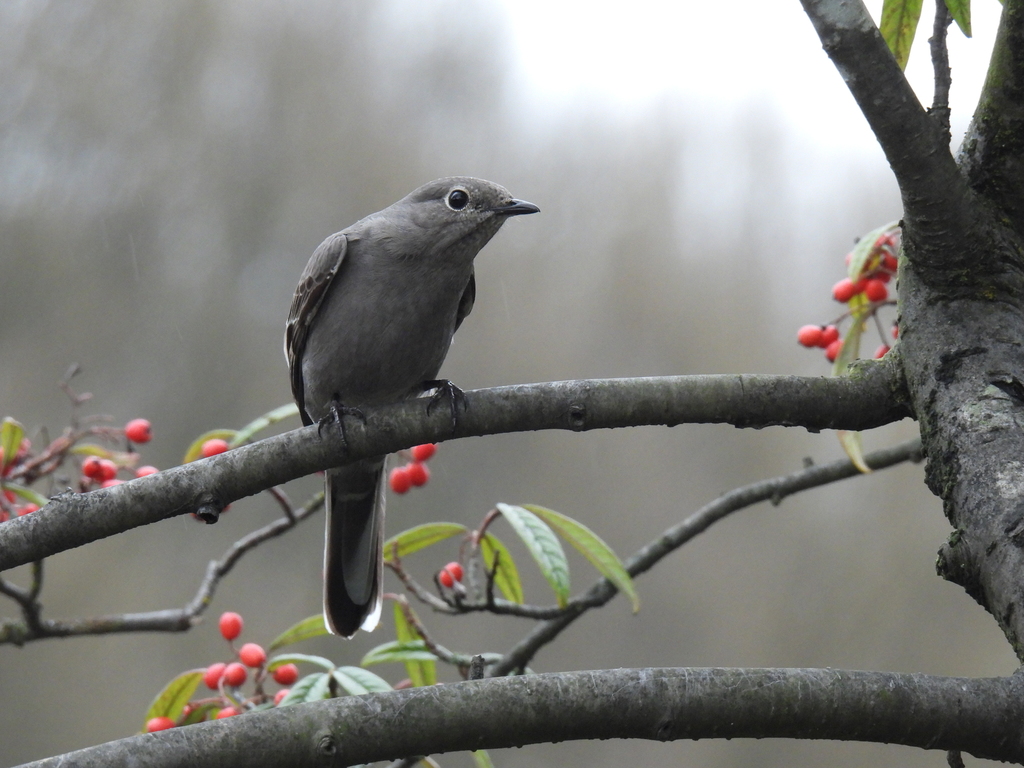
(c) Pete Lypkie, some rights reserved (CC BY) · licence
Family: Turdidae · Class: Aves · Order: Passeriformes
Myadestes townsendi (Townsend's Solitaire) is a California animal in the Turdidae family.
Townsend's Solitaire is a medium-sized thrush measuring 20 to 24 centimeters (8 to 9.5 inches) in length with a wingspan of 37 centimeters (14.5 inches). Adults weigh between 28 to 37 grams (1 to 1.3 ounces). The species exhibits subtle gray plumage overall, with a distinctive white eye-ring and white outer tail feathers visible in flight. The wings display prominent buff or white wing patches, and the bill is dark with a yellow-orange base. Juveniles show spotted underparts and scaled upperparts before molting into adult plumage. Townsend's Solitaire breeds across western North America from southeastern Alaska through western Canada and the western United States, extending south through the mountains of Mexico to Baja California. In California, the species occurs primarily in the Sierra Nevada, Cascade Range, Klamath Mountains, and other higher mountain ranges. During winter, populations move to lower elevations and expand their range into desert areas, including the Mojave and Colorado deserts. The species inhabits montane coniferous forests during the breeding season, typically at elevations between 1,500 to 3,400 meters (5,000 to 11,000 feet). Preferred breeding habitat includes open stands of spruce, fir, pine, and Douglas-fir with sparse understory vegetation. Townsend's Solitaires require prominent perches such as dead snags or tall trees for hunting and territorial displays. During winter, they occupy lower elevation habitats including pinyon-juniper woodlands, desert scrub, and riparian areas with berry-producing plants. Townsend's Solitaires are primarily insectivorous during the breeding season, capturing flying insects through aerial sallies from exposed perches. Their diet includes moths, beetles, ants, flies, and other arthropods. During fall and winter, the species becomes heavily frugivorous, consuming berries from juniper, mistletoe, elderberry, and other plants. This dietary shift coincides with their altitudinal migration to lower elevations. The species is known for aggressive defense of winter fruit sources. Breeding occurs from May through August, with peak nesting activity in June and July. Females construct cup-shaped nests on the ground, typically placed under overhanging rocks, tree roots, or in small cavities on steep slopes. Clutch size ranges from three to five eggs, with an incubation period of 12 to 14 days. Young fledge after 12 to 15 days but remain dependent on parents for several weeks. The species typically produces one brood per year, though second broods may occur in favorable conditions. Townsend's Solitaire is not federally or state listed and maintains stable populations across most of its range. The species is classified as Least Concern by the International Union for Conservation of Nature. However, local populations may face threats from habitat loss due to logging, fire suppression altering forest structure, and climate change affecting montane ecosystems. The species' dependence on specific elevation ranges and seasonal fruit sources makes it potentially vulnerable to shifts in temperature and precipitation patterns that could alter habitat availability and food resources.
Classification
Class: Aves · Order: Passeriformes · Family: Turdidae
Frequently asked questions
How is Myadestes townsendi classified?
Myadestes townsendi belongs to class Aves, order Passeriformes, family Turdidae.
What family does Myadestes townsendi belong to?
Myadestes townsendi is in the Turdidae family.
What is Myadestes townsendi?
Townsend's Solitaire is a medium-sized thrush measuring 20 to 24 centimeters (8 to 9.5 inches) in length with a wingspan of 37 centimeters (14.5 inches).
Is Myadestes townsendi found in California?
Yes. Myadestes townsendi is recorded in California in The California Species Project's catalogue.
Related species
Other California species in the same genus, family, or bioregion.
Data from The California Species Project — 14,000+ California species with verified data from CNPS, CDFW, USFWS, and more.