Myiarchus crinitus
Great Crested Flycatcher
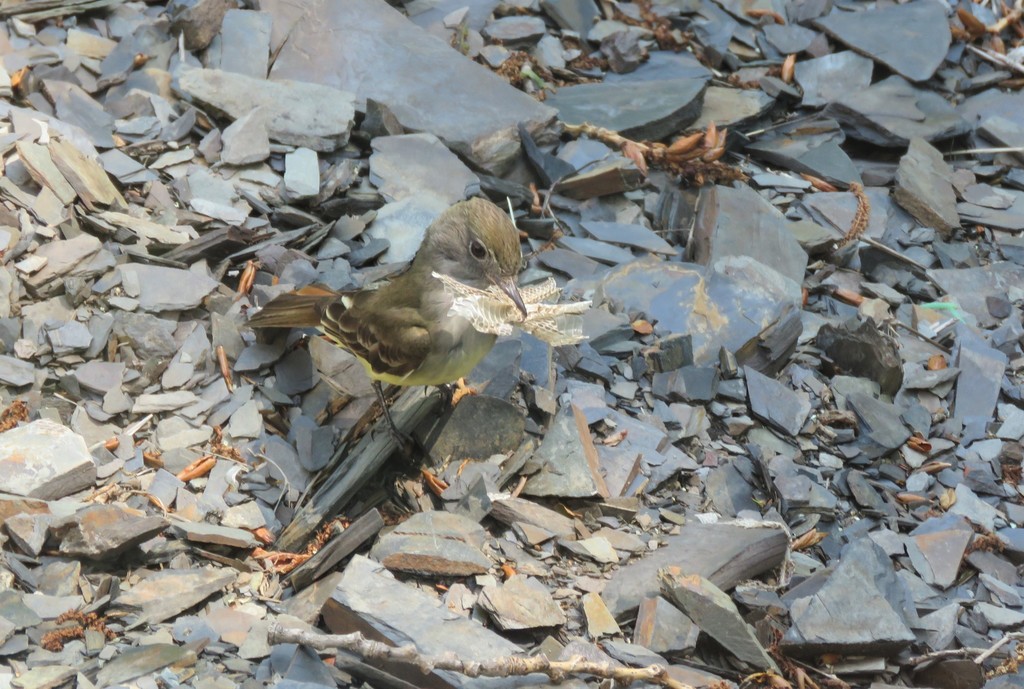
(c) Chelsea Carroll, some rights reserved (CC BY) · licence
Family: Tyrannidae · Class: Aves · Order: Passeriformes
Myiarchus crinitus (Great Crested Flycatcher) is a California animal in the Tyrannidae family.
The Great Crested Flycatcher is a medium-sized songbird measuring 17 to 21 cm (6.7 to 8.3 inches) in length with a wingspan of 33 to 36 cm (13 to 14 inches). Adults weigh 27 to 40 grams. The species displays a distinctive brownish-olive back and wings, with a grayish-brown head featuring a pronounced crest that gives the bird its common name. The throat and upper breast are pale gray, transitioning to bright yellow on the lower breast and belly. Wing coverts show rufous edges, and the primaries display conspicuous rufous patches visible in flight. The bill is broad and dark with a slightly hooked tip, typical of insectivorous flycatchers. Males and females appear similar, though males average slightly larger. The Great Crested Flycatcher breeds across eastern North America from southeastern Canada south to Florida and west to the Great Plains. In California, this species is considered a vagrant, with documented records primarily from the southeastern desert regions and Central Valley. Most California sightings occur during migration periods, particularly in late spring and early fall. The species does not breed regularly in California, with records representing overshooting migrants or individuals displaced from their normal range. Throughout its primary range, Great Crested Flycatchers inhabit mature deciduous and mixed forests, woodland edges, orchards, and parks with large trees. They prefer open woodlands with scattered trees rather than dense forest interiors. The species requires cavities for nesting, utilizing natural tree hollows, old woodpecker holes, or artificial nest boxes. They typically select sites 3 to 20 meters above ground in dead or living trees. Great Crested Flycatchers are primarily insectivorous, catching prey through aerial sallies from exposed perches. Their diet includes beetles, flies, moths, caterpillars, and other flying insects, supplemented by berries and small fruits, particularly during migration and winter. The species exhibits distinctive nesting behavior, often incorporating shed snake skins into nest construction, though plastic strips and cellophane may serve as substitutes in developed areas. Females lay 4 to 5 cream-colored eggs marked with brown and purple streaks. Incubation lasts 13 to 15 days, performed entirely by the female, while both parents feed nestlings for 14 to 21 days until fledging. The species is strongly migratory, departing breeding grounds in August and September for wintering areas in southern Mexico, Central America, and northern South America. Spring migration occurs from March through May. Great Crested Flycatchers are territorial during breeding season, with males defending territories through loud calling and aggressive displays. The Great Crested Flycatcher is not federally or state listed in California, reflecting its status as a vagrant rather than a resident species. Across its primary range, populations appear stable according to Breeding Bird Survey data, though habitat loss from deforestation and urbanization poses localized threats. The species benefits from nest box programs in areas where natural cavities are limited.
Classification
Class: Aves · Order: Passeriformes · Family: Tyrannidae
Frequently asked questions
How is Myiarchus crinitus classified?
Myiarchus crinitus belongs to class Aves, order Passeriformes, family Tyrannidae.
What family does Myiarchus crinitus belong to?
Myiarchus crinitus is in the Tyrannidae family.
What is Myiarchus crinitus?
The Great Crested Flycatcher is a medium-sized songbird measuring 17 to 21 cm (6.7 to 8.3 inches) in length with a wingspan of 33 to 36 cm (13 to 14 inches).
Is Myiarchus crinitus found in California?
Yes. Myiarchus crinitus is recorded in California in The California Species Project's catalogue.
Related species
Other California species in the same genus, family, or bioregion.
Data from The California Species Project — 14,000+ California species with verified data from CNPS, CDFW, USFWS, and more.