Myiarchus nuttingi
Nutting's Flycatcher
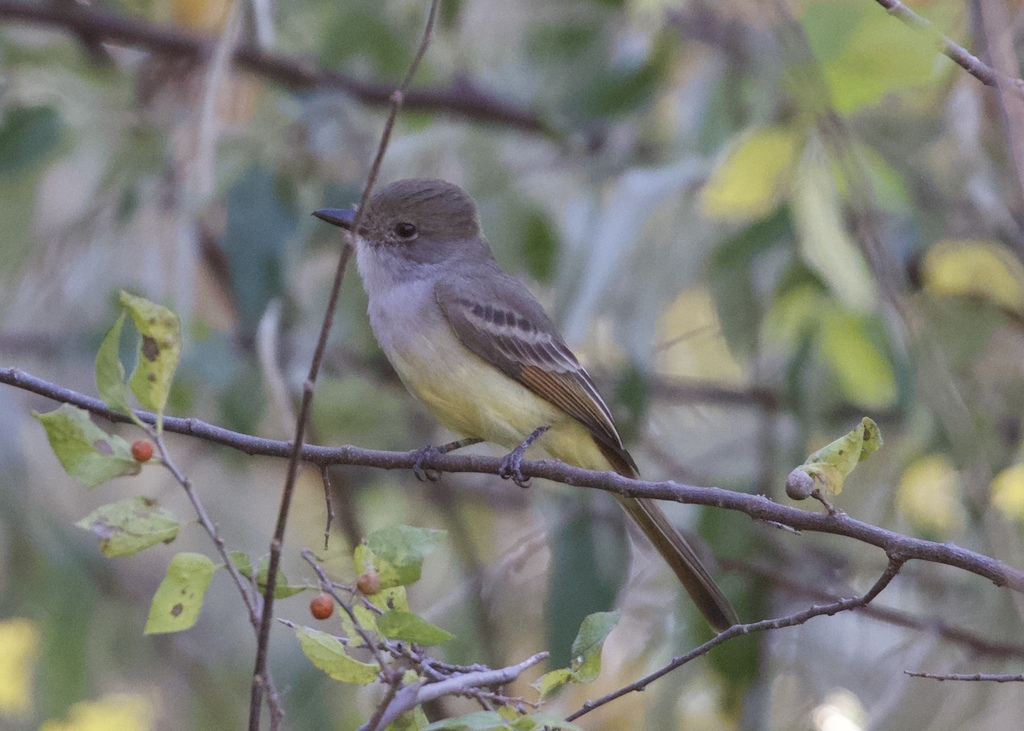
(c) RJ Baltierra, some rights reserved (CC BY) · licence
Family: Tyrannidae · Class: Aves · Order: Passeriformes
Myiarchus nuttingi (Nutting's Flycatcher) is a California animal in the Tyrannidae family.
Nutting's Flycatcher is a medium-sized tyrant flycatcher measuring approximately 18-20 cm (7.1-7.9 inches) in length with a wingspan of 28-30 cm (11.0-11.8 inches). The species exhibits typical Myiarchus characteristics with an olive-brown to grayish-brown back and wings, a pale gray throat and breast, and a yellow belly. The tail feathers display rufous inner webs, particularly visible in flight. A modest crest can be raised when the bird is alert or agitated. The bill is dark above with a pale orange-yellow base on the lower mandible. Sexual dimorphism is minimal, though males may be slightly larger than females. Nutting's Flycatcher has a predominantly Mexican distribution, ranging from northwestern Mexico through Central America to northwestern Costa Rica. In the United States, the species occurs as an irregular vagrant, with documented records primarily in Arizona and occasionally in California. Most California occurrences have been reported in the southeastern desert regions, including areas near the Colorado River and Salton Sea. The species' presence in California is considered accidental, with fewer than a dozen confirmed records as of 2023. The species inhabits tropical deciduous forests, thorn scrub, and woodland edges at elevations ranging from sea level to approximately 1,200 meters (3,937 feet). In its core range, Nutting's Flycatcher prefers semi-open habitats with scattered trees and dense understory vegetation. During vagrant appearances in California, individuals have been found in desert oases, riparian corridors with cottonwoods and willows, and urban parks with mature trees. The species shows a preference for areas with natural or artificial water sources. Nutting's Flycatcher exhibits typical flycatcher foraging behavior, sallying from exposed perches to capture flying insects before returning to the same or nearby perch. The diet consists primarily of flying ants, beetles, flies, moths, and other aerial arthropods. Some fruit consumption has been documented, particularly during winter months. Breeding occurs from April through July in the core range, with pairs constructing cup-shaped nests in tree cavities or dense vegetation. Females typically lay 3-4 cream-colored eggs with brown markings. The species is generally solitary outside the breeding season, though small mixed-species flocks may form during migration. Nutting's Flycatcher is not federally listed in the United States, as it is not considered a regular breeding resident. The International Union for Conservation of Nature classifies the species as Least Concern globally, with stable population trends throughout most of its range. However, habitat loss due to agricultural conversion and urban development poses localized threats in parts of Mexico. Climate change may affect the species' distribution and vagrant patterns, potentially altering the frequency of appearances in California border regions. The species' irregular occurrence in California makes population monitoring challenging, relying primarily on citizen science reports and eBird submissions for documentation of vagrant individuals.
Classification
Class: Aves · Order: Passeriformes · Family: Tyrannidae
Frequently asked questions
How is Myiarchus nuttingi classified?
Myiarchus nuttingi belongs to class Aves, order Passeriformes, family Tyrannidae.
What family does Myiarchus nuttingi belong to?
Myiarchus nuttingi is in the Tyrannidae family.
What is Myiarchus nuttingi?
Nutting's Flycatcher is a medium-sized tyrant flycatcher measuring approximately 18-20 cm (7.1-7.9 inches) in length with a wingspan of 28-30 cm (11.0-11.8 inches).
Is Myiarchus nuttingi found in California?
Yes. Myiarchus nuttingi is recorded in California in The California Species Project's catalogue.
Related species
Other California species in the same genus, family, or bioregion.
Data from The California Species Project — 14,000+ California species with verified data from CNPS, CDFW, USFWS, and more.