Myiarchus tuberculifer
Dusky-capped Flycatcher
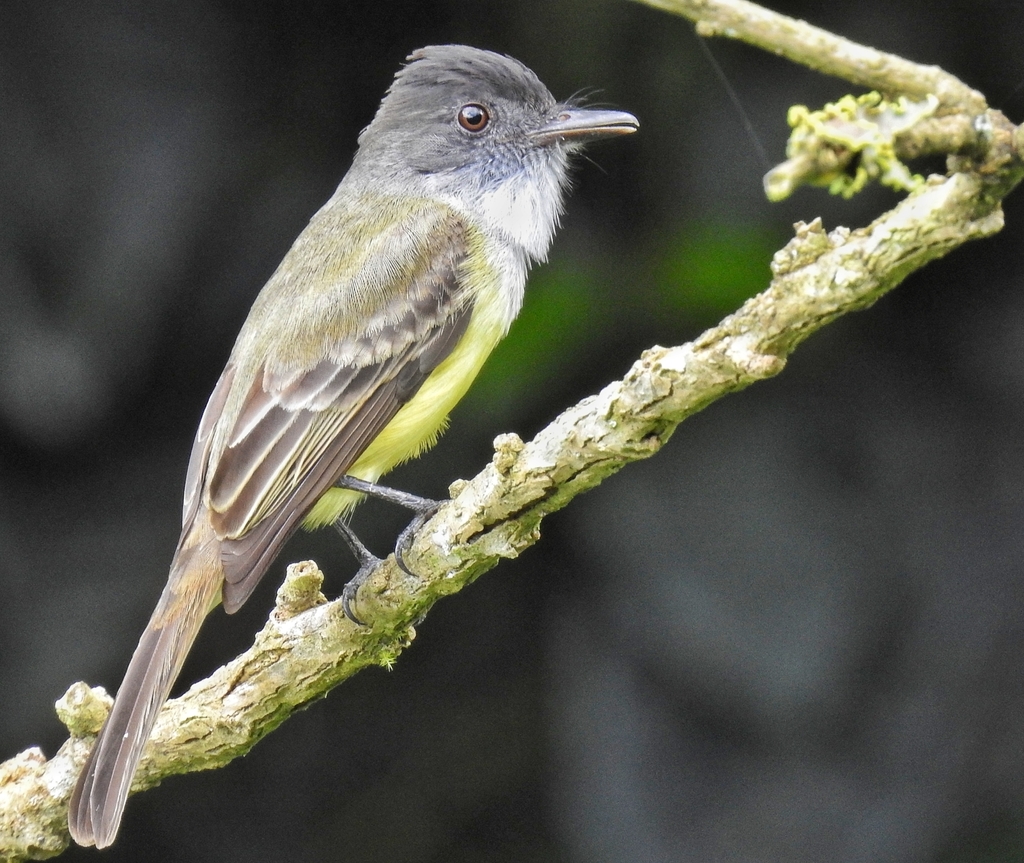
(c) Esteban Poveda, some rights reserved (CC BY) · licence
Family: Tyrannidae · Class: Aves · Order: Passeriformes
Myiarchus tuberculifer (Dusky-capped Flycatcher) is a California animal in the Tyrannidae family.
The Dusky-capped Flycatcher is a medium-sized tyrant flycatcher measuring 16.5 to 19 cm (6.5 to 7.5 inches) in length with a wingspan of approximately 25 to 28 cm (9.8 to 11 inches). Adults weigh 14 to 23 grams. The species exhibits a distinctive brownish cap on the head, contrasting with grayish-brown upperparts and pale yellow to whitish underparts. The throat and breast are typically grayish-white, while the belly and undertail coverts show a pale yellow wash. Wings display rufous edges on the flight feathers, and the tail shows rufous coloration, particularly visible from below. The bill is dark above and pale below, with a slightly hooked tip characteristic of flycatchers. The Dusky-capped Flycatcher has a broad distribution from the southwestern United States through Central America to South America. In California, the species occurs primarily in the extreme southeastern portion of the state, with documented breeding populations in the Colorado River valley and adjacent desert mountain ranges. The species is considered a rare to uncommon resident in suitable habitat within San Bernardino and Riverside counties, with occasional records extending into Imperial County. This flycatcher inhabits riparian woodlands, desert oases, and montane canyons with dense vegetation. In California, the species is typically associated with cottonwood-willow galleries along desert streams, palm oases, and mesquite bosques. Elevation range extends from below sea level in the Colorado River valley to approximately 1,200 meters (3,900 feet) in desert mountain canyons. The species requires dense canopy cover and water proximity, making it dependent on limited riparian habitats in the desert environment. Dusky-capped Flycatchers are insectivorous, capturing prey through aerial hawking and gleaning from foliage. Diet consists primarily of flying insects including flies, bees, wasps, beetles, and moths, supplemented by spiders and occasionally small fruits. Breeding occurs from April through July, with pairs constructing cup-shaped nests in tree cavities, abandoned woodpecker holes, or artificial nest boxes. Females lay 3 to 5 cream-colored eggs with brown markings, incubating for 15 to 16 days. Young fledge after 14 to 16 days but remain dependent on parents for several weeks. The species exhibits partial migratory behavior, with northern populations migrating south for winter while southern populations, including those in California, may remain year-round residents. Territorial males produce a distinctive whistled call described as a rising 'whit-will-do' or 'ka-wheer.' The Dusky-capped Flycatcher holds no special conservation status at federal or state levels in California. However, the species faces threats from habitat loss due to water diversions, urban development, and invasive plant species in riparian areas. Climate change poses additional challenges through altered precipitation patterns and increased temperatures affecting desert water sources. Populations in California appear stable but remain limited by the availability of suitable riparian habitat in desert environments.
Classification
Class: Aves · Order: Passeriformes · Family: Tyrannidae
Frequently asked questions
How is Myiarchus tuberculifer classified?
Myiarchus tuberculifer belongs to class Aves, order Passeriformes, family Tyrannidae.
What family does Myiarchus tuberculifer belong to?
Myiarchus tuberculifer is in the Tyrannidae family.
What is Myiarchus tuberculifer?
The Dusky-capped Flycatcher is a medium-sized tyrant flycatcher measuring 16.5 to 19 cm (6.5 to 7.5 inches) in length with a wingspan of approximately 25 to 28 cm (9.8 to 11 inches).
Is Myiarchus tuberculifer found in California?
Yes. Myiarchus tuberculifer is recorded in California in The California Species Project's catalogue.
Related species
Other California species in the same genus, family, or bioregion.
Data from The California Species Project — 14,000+ California species with verified data from CNPS, CDFW, USFWS, and more.