Myiarchus tyrannulus
Brown-crested Flycatcher
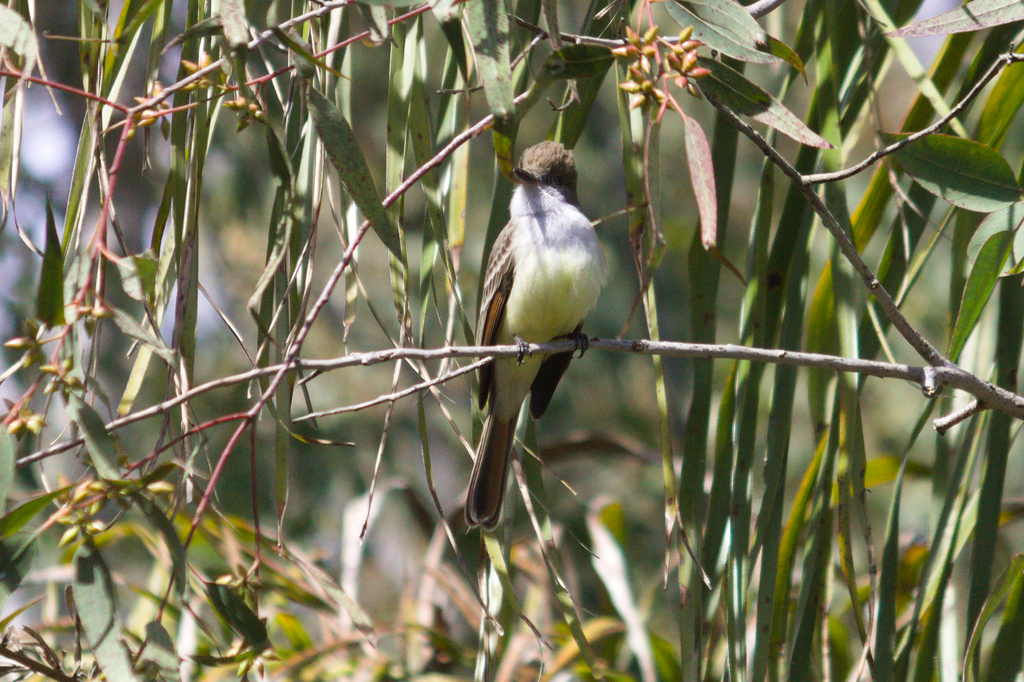
no rights reserved · CC0
Family: Tyrannidae · Class: Aves · Order: Passeriformes
Conservation status: WL · G5 S3
Myiarchus tyrannulus (Brown-crested Flycatcher) is a California animal in the Tyrannidae family.
The Brown-crested Flycatcher is a medium-sized passerine bird measuring 18 to 21 cm (7.1 to 8.3 inches) in length with a wingspan of 30 to 33 cm (11.8 to 13.0 inches). Adults weigh between 27 to 40 grams. The species displays distinctive olive-brown upperparts with a darker brown head and crest. The throat and breast are pale gray, transitioning to bright yellow on the belly and undertail coverts. Wings show rufous patches most visible in flight, and the tail exhibits rufous inner webs with darker outer feathers. The bill is broad and dark, typical of insectivorous flycatchers, with a slightly hooked tip. Males and females appear similar, though males average slightly larger. The Brown-crested Flycatcher breeds across much of the southwestern United States and Mexico, with California populations representing the northwestern edge of the species' range. In California, breeding occurs primarily in the Colorado River valley, including Imperial and Riverside counties, with smaller populations in the Salton Sea region and occasionally in San Diego County. The species is a neotropical migrant, arriving on breeding grounds from March through May and departing by September for wintering areas in Mexico and Central America. This flycatcher inhabits riparian woodlands, desert washes with scattered trees, and open woodlands dominated by cottonwoods, willows, and mesquite. Elevation ranges from below sea level in the Salton Sea basin to approximately 1,200 meters (3,940 feet) in desert mountain ranges. The species shows strong preference for areas with large trees containing natural cavities or old woodpecker holes for nesting. Habitat requirements include a mix of open areas for foraging and dense vegetation for cover. Brown-crested Flycatchers are sit-and-wait predators, perching on exposed branches and making aerial sallies to capture flying insects. Diet consists primarily of beetles, flies, wasps, ants, and flying termites, supplemented occasionally with small fruits and berries. Breeding occurs from April through July, with pairs typically producing one brood annually. Females construct cup-shaped nests in tree cavities, laying 3 to 5 pale buff eggs marked with brown and purple streaks. Incubation lasts 13 to 15 days, performed exclusively by females. Both parents feed nestlings, which fledge after 14 to 21 days. The species is known for its loud, harsh calls including a distinctive 'whit-will-do' phrase and various chattering notes. The Brown-crested Flycatcher is designated as a Watch List species (WL) in California with a state rank of S3, indicating the species is vulnerable to extirpation. The global rank of G5 reflects overall stability across the species' range, but California populations face significant conservation concerns. Primary threats include riparian habitat loss due to water diversions, urban development, and agricultural conversion along the Colorado River. Cowbird parasitism poses additional reproductive challenges. According to North American Breeding Bird Survey data, California populations have shown declining trends over recent decades. Conservation efforts focus on protecting and restoring riparian corridors, particularly cottonwood-willow habitats essential for breeding success.
Classification
Class: Aves · Order: Passeriformes · Family: Tyrannidae
Conservation status
WL · G5 S3
Frequently asked questions
How is Myiarchus tyrannulus classified?
Myiarchus tyrannulus belongs to class Aves, order Passeriformes, family Tyrannidae.
What family does Myiarchus tyrannulus belong to?
Myiarchus tyrannulus is in the Tyrannidae family.
Is Myiarchus tyrannulus protected or of conservation concern?
Myiarchus tyrannulus carries the following status: WL · G5 S3.
What is Myiarchus tyrannulus?
The Brown-crested Flycatcher is a medium-sized passerine bird measuring 18 to 21 cm (7.1 to 8.3 inches) in length with a wingspan of 30 to 33 cm (11.8 to 13.0 inches).
Is Myiarchus tyrannulus found in California?
Yes. Myiarchus tyrannulus is recorded in California in The California Species Project's catalogue.
Related species
Other California species in the same genus, family, or bioregion.
Data from The California Species Project — 14,000+ California species with verified data from CNPS, CDFW, USFWS, and more.