Myioborus pictus
Painted Redstart
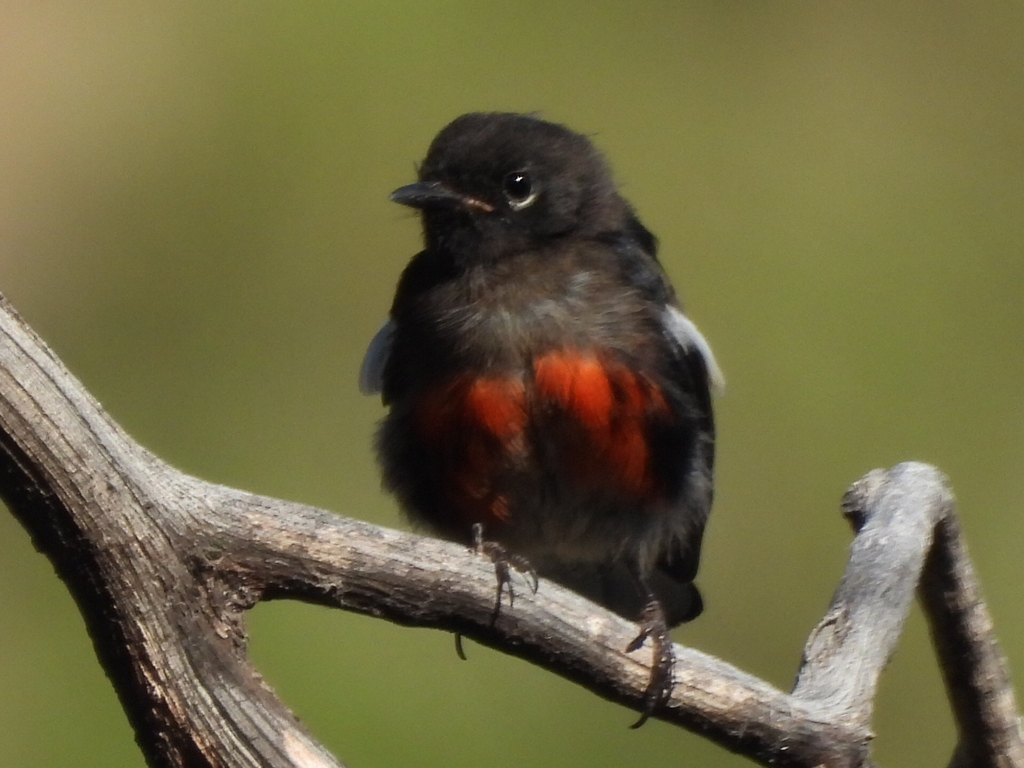
(c) Sam Kieschnick, some rights reserved (CC BY) · licence
Family: Parulidae · Class: Aves · Order: Passeriformes
Myioborus pictus (Painted Redstart) is a California animal in the Parulidae family.
The Painted Redstart is a small, distinctive warbler measuring 13 to 15 cm (5.1 to 5.9 inches) in length with a wingspan of approximately 20 cm (7.9 inches). Adults weigh 6 to 9 grams. The species displays striking black plumage on the head, back, wings, and tail, contrasting sharply with a bright red breast and belly. White patches are prominent on the outer tail feathers and wing coverts, creating a conspicuous flash pattern during flight and foraging movements. Both sexes appear similar, though females may show slightly duller red coloration. Juveniles lack the red breast coloration, instead showing grayish-white underparts with black upperparts. The Painted Redstart's range extends from the southwestern United States through Mexico to Nicaragua. In California, the species occurs as an uncommon resident in mountainous regions of the southeastern desert ranges, including the Laguna, Cuyamaca, and Peninsular ranges in San Diego and Imperial counties. The species also occurs in portions of Riverside County. Small breeding populations are established in oak woodlands and pine-oak forests at elevations between 1,200 and 2,400 meters (3,900 to 7,900 feet). During winter months, some individuals may descend to lower elevations or move south into Baja California. Painted Redstarts inhabit mixed coniferous and deciduous forests, particularly pine-oak woodlands and riparian areas with dense canopy cover. The species shows preference for mature forests with open understories and nearby water sources. In California, they are most commonly found in coast live oak and Engelmann oak woodlands, often associated with streams and canyon bottoms. The species requires diverse vertical forest structure for foraging and nesting. This active warbler employs a distinctive foraging strategy, frequently spreading its tail and wings to flash white patches while gleaning insects from foliage and bark surfaces. This behavior, known as flush-pursuit foraging, startles insects into movement, making them easier to capture. The diet consists primarily of small insects, caterpillars, and arthropods. Painted Redstarts nest in crevices or cavities in rock faces, trees, or steep banks, constructing cup-shaped nests of grass, bark strips, and rootlets. Breeding occurs from April through July, with females laying 3 to 4 white eggs marked with brown speckles. Incubation lasts 13 to 14 days, and nestlings fledge after 10 to 11 days. The Painted Redstart is not federally listed and maintains stable populations throughout most of its range as of December 2025. However, California populations represent the northern extent of the species' distribution and remain relatively small and localized. Primary conservation concerns include habitat loss from urban development, wildfire impacts on oak woodland ecosystems, and climate change effects on montane forest communities. The species benefits from forest management practices that maintain mature canopy structure and protect riparian corridors. Monitoring programs track breeding success and population trends in key California habitats to assess long-term population stability.
Classification
Class: Aves · Order: Passeriformes · Family: Parulidae
Frequently asked questions
How is Myioborus pictus classified?
Myioborus pictus belongs to class Aves, order Passeriformes, family Parulidae.
What family does Myioborus pictus belong to?
Myioborus pictus is in the Parulidae family.
What is Myioborus pictus?
The Painted Redstart is a small, distinctive warbler measuring 13 to 15 cm (5.1 to 5.9 inches) in length with a wingspan of approximately 20 cm (7.9 inches).
Is Myioborus pictus found in California?
Yes. Myioborus pictus is recorded in California in The California Species Project's catalogue.
Related species
Other California species in the same genus, family, or bioregion.
Data from The California Species Project — 14,000+ California species with verified data from CNPS, CDFW, USFWS, and more.