Myotis evotis
Long-eared Myotis
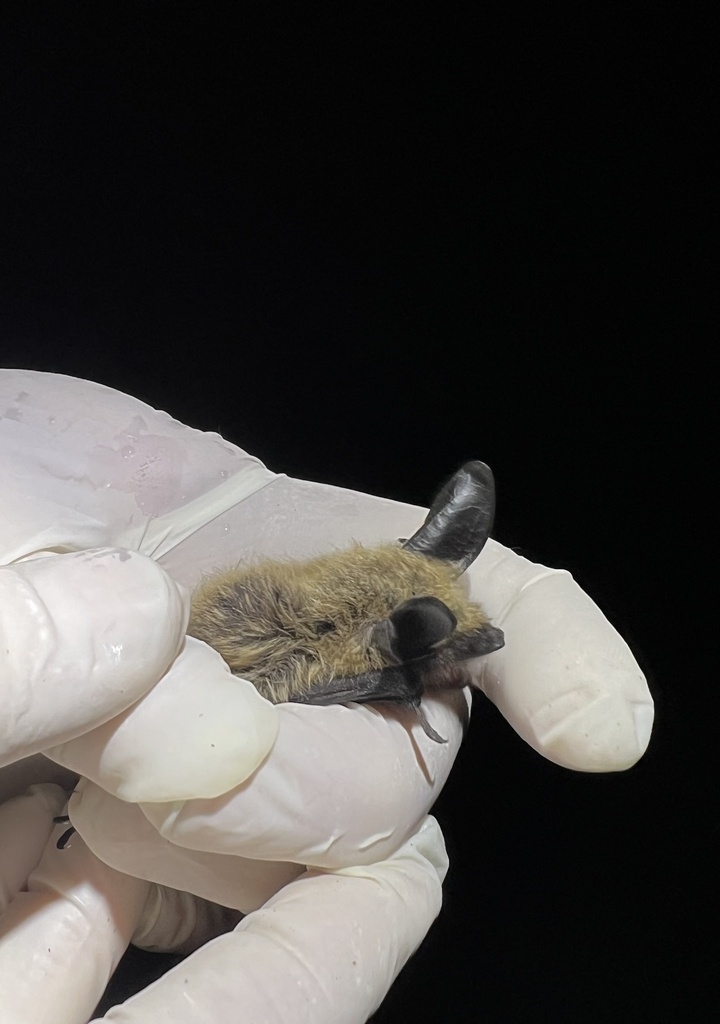
(c) Aiva Noringseth, some rights reserved (CC BY) · licence
Family: Vespertilionidae · Class: Mammalia · Order: Chiroptera
Conservation status: G5 S3
Myotis evotis (Long-eared Myotis) is a California animal in the Vespertilionidae family.
The Long-eared Myotis is a medium-sized bat distinguished by its exceptionally large ears, which measure 22 to 25 mm in length and extend well beyond the nose when folded forward. Adults have a forearm length of 37 to 44 mm and weigh 5 to 12 grams. The dorsal fur ranges from pale yellow-brown to dark brown, while the ventral surface is typically buff to pale brown. The tragus is long, narrow, and pointed, reaching approximately half the ear length. Wing membranes are dark brown to black, and the calcar lacks a keel. Long-eared Myotis occur throughout western North America, with California populations distributed primarily in mountainous regions of the state. The species is found in the Sierra Nevada, Cascade Range, Coast Ranges, Transverse Ranges, and Peninsular Ranges. Elevational distribution extends from near sea level to over 3,000 meters, though the species is most common between 1,200 and 2,700 meters elevation. Historical records indicate a broader distribution that may have contracted in some areas. This species inhabits diverse forest types including coniferous, mixed coniferous-deciduous, and riparian woodlands. Preferred habitat features include areas near water sources such as streams, ponds, or meadows. Long-eared Myotis roost in buildings, mines, caves, rock crevices, tree hollows, and under bark. Maternity colonies typically form in warm, protected sites including attics, abandoned buildings, and large tree cavities. Night roosts are commonly established under bridges, in culverts, or in partially enclosed structures. Long-eared Myotis are insectivorous, employing both aerial hawking and gleaning foraging strategies. Their diet consists primarily of moths, beetles, flies, and other small arthropods. The large ears provide enhanced echolocation capabilities for detecting prey on surfaces and in cluttered environments. Mating occurs in late summer and fall, with females storing sperm through winter hibernation. Gestation lasts approximately 50 to 60 days, with parturition occurring from May through July depending on elevation and latitude. Females typically produce a single pup annually. Maternity colonies may contain 12 to 200 individuals. The species hibernates from October through April in mines, caves, and buildings where temperatures remain stable above freezing. The Long-eared Myotis is not federally listed but has a California state rank of S3, indicating the species is vulnerable with 21 to 100 occurrences or limited acreage. Primary threats include habitat loss from logging and development, disturbance of roosting sites, and white-nose syndrome, a fungal disease affecting North American bats. Mine closures for safety reasons have eliminated important roosting habitat, though some closures now incorporate bat-compatible gates. Climate change may affect prey availability and suitable roosting temperatures. Conservation efforts focus on protecting known roosting sites, maintaining forest habitat connectivity, and monitoring for white-nose syndrome expansion into western states.
Classification
Class: Mammalia · Order: Chiroptera · Family: Vespertilionidae
Conservation status
G5 S3
Frequently asked questions
How is Myotis evotis classified?
Myotis evotis belongs to class Mammalia, order Chiroptera, family Vespertilionidae.
What family does Myotis evotis belong to?
Myotis evotis is in the Vespertilionidae family.
Is Myotis evotis protected or of conservation concern?
Myotis evotis carries the following status: G5 S3.
What is Myotis evotis?
The Long-eared Myotis is a medium-sized bat distinguished by its exceptionally large ears, which measure 22 to 25 mm in length and extend well beyond the nose when folded forward.
Is Myotis evotis found in California?
Yes. Myotis evotis is recorded in California in The California Species Project's catalogue.
Related species
Other California species in the same genus, family, or bioregion.
Data from The California Species Project — 14,000+ California species with verified data from CNPS, CDFW, USFWS, and more.