Myotis lucifugus
Arizona Myotis, Little Brown Bat
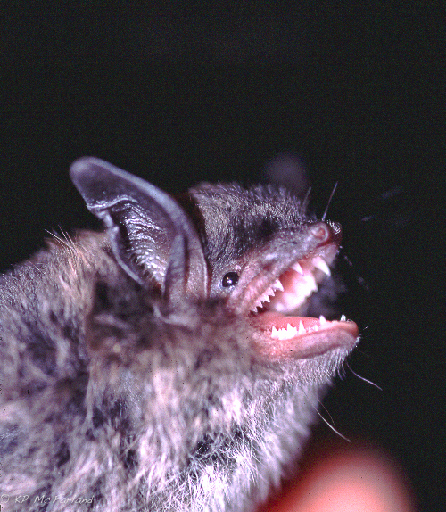
no rights reserved · CC0
Family: Vespertilionidae · Class: Mammalia · Order: Chiroptera
Conservation status: G4 S1, G3 S2S3
Myotis lucifugus (Arizona Myotis, Little Brown Bat) is a California animal in the Vespertilionidae family.
The Arizona myotis (Myotis lucifugus) is a small vespertilionid bat with distinctive physical characteristics that distinguish it from other regional bat species. Adults measure 80-95 mm (3.1-3.7 inches) in total length with a forearm length of 34-40 mm (1.3-1.6 inches). Body weight ranges from 5-14 grams (0.2-0.5 ounces). The dorsal fur is glossy brown to dark brown, while ventral coloration is lighter, appearing buff to pale gray. The ears are moderately sized, extending slightly beyond the nose when laid forward, and the tragus is long and pointed. Wing membranes are dark brown to black. Historically, the Arizona myotis occurred throughout much of western North America, ranging from British Columbia south through California, Nevada, Utah, Colorado, Arizona, and New Mexico. In California, the species has experienced significant range contraction and population decline. Current California populations are primarily restricted to the San Bernardino Mountains, representing a severely fragmented distribution compared to historical records. The species has been extirpated from much of its former California range, including the Sierra Nevada and other montane regions where it was previously documented. Arizona myotis typically inhabit forested environments in mountainous regions, showing preference for coniferous and mixed coniferous-deciduous forests. The species occurs at elevations ranging from 1,200 to 2,800 meters (3,900 to 9,200 feet). Day roosts are established in tree cavities, rock crevices, caves, mines, and human structures including buildings and bridges. Maternity colonies form in warm, protected sites such as attics, tree hollows, or rock crevices. The species demonstrates high site fidelity to both day roosts and foraging areas. These bats are insectivorous, foraging primarily over water surfaces and forest openings where they capture flying insects including midges, mayflies, caddisflies, and beetles. Foraging typically occurs within 1-2 kilometers of day roosts. The species employs echolocation calls with frequencies ranging from 40-80 kHz, with peak energy around 50 kHz. Mating occurs in fall, followed by delayed fertilization. Females give birth to a single pup in late May through July after a gestation period of approximately 60 days. Hibernation occurs from October through April in caves, mines, or similar protected sites with stable temperatures. The Arizona myotis faces severe conservation challenges in California, reflected in its state ranking of S1 (critically imperiled) or S2S3 (imperiled to vulnerable), despite the global population ranking of G3-G4 (vulnerable to apparently secure). The dramatic range contraction in California suggests significant population decline over recent decades. Primary threats include habitat loss from forest management practices, roost site disturbance, climate change affecting prey availability and hibernation sites, and potential impacts from white-nose syndrome, though this fungal disease has not yet been confirmed in California populations. The restricted San Bernardino Mountains population represents a conservation priority requiring targeted habitat protection and population monitoring to prevent extirpation from the state.
Classification
Class: Mammalia · Order: Chiroptera · Family: Vespertilionidae
Conservation status
G4 S1, G3 S2S3
Frequently asked questions
How is Myotis lucifugus classified?
Myotis lucifugus belongs to class Mammalia, order Chiroptera, family Vespertilionidae.
What family does Myotis lucifugus belong to?
Myotis lucifugus is in the Vespertilionidae family.
Is Myotis lucifugus protected or of conservation concern?
Myotis lucifugus carries the following status: G4 S1, G3 S2S3.
What is Myotis lucifugus?
The Arizona myotis (Myotis lucifugus) is a small vespertilionid bat with distinctive physical characteristics that distinguish it from other regional bat species.
Is Myotis lucifugus found in California?
Yes. Myotis lucifugus is recorded in California in The California Species Project's catalogue.
Related species
Other California species in the same genus, family, or bioregion.
Data from The California Species Project — 14,000+ California species with verified data from CNPS, CDFW, USFWS, and more.