Myotis thysanodes
Fringed Myotis
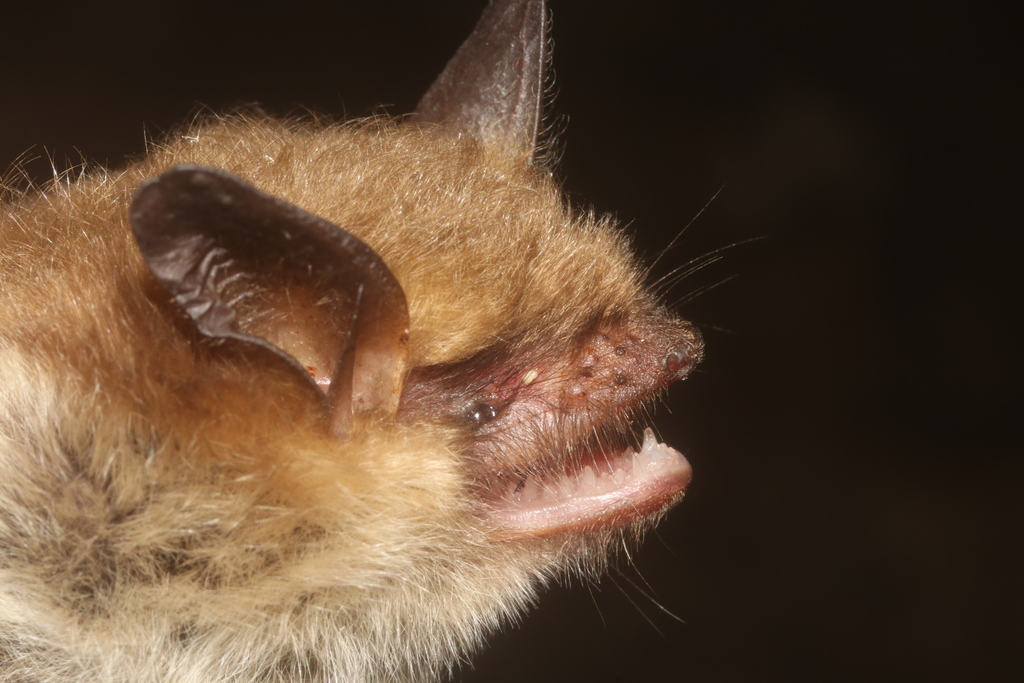
(c) Juan Cruzado Cortés, some rights reserved (CC BY-SA) · licence
Family: Vespertilionidae · Class: Mammalia · Order: Chiroptera
Conservation status: G4 S3
Myotis thysanodes (Fringed Myotis) is a California animal in the Vespertilionidae family.
The fringed myotis is a medium-sized bat with distinctive morphological features that aid in identification. Adults measure 80-95 mm (3.1-3.7 inches) in total length with a wingspan of 270-300 mm (10.6-11.8 inches). The species weighs 5-8 grams (0.18-0.28 ounces). The dorsal fur is pale yellow-brown to dark brown, while the ventral surface is lighter buff or pale brown. The most diagnostic feature is the conspicuous fringe of stiff hairs along the trailing edge of the interfemoral membrane, from which the species derives its common name. The ears are long and pointed, extending beyond the nose when laid forward, and the tragus is long and narrow. The fringed myotis occurs throughout much of western North America, from southern British Columbia south to central Mexico. In California, the species is distributed primarily in mountainous regions of the Sierra Nevada, Cascade Range, and scattered locations in the Coast Range and Transverse Ranges. Populations are documented from Siskiyou County south to Kern County, with elevational ranges extending from approximately 1,200 to 2,750 meters (3,900 to 9,000 feet). The species appears to be absent from the Central Valley and coastal lowlands. This bat inhabits coniferous and mixed coniferous-deciduous forests, preferring areas with open understory and nearby water sources. Roosting sites include buildings, mines, caves, rock crevices, and hollow trees. Maternity colonies typically form in warm, protected sites such as attics or abandoned buildings, while males often roost solitarily in cooler locations. The species demonstrates fidelity to traditional roosting sites, returning to the same locations across multiple years. Fringed myotis are insectivorous, foraging primarily on moths, beetles, flies, and other flying insects. Foraging occurs in forest clearings, along forest edges, and over water bodies, typically within 2-3 kilometers of roost sites. The species employs both aerial hawking and gleaning techniques, using echolocation calls of 35-60 kHz with peak energy around 45 kHz. Mating occurs in late summer or fall, with delayed fertilization and a single pup born in late June or July after a gestation period of approximately 60 days. Females reach sexual maturity at one year, and longevity can exceed 18 years. The fringed myotis is not federally listed but holds a G4 S3 ranking, indicating it is apparently secure globally but vulnerable in California. Population trends are poorly documented, but the species faces threats from habitat loss due to forest management practices, mine closures that eliminate roosting sites, and disturbance of maternity colonies. White-nose syndrome, a fungal disease affecting North American bats, poses an emerging threat. Climate change may affect prey availability and alter suitable habitat ranges. Conservation efforts focus on protecting known roosting sites and maintaining forest habitat connectivity.
Classification
Class: Mammalia · Order: Chiroptera · Family: Vespertilionidae
Conservation status
G4 S3
Frequently asked questions
How is Myotis thysanodes classified?
Myotis thysanodes belongs to class Mammalia, order Chiroptera, family Vespertilionidae.
What family does Myotis thysanodes belong to?
Myotis thysanodes is in the Vespertilionidae family.
Is Myotis thysanodes protected or of conservation concern?
Myotis thysanodes carries the following status: G4 S3.
What is Myotis thysanodes?
The fringed myotis is a medium-sized bat with distinctive morphological features that aid in identification.
Is Myotis thysanodes found in California?
Yes. Myotis thysanodes is recorded in California in The California Species Project's catalogue.
Related species
Other California species in the same genus, family, or bioregion.
Data from The California Species Project — 14,000+ California species with verified data from CNPS, CDFW, USFWS, and more.