Myotis volans
Long-legged Myotis
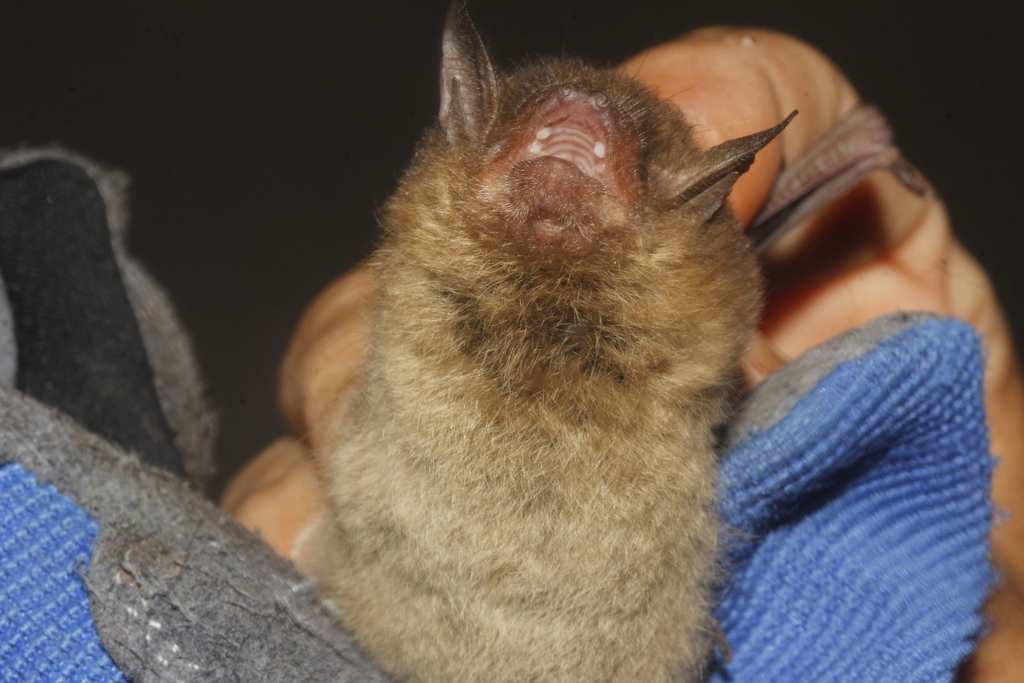
(c) Juan Cruzado Cortés, some rights reserved (CC BY-SA) · licence
Family: Vespertilionidae · Class: Mammalia · Order: Chiroptera
Conservation status: G4G5 S3
Myotis volans (Long-legged Myotis) is a California animal in the Vespertilionidae family.
The long-legged myotis is a medium-sized bat with distinctive long legs and large feet that distinguish it from other Myotis species. Adults measure 8.6 to 10.0 cm (3.4 to 3.9 inches) in total length with a wingspan of 26.0 to 29.0 cm (10.2 to 11.4 inches). Body mass ranges from 5 to 11 grams. The fur is long and glossy, typically dark brown to black on the dorsal surface with slightly paler ventral coloration. The ears are moderately long and narrow, extending just beyond the nose when laid forward. The interfemoral membrane is well-furred on the dorsal surface, and the calcar extends approximately halfway to the tail tip. This species ranges across western North America from British Columbia south through California, Nevada, Utah, Colorado, Arizona, and New Mexico. In California, long-legged myotis occur throughout the mountainous regions of the state, including the Sierra Nevada, Cascade Range, Coast Ranges, Transverse Ranges, and Peninsular Ranges. The species has been documented from Shasta County south to San Diego County, with populations also present in the Warner Mountains of Modoc County. Long-legged myotis inhabit coniferous and mixed coniferous-deciduous forests, typically at elevations ranging from 1,200 to 3,400 meters (3,900 to 11,200 feet). The species shows strong association with old-growth forests and mature stands with large-diameter trees. Day roosts are established in tree cavities, under loose bark of snags, in rock crevices, and occasionally in buildings. Maternity colonies commonly utilize hollow trees, particularly large ponderosa pines, Douglas-firs, and other conifers. Night roosts are often located in more open areas such as porches, bridges, and mine adits. This species emerges shortly after sunset to forage primarily above the forest canopy and along forest edges. Long-legged myotis are insectivorous, feeding predominantly on moths, beetles, flies, and other flying insects. Their long legs and large feet facilitate gleaning prey from foliage and bark surfaces. Mating occurs during autumn swarming, with females storing sperm through winter. Pregnancy begins in spring, and single young are born from late June through July after a gestation period of approximately 60 days. Maternity colonies typically contain 20 to 100 females. The species hibernates during winter months, often in mines, caves, or tree cavities. The long-legged myotis has no federal listing status but is ranked S3 (vulnerable) in California, indicating concern for population viability. Primary threats include habitat loss from logging of old-growth forests, forest management practices that reduce snag availability, and white-nose syndrome, a fungal disease affecting North American bats. Climate change may alter suitable habitat distribution and prey availability. Mine closures for safety purposes can eliminate important roosting sites. Conservation efforts focus on maintaining mature forest habitats, preserving snags and hollow trees, and implementing bat-compatible mine closure techniques.
Classification
Class: Mammalia · Order: Chiroptera · Family: Vespertilionidae
Conservation status
G4G5 S3
Frequently asked questions
How is Myotis volans classified?
Myotis volans belongs to class Mammalia, order Chiroptera, family Vespertilionidae.
What family does Myotis volans belong to?
Myotis volans is in the Vespertilionidae family.
Is Myotis volans protected or of conservation concern?
Myotis volans carries the following status: G4G5 S3.
What is Myotis volans?
The long-legged myotis is a medium-sized bat with distinctive long legs and large feet that distinguish it from other Myotis species.
Is Myotis volans found in California?
Yes. Myotis volans is recorded in California in The California Species Project's catalogue.
Related species
Other California species in the same genus, family, or bioregion.
Data from The California Species Project — 14,000+ California species with verified data from CNPS, CDFW, USFWS, and more.