Myrmecophilus oregonensis
West Coast Ant Cricket
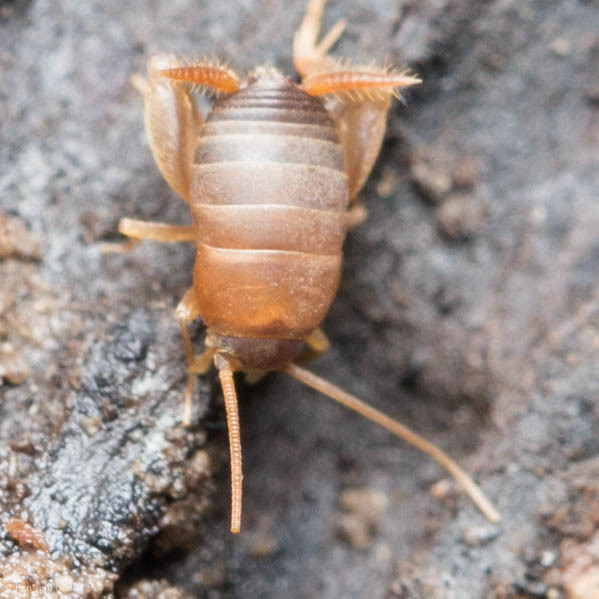
(c) Ken-ichi Ueda, some rights reserved (CC BY) · licence
Family: Myrmecophilidae · Class: Insecta · Order: Orthoptera
Myrmecophilus oregonensis (West Coast Ant Cricket) is a California animal in the Myrmecophilidae family.
The West Coast ant cricket is a minute orthopteran insect measuring approximately 3 mm in length. Adults are typically pale yellow to light brown in coloration with a compact, wingless body form characteristic of the family Myrmecophilidae. The species exhibits sexual dimorphism, with females generally larger and more robust than males. Their antennae are relatively short compared to other cricket families, and they lack the prominent hind legs typical of jumping crickets. Myrmecophilus oregonensis ranges from southwestern British Columbia south through California, representing the only ant cricket species recorded in Canada (BugGuide 2009). Along the Pacific Coast, the species occurs from sea level to moderate elevations in forested and woodland habitats. In California, documented populations include locations in San Mateo County, where specimens have been observed in El Corte de Madera Creek Open Space Preserve. This species inhabits areas where suitable ant host colonies are present, typically under logs, rocks, and in leaf litter of forested environments. They are obligate inquilines, living exclusively within or in close association with ant nests throughout their lifecycle. The crickets are commonly found under dead logs and other decaying wood where ant colonies establish territories. Surface conditions must provide adequate moisture and protection from environmental extremes. West Coast ant crickets are myrmecophilous, meaning they have evolved specialized relationships with their ant hosts. They feed on organic matter within ant nests, including food scraps, secretions, and possibly ant eggs or larvae, though their exact diet requires further study. The crickets produce chemical signals that allow them to coexist peacefully with their aggressive ant hosts, essentially mimicking ant pheromones to avoid detection and attack. Reproduction occurs within the protective environment of ant colonies, though specific breeding behaviors and seasonal timing have not been well documented. Adults are most commonly encountered during fall months, with November observations recorded in California. The conservation status of M. oregonensis has not been formally assessed at federal or state levels. The species appears on California's Special Animals list, indicating it is tracked by the California Natural Diversity Database as a species requiring monitoring, though this designation does not confer regulatory protection (CDFW 2016). Limited ecological research has been conducted on this species, making population trends difficult to assess. The cryptic nature of their ant-dependent lifestyle makes detection challenging, and their true distribution and abundance remain poorly understood. Habitat loss through forest fragmentation and urbanization may pose threats to both the species and their ant hosts, though specific impacts have not been quantified. Climate change effects on forest ecosystems could indirectly affect ant cricket populations by altering the distribution and abundance of suitable host ant species. Detailed ecological studies of this species remain limited. The information presented here synthesizes available observations from taxonomic databases and field reports. Additional research is needed to better understand the species' host ant relationships, reproductive biology, and conservation needs.
Classification
Class: Insecta · Order: Orthoptera · Family: Myrmecophilidae
Frequently asked questions
How is Myrmecophilus oregonensis classified?
Myrmecophilus oregonensis belongs to class Insecta, order Orthoptera, family Myrmecophilidae.
What family does Myrmecophilus oregonensis belong to?
Myrmecophilus oregonensis is in the Myrmecophilidae family.
What is Myrmecophilus oregonensis?
The West Coast ant cricket is a minute orthopteran insect measuring approximately 3 mm in length.
Is Myrmecophilus oregonensis found in California?
Yes. Myrmecophilus oregonensis is recorded in California in The California Species Project's catalogue.
More California species
This species has no close relatives in our California data — here are other species to explore.
Data from The California Species Project — 14,000+ California species with verified data from CNPS, CDFW, USFWS, and more.