Myscelia cyananthe
Blackened Bluewing
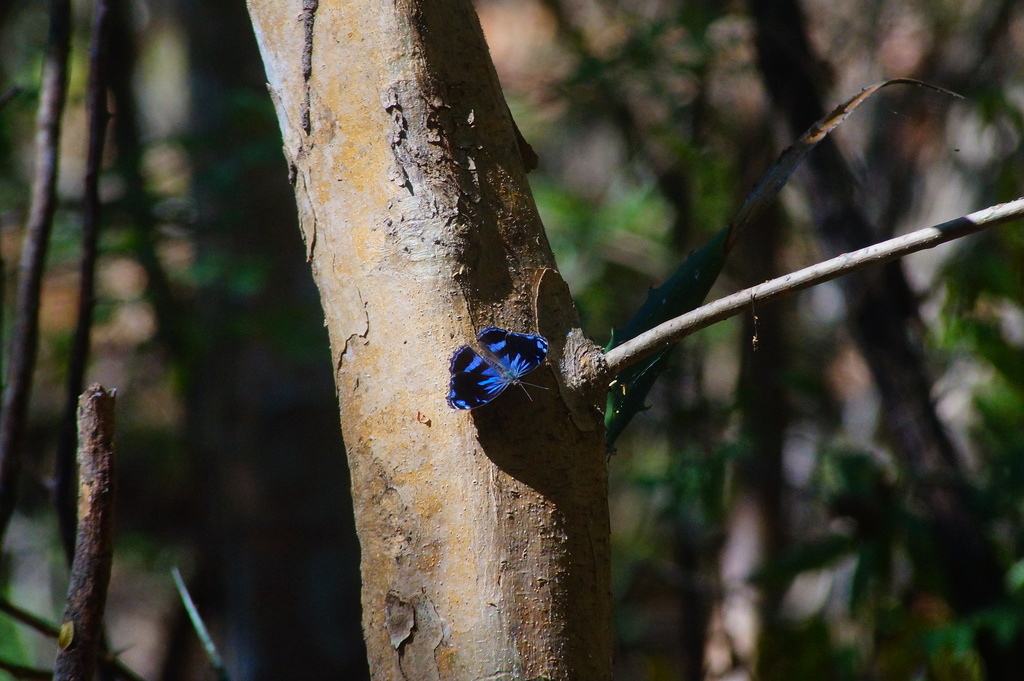
(c) Carlos Domínguez-Rodríguez, some rights reserved (CC BY) · licence
Family: Nymphalidae · Class: Insecta · Order: Lepidoptera
Myscelia cyananthe (Blackened Bluewing) is a California animal in the Nymphalidae family.
The Blackened Bluewing (Myscelia cyananthe) is a neotropical butterfly in the family Nymphalidae that occurs as a rare vagrant in the southwestern United States. This medium-sized brush-footed butterfly exhibits striking sexual dimorphism and distinctive wing patterns that distinguish it from other North American species. The species displays prominent black wings with iridescent blue bands on the dorsal surface, while the center of the forewing remains black without banding (Butterflies and Moths of North America). The metallic blue coloration creates a distinctive contrast against the dark background. Wing span measurements and detailed ventral patterns have not been well documented in North American literature, likely due to the species' rarity as a stray. Myscelia cyananthe is primarily distributed throughout subtropical Mexico, where established populations occur. In the United States, this species appears only as a rare stray reaching South Texas and New Mexico. The species does not maintain breeding populations north of Mexico, and all U.S. records represent dispersing individuals from Mexican source populations. No confirmed records exist for California, despite the species' inclusion in regional databases. The species inhabits subtropical environments in its native range. Specific habitat preferences within Mexico have not been thoroughly documented in available literature, though the subtropical designation suggests association with warm, humid forest environments typical of Central American butterfly fauna. Elevation ranges and microhabitat requirements remain poorly studied. Life history information for Myscelia cyananthe remains limited in North American literature. Host plant relationships have not been reported in available sources, representing a significant knowledge gap for this species. Breeding behavior, flight periods, and developmental timing are similarly undocumented. The species likely exhibits typical nymphalid characteristics including complete metamorphosis and multiple broods per year in its subtropical range, though specific details require further research. The Blackened Bluewing requires no conservation measures in the United States due to its status as a rare stray rather than an established resident (Butterflies and Moths of North America). The species lacks formal conservation status at state or federal levels, reflecting its marginal occurrence north of Mexico. Population trends cannot be assessed for U.S. occurrences due to the sporadic nature of vagrant records. Conservation focus appropriately centers on Mexican populations where the species maintains viable breeding populations. Scientific documentation for this species remains limited in North American contexts. The information presented here is based on available sources including the Butterflies and Moths of North America database and BugGuide taxonomic references. If you have additional verified information about this species' biology, distribution, or ecology in North America, please contact us to help improve this species account.
Classification
Class: Insecta · Order: Lepidoptera · Family: Nymphalidae
Frequently asked questions
How is Myscelia cyananthe classified?
Myscelia cyananthe belongs to class Insecta, order Lepidoptera, family Nymphalidae.
What family does Myscelia cyananthe belong to?
Myscelia cyananthe is in the Nymphalidae family.
What is Myscelia cyananthe?
The Blackened Bluewing (Myscelia cyananthe) is a neotropical butterfly in the family Nymphalidae that occurs as a rare vagrant in the southwestern United States.
Is Myscelia cyananthe found in California?
Yes. Myscelia cyananthe is recorded in California in The California Species Project's catalogue.
Related species
Other California species in the same genus, family, or bioregion.
Data from The California Species Project — 14,000+ California species with verified data from CNPS, CDFW, USFWS, and more.