Mythimna unipuncta
Armyworm Moth
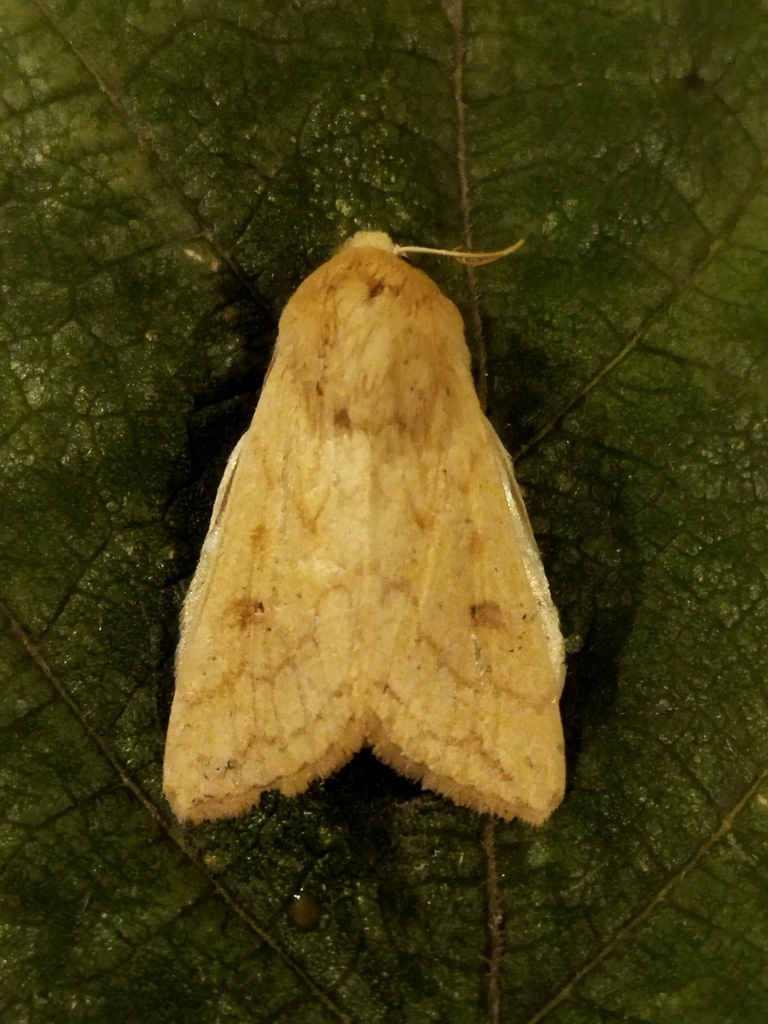
(c) SteveM4560, some rights reserved (CC BY) · licence
Family: Noctuidae · Class: Insecta · Order: Lepidoptera
Mythimna unipuncta (Armyworm Moth) is a California animal in the Noctuidae family.
The armyworm moth (Mythimna unipuncta) is a medium-sized noctuid moth with a wingspan ranging from 32 to 40 mm (1.3 to 1.6 inches). Adults display variable coloration, typically with pale brown to yellowish-brown forewings marked by darker streaks and lines. The forewings feature a distinctive white spot (the "unipuncta" referenced in the scientific name) near the center, along with subtle darker brown or gray markings that form irregular patterns. The hindwings are lighter, ranging from pale gray to whitish with darker marginal bands. At rest, the moth holds its wings roof-like over the body, creating a triangular profile. This species occurs across a vast range spanning North and South America, from southern Canada through the United States and extending into Central America and northern South America. In California, armyworm moths are found throughout the state from sea level to moderate elevations, inhabiting agricultural areas, grasslands, and disturbed habitats. The species is particularly common in the Central Valley and coastal regions where suitable host plants are abundant. Armyworm moths occupy diverse habitats including cultivated fields, pastures, grasslands, and weedy areas. Adults are active primarily at night and are strongly attracted to artificial lights. The species thrives in areas with dense grass coverage and shows particular affinity for agricultural landscapes where graminaceous crops are grown. Elevation tolerance ranges from sea level to approximately 1,500 meters (4,900 feet), though populations are most dense in lower elevation agricultural zones. Adults are nocturnal and exhibit strong migratory behavior, with populations capable of long-distance dispersal. Mating occurs during nighttime hours, with females releasing pheromones to attract males. After mating, females deposit clusters of 50 to 150 eggs on grass blades and other host plant surfaces. The species completes multiple generations per year in California, with continuous breeding possible in warmer regions. Larvae, known as armyworms due to their tendency to move in groups across fields, feed primarily on grasses including corn, wheat, oats, barley, and numerous wild graminoids. The larval stage typically lasts 3 to 4 weeks, during which individuals progress through six instars before pupating in soil chambers. The armyworm moth is not listed under federal or state endangered species legislation and maintains stable populations throughout its range. The species is considered agriculturally significant due to larval feeding damage on crops, particularly during outbreak years when populations surge dramatically. These periodic outbreaks can cause substantial economic damage to cereal crops, pastures, and turf grass. Climate variability influences population dynamics, with warm, wet conditions favoring rapid reproduction and population growth. The species serves as an important food source for various predators and parasitoids, playing a significant ecological role in agricultural and grassland ecosystems. Current populations appear stable with no conservation concerns identified.
Classification
Class: Insecta · Order: Lepidoptera · Family: Noctuidae
Frequently asked questions
How is Mythimna unipuncta classified?
Mythimna unipuncta belongs to class Insecta, order Lepidoptera, family Noctuidae.
What family does Mythimna unipuncta belong to?
Mythimna unipuncta is in the Noctuidae family.
What is Mythimna unipuncta?
The armyworm moth (Mythimna unipuncta) is a medium-sized noctuid moth with a wingspan ranging from 32 to 40 mm (1.3 to 1.6 inches).
Is Mythimna unipuncta found in California?
Yes. Mythimna unipuncta is recorded in California in The California Species Project's catalogue.
Related species
Other California species in the same genus, family, or bioregion.
Data from The California Species Project — 14,000+ California species with verified data from CNPS, CDFW, USFWS, and more.