Nandayus nenday
Black-hooded Parakeet
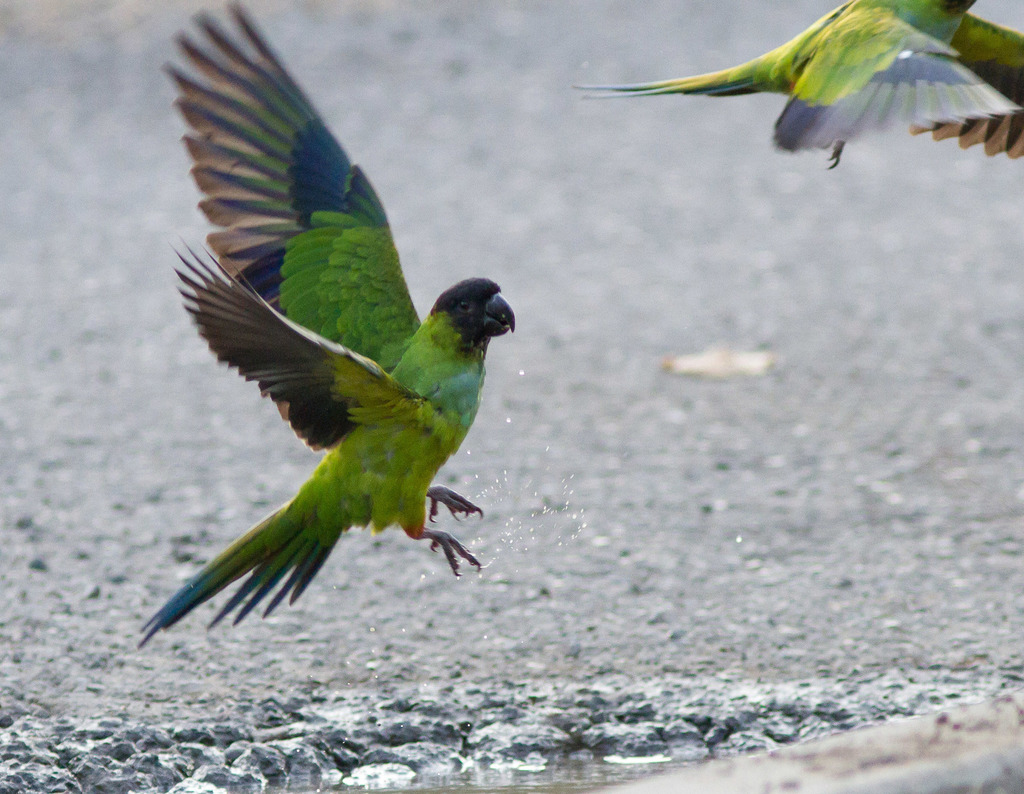
(c) Adam J. Searcy, some rights reserved (CC BY) · licence
Family: Psittacidae · Class: Aves · Order: Psittaciformes
Nandayus nenday (Black-hooded Parakeet) is a California animal in the Psittacidae family.
The Black-hooded Parakeet is a medium-sized parrot native to South America that has established non-native populations in California. Adults measure approximately 32 to 37 cm (12.6 to 14.6 inches) in length and weigh 120 to 140 grams. The species displays distinctive plumage with a black head and throat contrasting sharply with bright green body feathers. The wings show blue flight feathers, and the tail is long and graduated with blue-green coloration. The bill is black, and the eyes are dark brown surrounded by white periorbital skin. Historically confined to the wetlands and palm savannas of Paraguay, northern Argentina, southern Brazil, and Bolivia, the Black-hooded Parakeet now occurs as an introduced species in several locations worldwide. In California, established populations exist primarily in urban and suburban areas of Los Angeles, Orange, and San Diego counties. The species was first reported breeding in California in the 1980s, with populations likely originating from escaped or released cage birds. Current California populations are concentrated in areas with suitable nesting sites and food sources, including residential neighborhoods with mature palm trees. Black-hooded Parakeets inhabit urban environments, parks, residential areas with large trees, and agricultural zones. They show strong preference for areas with palm trees, particularly date palms and fan palms, which provide both nesting cavities and food sources. The species also utilizes eucalyptus groves, riparian woodland edges, and ornamental plantings in developed areas. They typically occur from sea level to approximately 300 meters elevation in California. These parakeets are highly social, forming flocks that range from small family groups to aggregations of several hundred individuals. They are cavity nesters, with breeding pairs excavating holes in palm tree trunks or utilizing existing cavities. The breeding season in California extends from February through August, with peak activity in spring. Females typically lay 3 to 4 white eggs, which are incubated for approximately 24 days. Young fledge after 7 to 8 weeks in the nest cavity. Black-hooded Parakeets are primarily granivorous, feeding on seeds, fruits, and palm dates. They also consume flowers, buds, and occasionally insects. Flocks often forage in agricultural areas, feeding on crops such as sunflowers and corn. The Black-hooded Parakeet is not federally listed and has no special conservation status in California as a non-native species. In their native range, populations remain stable with no significant conservation concerns. California populations appear to be expanding gradually, with new colonies established through natural dispersal and continued releases. The species' adaptability to urban environments and availability of suitable habitat suggest continued establishment success. Management considerations focus on potential impacts to native cavity-nesting birds and agricultural crops, though significant conflicts have not been documented as of December 2025.
Classification
Class: Aves · Order: Psittaciformes · Family: Psittacidae
Frequently asked questions
How is Nandayus nenday classified?
Nandayus nenday belongs to class Aves, order Psittaciformes, family Psittacidae.
What family does Nandayus nenday belong to?
Nandayus nenday is in the Psittacidae family.
What is Nandayus nenday?
The Black-hooded Parakeet is a medium-sized parrot native to South America that has established non-native populations in California.
Is Nandayus nenday found in California?
Yes. Nandayus nenday is recorded in California in The California Species Project's catalogue.
Related species
Other California species in the same genus, family, or bioregion.
Data from The California Species Project — 14,000+ California species with verified data from CNPS, CDFW, USFWS, and more.