Nannopterum auritum
Double-crested Cormorant
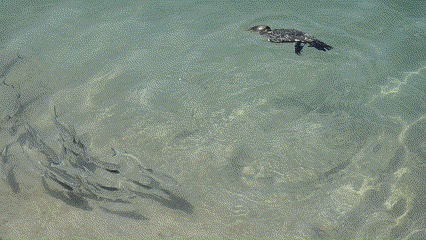
(c) Josiah Londerée, some rights reserved (CC BY) · licence
Family: Phalacrocoracidae · Class: Aves · Order: Suliformes
Conservation status: WL · G5 S4
Nannopterum auritum (Double-crested Cormorant) is a California animal in the Phalacrocoracidae family.
The Double-crested Cormorant (Nannopterum auritum) is a large waterbird measuring 70 to 90 cm (28 to 35 inches) in length with a wingspan of 114 to 123 cm (45 to 48 inches). Adults weigh between 1.2 to 2.5 kg (2.6 to 5.5 pounds). The species exhibits glossy black plumage with a greenish sheen during breeding season. The distinctive double crest of feathers behind each eye, from which the species derives its name, is present only during breeding season and appears as wispy, curved plumes. Non-breeding adults lack the crests and display duller black-brown plumage. The bill is hooked at the tip and yellow-orange in color, while the throat pouch is orange. Juveniles are brown above with lighter underparts. Double-crested Cormorants have one of the most extensive ranges of any North American waterbird. In California, they occur year-round along the entire coast and in the Central Valley, with seasonal presence in mountain lakes and reservoirs. The species breeds on offshore islands including the Channel Islands, as well as inland locations throughout the Sacramento and San Joaquin valleys. During winter, populations concentrate along the coast and in large inland water bodies. The species inhabits a wide variety of aquatic environments including coastal waters, estuaries, lakes, reservoirs, rivers, and wetlands. They prefer areas with abundant fish populations and suitable roosting and nesting sites. Breeding colonies are established on islands, cliffs, trees, or artificial structures such as bridges and towers. Nesting occurs from sea level to elevations exceeding 1,500 meters (4,900 feet) in mountain lakes. Double-crested Cormorants are pursuit divers that propel themselves underwater using their feet to capture fish. Their diet consists primarily of fish ranging from 2.5 to 25 cm (1 to 10 inches) in length, including anchovy, sardines, rockfish, and freshwater species such as carp and catfish. Breeding occurs from March through August, with peak activity from April to June. Females lay 1 to 7 eggs, typically 3 to 4, in stick nests lined with vegetation. Both parents incubate eggs for 25 to 28 days and feed young by regurgitation. Chicks fledge after 35 to 42 days but may continue to receive parental care for several additional weeks. In California, Double-crested Cormorants are designated as a Watch List species, indicating potential conservation concern but not requiring immediate protection measures. The global population is considered stable with the species rated G5 (secure) globally and S4 (apparently secure) in California. Historically, populations declined significantly due to DDT contamination, which caused eggshell thinning and reproductive failure. Following the ban on DDT and implementation of protective measures, populations have recovered substantially since the 1970s. Current threats include habitat loss from coastal development, disturbance at breeding colonies, pollution, and climate change effects on prey availability. Oil spills pose periodic risks to coastal populations.
Classification
Class: Aves · Order: Suliformes · Family: Phalacrocoracidae
Conservation status
WL · G5 S4
Frequently asked questions
How is Nannopterum auritum classified?
Nannopterum auritum belongs to class Aves, order Suliformes, family Phalacrocoracidae.
What family does Nannopterum auritum belong to?
Nannopterum auritum is in the Phalacrocoracidae family.
Is Nannopterum auritum protected or of conservation concern?
Nannopterum auritum carries the following status: WL · G5 S4.
What is Nannopterum auritum?
The Double-crested Cormorant (Nannopterum auritum) is a large waterbird measuring 70 to 90 cm (28 to 35 inches) in length with a wingspan of 114 to 123 cm (45 to 48 inches).
Is Nannopterum auritum found in California?
Yes. Nannopterum auritum is recorded in California in The California Species Project's catalogue.
Related species
Other California species in the same genus, family, or bioregion.
Data from The California Species Project — 14,000+ California species with verified data from CNPS, CDFW, USFWS, and more.