Nastra julia
Julia's Skipper
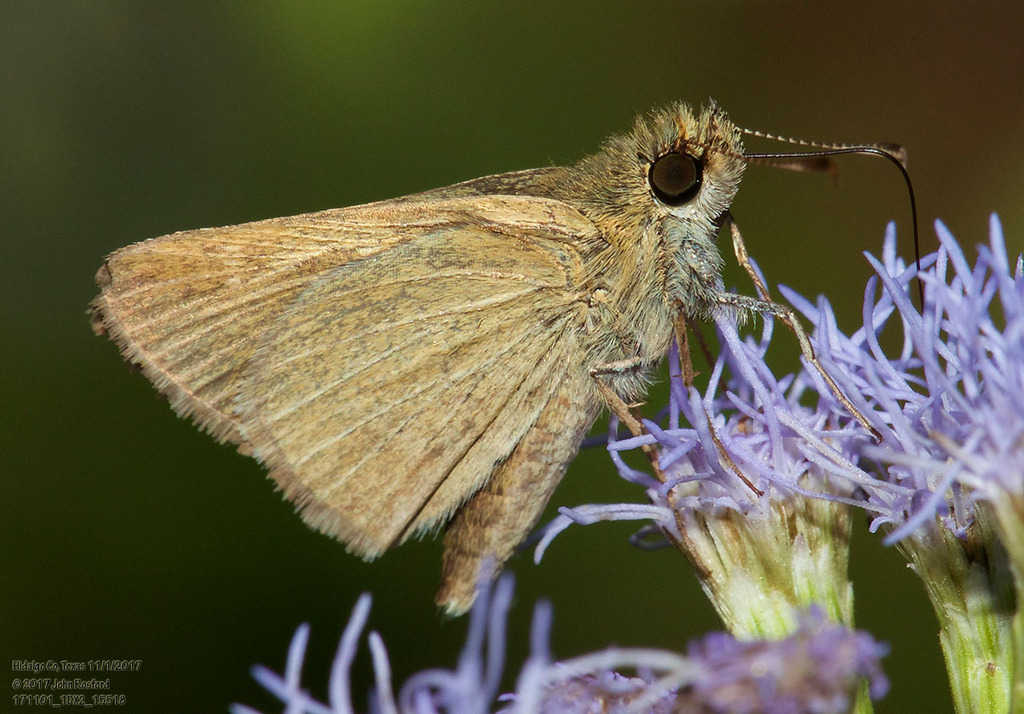
(c) John Rosford, some rights reserved (CC BY) · licence
Family: Hesperiidae · Class: Insecta · Order: Lepidoptera
Nastra julia (Julia's Skipper) is a California animal in the Hesperiidae family.
Julia's Skipper (Nastra julia) is a small butterfly in the family Hesperiidae, commonly known as the grass skippers. Adults have a wingspan of approximately 20-25 mm (0.8-1.0 inches), with males typically smaller than females. The dorsal wing surfaces are tawny-orange to brownish-orange, often with darker scaling along the wing margins. The ventral hindwings are pale yellow to cream-colored with faint, light-colored spots that may be indistinct or absent in some individuals. Males possess a distinctive dark stigma (scent patch) on the forewings, which appears as a dark streak or line of specialized scales used in courtship behavior. Julia's Skipper has a limited distribution range extending from South Texas south through eastern Mexico to central Mexico. In the United States, the species is documented primarily from the Rio Grande Valley region of extreme south Texas, including Cameron, Hidalgo, Starr, and Zapata counties. The northern limit of its range appears to be constrained by climate factors and host plant availability. Within Mexico, populations occur from Tamaulipas and Nuevo León southward through the eastern states to Veracruz and Puebla. The species inhabits open grasslands, pastures, roadsides, and disturbed areas where its primary host plant, Bermuda grass (Cynodon dactylon), grows abundantly. This introduced African grass species has become naturalized throughout much of the warmer regions of North America and provides the exclusive larval food source for Julia's Skipper. Adults are typically found in areas with scattered shrubs or trees that provide nectar sources and roosting sites. The species occurs from sea level to approximately 1,500 meters (4,900 feet) elevation, though it is most common in lowland areas. Julia's Skipper is multivoltine, producing multiple broods throughout the year in suitable climate conditions. Adults are active during daylight hours and exhibit rapid, darting flight patterns typical of grass skippers. Males establish territories in sunny openings and patrol for receptive females. Mating typically occurs during midday hours when temperatures are optimal for activity. Females lay single eggs on or near Bermuda grass blades, and larvae feed within rolled leaf shelters constructed by binding grass blades together with silk. The caterpillars are pale green with darker longitudinal stripes and a brown head capsule. Adult Julia's Skippers nectar on various small flowers, including those of composites, legumes, and other low-growing plants. The species shows a preference for white or pale-colored flowers. Flight period extends from March through November in south Texas, with peak abundance typically occurring during spring and fall months when temperatures are moderate. Julia's Skipper is not federally or state listed and appears to have stable populations throughout its range. The species has likely benefited from the widespread establishment of Bermuda grass, which has expanded available habitat. However, intensive agricultural practices and urban development may pose localized threats to populations. The species' dependence on a single host plant species makes it potentially vulnerable to large-scale changes in land use or grass management practices.
Classification
Class: Insecta · Order: Lepidoptera · Family: Hesperiidae
Frequently asked questions
How is Nastra julia classified?
Nastra julia belongs to class Insecta, order Lepidoptera, family Hesperiidae.
What family does Nastra julia belong to?
Nastra julia is in the Hesperiidae family.
What is Nastra julia?
Julia's Skipper (Nastra julia) is a small butterfly in the family Hesperiidae, commonly known as the grass skippers.
Is Nastra julia found in California?
Yes. Nastra julia is recorded in California in The California Species Project's catalogue.
Related species
Other California species in the same genus, family, or bioregion.
Data from The California Species Project — 14,000+ California species with verified data from CNPS, CDFW, USFWS, and more.