Nemoria darwiniata
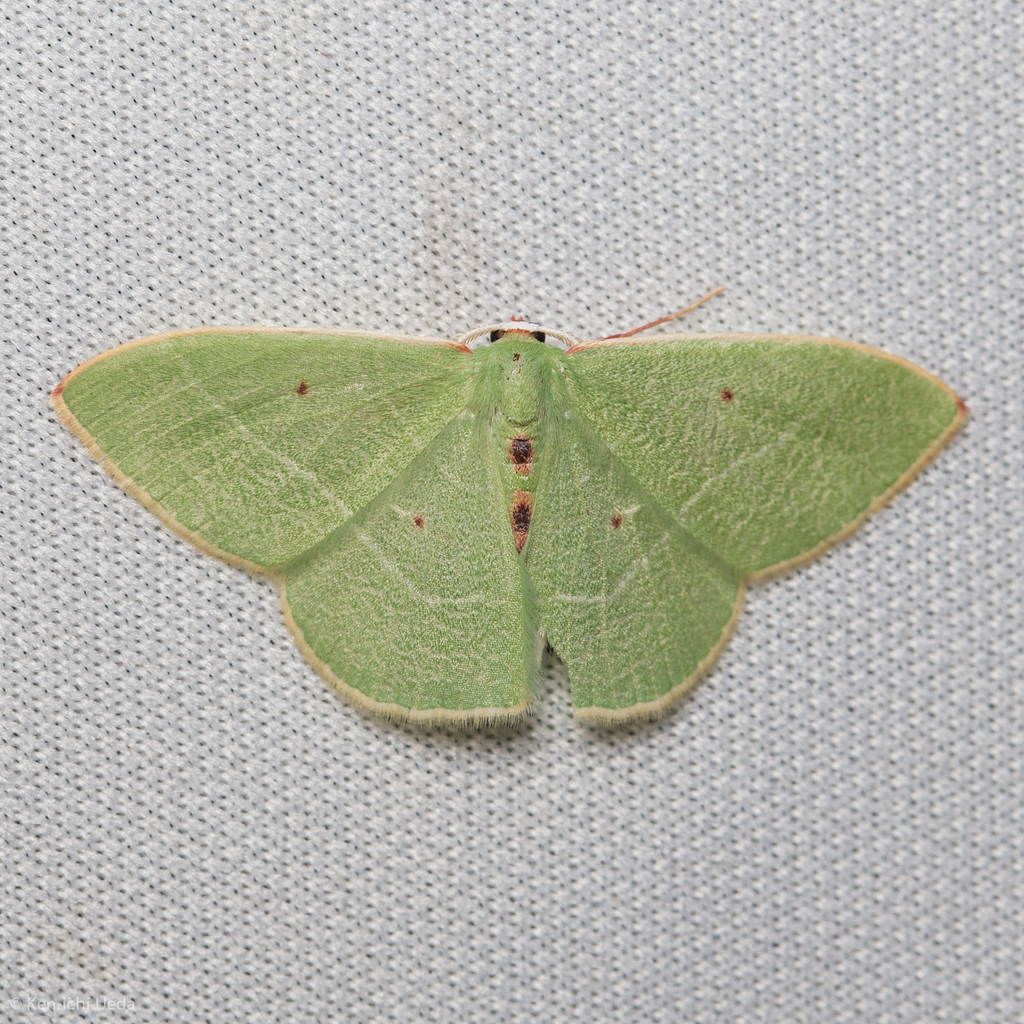
(c) Ken-ichi Ueda, some rights reserved (CC BY) · licence
Family: Geometridae · Class: Insecta · Order: Lepidoptera
Nemoria darwiniata is a California animal in the Geometridae family.
Nemoria darwiniata, commonly known as the Columbian emerald, is a small moth in the family Geometridae, part of the emerald moth subfamily. This species exhibits the characteristic bright green coloration typical of emerald moths, with delicate wings that help camouflage it among foliage. Adults typically measure 15-25 mm in wingspan, displaying the geometric patterns common to the Geometridae family. The forewings are emerald green with subtle white or pale green cross-lines, while the hindwings are similarly colored but often slightly paler. The species occurs across North America, with documented populations from southeastern Canada south through the eastern and central United States (iNaturalist). The subspecies N. d. punctularia and N. d. darwiniata have been documented, suggesting geographic variation across the range (iNaturalist). In California, specific distribution records are limited, though the species' North American range suggests it may occur in suitable habitat throughout the state. Habitat requirements for N. darwiniata are not well documented in the scientific literature. Like other Nemoria species, the Columbian emerald likely inhabits deciduous and mixed forests where host plants are present. Emerald moths typically prefer wooded areas with diverse understory vegetation and are often associated with edge habitats where forest meets more open areas. The larval biology and host plant relationships of N. darwiniata remain poorly documented. Most Nemoria species are known to feed on various deciduous trees and shrubs as caterpillars, but specific host plants for the Columbian emerald have not been definitively established. Adults are likely active during late spring through early fall, following the typical flight periods of related emerald moth species. Like other Geometridae, larvae are probably "inchworms" or "loopers" that move in the characteristic arching motion of measuring worms. The reproductive behavior follows typical patterns for emerald moths, with adults likely mating during evening hours. Females deposit eggs singly or in small groups on or near host plant foliage. Development probably includes multiple larval instars before pupation, with overwintering occurring as pupae in leaf litter or soil. Conservation status information for N. darwiniata is extremely limited. The species does not appear to have formal conservation rankings or protection status. Population trends and specific threats are undocumented, reflecting the general lack of comprehensive surveys for most micro-lepidoptera. Habitat loss and fragmentation of deciduous forests could potentially impact populations, as could changes in forest composition due to invasive species or climate change, but these effects have not been studied for this species. Scientific documentation for this species remains limited. The information presented here is based on available sources including iNaturalist observations and BugGuide records. If you have additional verified information about this species' biology, distribution, or ecology, please contact us to help improve this species account.
Classification
Class: Insecta · Order: Lepidoptera · Family: Geometridae
Frequently asked questions
How is Nemoria darwiniata classified?
Nemoria darwiniata belongs to class Insecta, order Lepidoptera, family Geometridae.
What family does Nemoria darwiniata belong to?
Nemoria darwiniata is in the Geometridae family.
What is Nemoria darwiniata?
Nemoria darwiniata, commonly known as the Columbian emerald, is a small moth in the family Geometridae, part of the emerald moth subfamily.
Is Nemoria darwiniata found in California?
Yes. Nemoria darwiniata is recorded in California in The California Species Project's catalogue.
Related species
Other California species in the same genus, family, or bioregion.
Data from The California Species Project — 14,000+ California species with verified data from CNPS, CDFW, USFWS, and more.