Nemoria leptalea
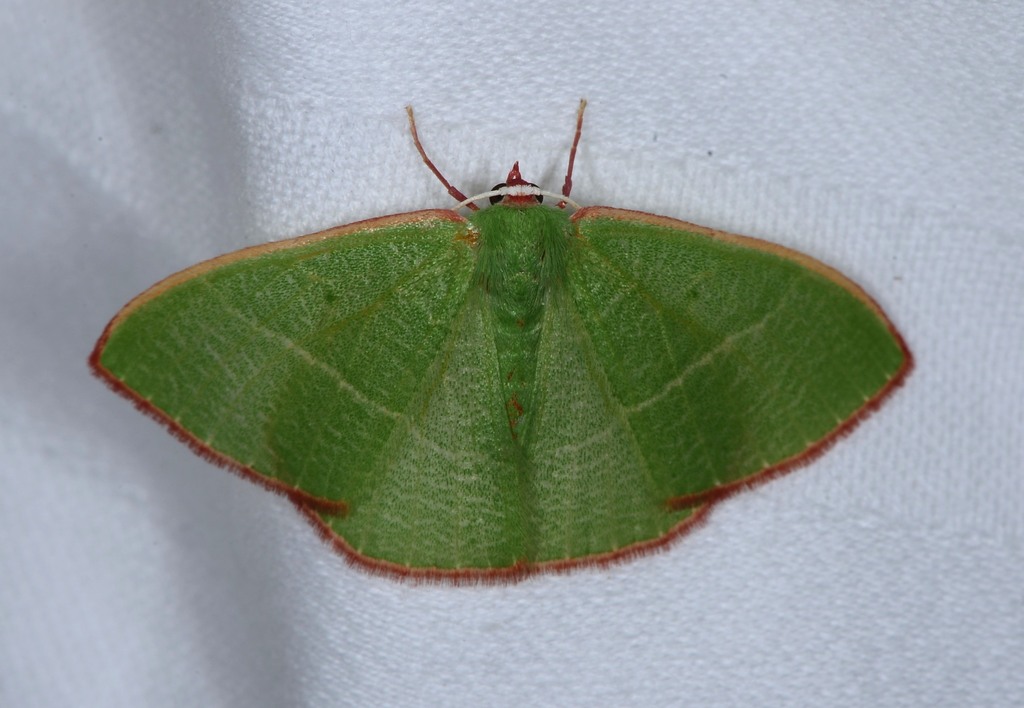
(c) Don Loarie, some rights reserved (CC BY) · licence
Family: Geometridae · Class: Insecta · Order: Lepidoptera
Nemoria leptalea is a California animal in the Geometridae family.
Nemoria leptalea is a small geometrid moth belonging to the family Geometridae, commonly known as emerald moths or inchworm moths. This species represents one of the numerous Geometridae species found in North America, though detailed morphological descriptions and life history information remain limited in the scientific literature. The physical characteristics of Nemoria leptalea follow the typical Geometridae body plan, with adults likely displaying the slender build characteristic of the genus Nemoria. Members of this genus typically exhibit delicate wing structures with wingspan measurements generally ranging from 15 to 25 millimeters (0.6 to 1.0 inches). The wing coloration and patterning specific to N. leptalea require further documentation, though related Nemoria species often display subtle green or brown tones that provide effective camouflage among vegetation. The current documented range of Nemoria leptalea appears to be restricted to specific regions of North America, though comprehensive distribution data remains incomplete. Many Geometridae species demonstrate localized distributions tied to specific host plant availability and microhabitat conditions. The species likely occupies areas where suitable larval host plants occur, as geometrid larvae are typically specialized feeders with narrow host plant ranges. Habitat requirements for Nemoria leptalea remain poorly documented, though the species presumably occupies forested or woodland environments typical of many Nemoria species. Geometridae moths generally inhabit areas supporting their specific larval host plants, which often include deciduous trees and shrubs. Adults likely frequent areas with flowering plants that provide nectar sources, while larvae develop on foliage of their designated host species. The life cycle of Nemoria leptalea follows the standard Geometridae pattern of complete metamorphosis. Adult moths likely emerge during specific seasonal periods, with timing dependent on local climate conditions and elevation. Females deposit eggs on or near suitable host plants, where larvae develop as characteristic 'inchworms' or 'loopers,' moving with the distinctive arching motion that gives Geometridae their common name. Larvae likely feed externally on host plant foliage, progressing through multiple instars before pupating in soil or leaf litter. The conservation status of Nemoria leptalea remains undetermined due to insufficient population and distribution data. Many Geometridae species face potential threats from habitat loss, particularly deforestation and conversion of natural areas to agricultural or urban uses. Climate change may affect the species through alterations in host plant phenology and distribution, potentially disrupting synchronized relationships between moth emergence and optimal host plant conditions. The species' apparent rarity or localized distribution may indicate conservation concern, though comprehensive surveys and taxonomic research are needed to assess population status accurately. Further research is needed to document the species' complete range, host plant associations, life history timing, and population trends to determine appropriate conservation priorities and management strategies.
Classification
Class: Insecta · Order: Lepidoptera · Family: Geometridae
Frequently asked questions
How is Nemoria leptalea classified?
Nemoria leptalea belongs to class Insecta, order Lepidoptera, family Geometridae.
What family does Nemoria leptalea belong to?
Nemoria leptalea is in the Geometridae family.
What is Nemoria leptalea?
Nemoria leptalea is a small geometrid moth belonging to the family Geometridae, commonly known as emerald moths or inchworm moths.
Is Nemoria leptalea found in California?
Yes. Nemoria leptalea is recorded in California in The California Species Project's catalogue.
Related species
Other California species in the same genus, family, or bioregion.
Data from The California Species Project — 14,000+ California species with verified data from CNPS, CDFW, USFWS, and more.