Nemoria pistaciaria
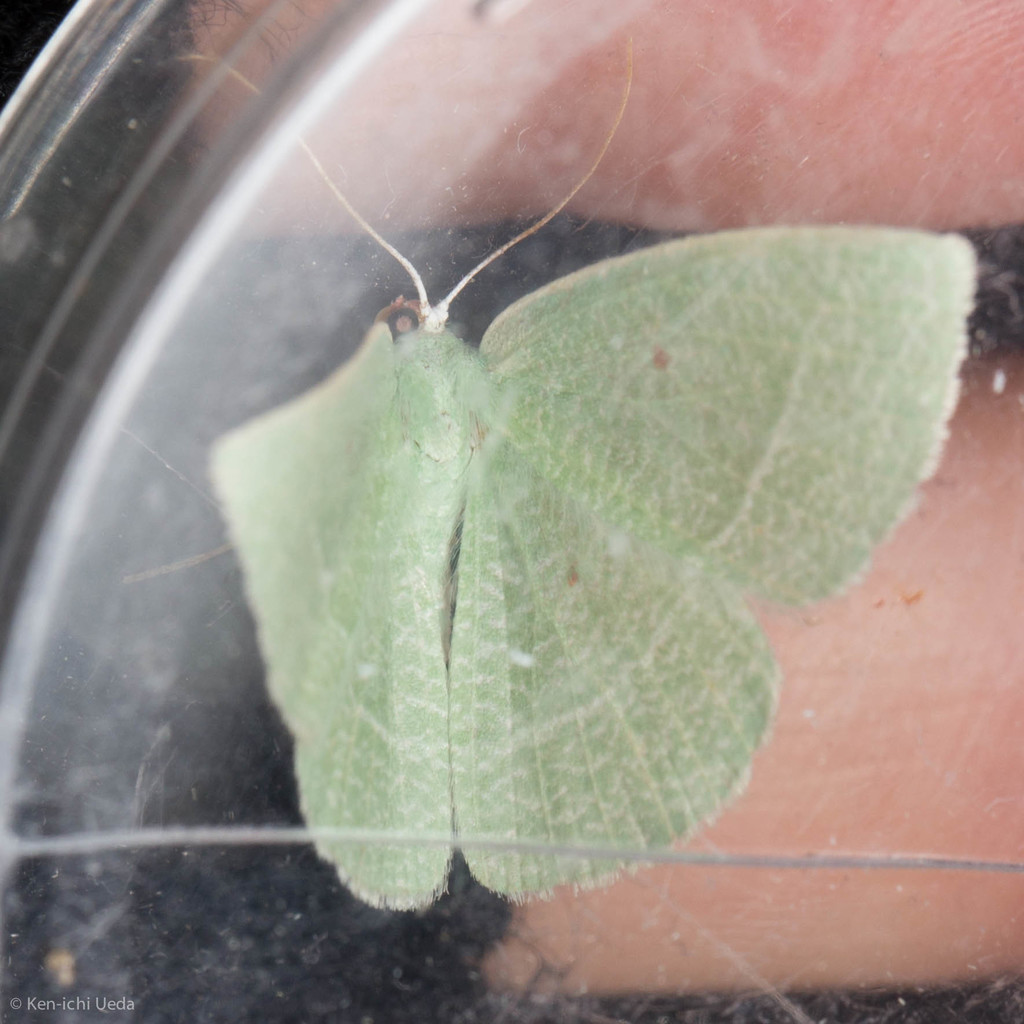
(c) Ken-ichi Ueda, some rights reserved (CC BY) · licence
Family: Geometridae · Class: Insecta · Order: Lepidoptera
Nemoria pistaciaria is a California animal in the Geometridae family.
Nemoria pistaciaria is a small geometrid moth in the family Geometridae, subfamily Geometrinae. Adults exhibit the typical emerald green coloration characteristic of many Nemoria species, with forewings measuring approximately 10-15 mm in length. The wings display a uniform pale green ground color with subtle darker green striations and white marginal lines. Like other geometrids, the species holds its wings horizontally when at rest, creating a triangular silhouette. The antennae are filiform in both sexes, and the body maintains the same pale green coloration as the wings, providing effective camouflage against foliage. This species occurs in western North America, with records from California, Oregon, and Washington. In California, Nemoria pistaciaria has been documented from various counties throughout the state, though specific distributional data remains limited in published literature. The species appears to have a relatively broad range within suitable habitat types across the Pacific Coast region. Nemoria pistaciaria inhabits deciduous and mixed woodlands, particularly areas dominated by oak species. The moth is associated with oak woodland ecosystems from sea level to moderate elevations in foothill regions. Adults are typically found in areas with dense canopy cover where host plants are abundant. The species shows preference for woodland edges and clearings adjacent to mature oak stands. Larvae of Nemoria pistaciaria feed on various oak species (Quercus spp.), though specific host plant associations require further documentation. The caterpillars are twig mimics, exhibiting cryptic coloration and body positioning that resembles small branches or twigs of their host plants. This defensive strategy is common among geometrid larvae and provides protection from avian predators. Adults are nocturnal and are attracted to artificial lights during evening hours. Flight period extends from spring through early summer, typically May through July, with peak activity occurring in June. The species likely produces one generation per year in most of its range. Nemoria pistaciaria does not currently hold any special conservation status at federal or state levels. Population trends for this species are not well documented, as comprehensive surveys of geometrid moths are limited. Like many woodland-associated lepidopterans, the species may face habitat pressure from urban development, particularly in California's rapidly developing foothill regions. Oak woodland conversion and fragmentation represent potential threats to local populations. Climate change may alter the timing of larval development relative to host plant phenology, though specific impacts on this species have not been studied. The moth's apparent ability to utilize multiple oak species as hosts may provide some resilience against localized habitat changes. Current knowledge of this species' ecology and distribution patterns would benefit from additional field surveys and taxonomic research to better understand its conservation needs and population status throughout its range.
Classification
Class: Insecta · Order: Lepidoptera · Family: Geometridae
Frequently asked questions
How is Nemoria pistaciaria classified?
Nemoria pistaciaria belongs to class Insecta, order Lepidoptera, family Geometridae.
What family does Nemoria pistaciaria belong to?
Nemoria pistaciaria is in the Geometridae family.
What is Nemoria pistaciaria?
Nemoria pistaciaria is a small geometrid moth in the family Geometridae, subfamily Geometrinae.
Is Nemoria pistaciaria found in California?
Yes. Nemoria pistaciaria is recorded in California in The California Species Project's catalogue.
Related species
Other California species in the same genus, family, or bioregion.
Data from The California Species Project — 14,000+ California species with verified data from CNPS, CDFW, USFWS, and more.