Neogale vison
American Mink
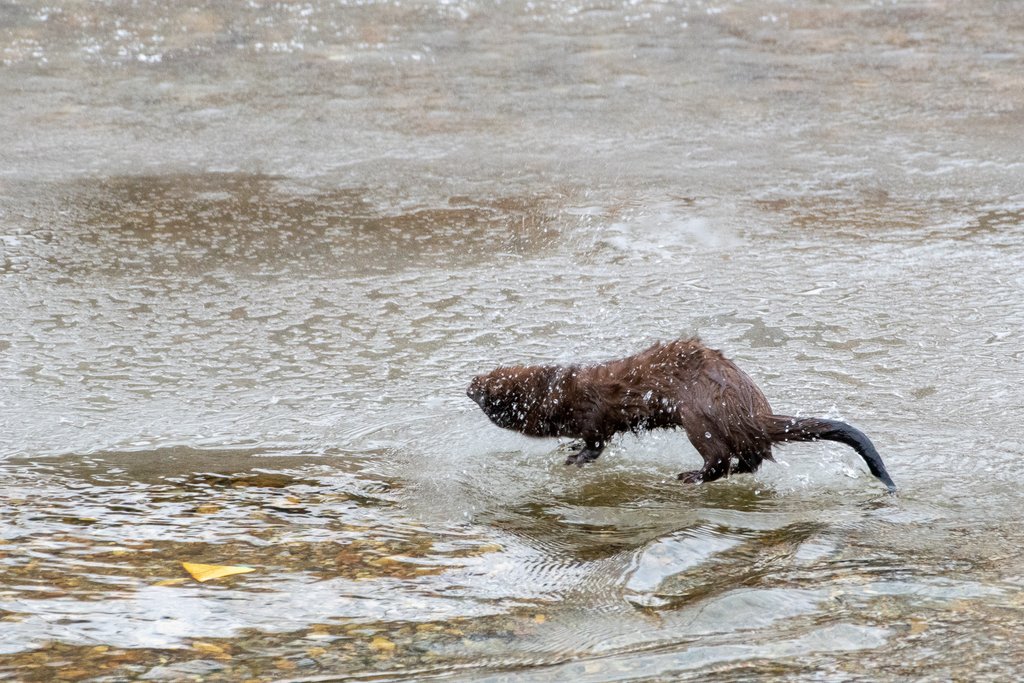
(c) Richard Littauer, some rights reserved (CC BY) · licence
Family: Mustelidae · Class: Mammalia · Order: Carnivora
Neogale vison (American Mink) is a California animal in the Mustelidae family.
The American mink is a semi-aquatic carnivorous mammal belonging to the weasel family Mustelidae. Adults measure 31 to 45 cm (12 to 18 inches) in body length, with males significantly larger than females. The tail adds an additional 13 to 23 cm (5 to 9 inches). Body weight ranges from 0.7 to 2.0 kg (1.5 to 4.4 pounds), with males averaging nearly twice the weight of females. The dense, waterproof fur is typically dark brown to black, though color variations include chocolate brown and occasional lighter phases. A distinctive white patch often appears on the chin and throat. The body is elongated and streamlined for aquatic locomotion, with short legs, webbed toes, and a moderately bushy tail. Historically, American mink ranged throughout most of North America from Alaska to the Maritime Provinces of Canada, extending south through most of the contiguous United States except for arid southwestern regions. In California, native populations were restricted to the northeastern portion of the state, primarily in the Cascade Range and northern Sierra Nevada. Current wild populations in California are largely derived from escaped or released fur farm animals, with established populations documented in the Sacramento Valley, San Francisco Bay Area, and various coastal and inland waterways. American mink inhabit riparian corridors, marshes, swamps, and lakeshores where dense vegetation provides cover. They require permanent water sources with abundant prey and suitable denning sites. Dens are typically located in hollow logs, rock crevices, abandoned beaver lodges, or burrows excavated in stream banks. The species occupies elevations from sea level to approximately 1,500 meters (4,900 feet) in montane environments. Home ranges vary from 1 to 6 kilometers (0.6 to 3.7 miles) of waterway, depending on habitat quality and prey availability. Mink are opportunistic predators with a diet consisting primarily of fish, amphibians, crustaceans, small mammals, and birds. They are excellent swimmers and divers, capable of pursuing prey underwater for distances up to 30 meters. Breeding occurs from January through March, with females producing litters of 2 to 10 kits after a gestation period of 40 to 75 days, including delayed implantation. Kits remain in dens for approximately 5 to 6 weeks before beginning to accompany adults on hunting excursions. Sexual maturity is reached at 10 to 12 months of age. The American mink is not federally listed and maintains stable populations across most of its range. In California, the species' status is complicated by the presence of both native and introduced populations. Native populations in northeastern California remain limited, while feral populations established from escaped fur farm animals have colonized suitable habitats throughout much of the state. These introduced populations may impact native wildlife through predation on ground-nesting birds, small mammals, and amphibians. Climate change and habitat modification represent ongoing challenges, particularly for remnant native populations in montane environments where water availability may become increasingly limited.
Classification
Class: Mammalia · Order: Carnivora · Family: Mustelidae
Frequently asked questions
How is Neogale vison classified?
Neogale vison belongs to class Mammalia, order Carnivora, family Mustelidae.
What family does Neogale vison belong to?
Neogale vison is in the Mustelidae family.
What is Neogale vison?
The American mink is a semi-aquatic carnivorous mammal belonging to the weasel family Mustelidae.
Is Neogale vison found in California?
Yes. Neogale vison is recorded in California in The California Species Project's catalogue.
Related species
Other California species in the same genus, family, or bioregion.
Data from The California Species Project — 14,000+ California species with verified data from CNPS, CDFW, USFWS, and more.