Neohermes californicus
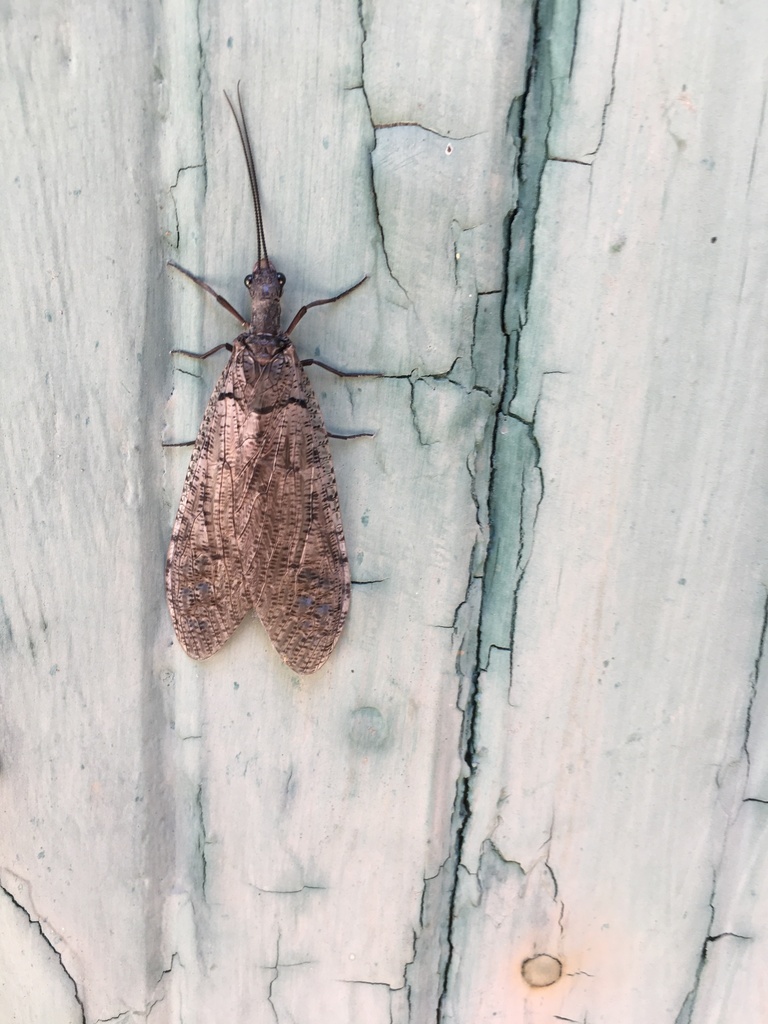
(c) rickr, some rights reserved (CC BY) · licence
Family: Corydalidae · Class: Insecta · Order: Megaloptera
Neohermes californicus is a California animal in the Corydalidae family.
Neohermes californicus is a large dobsonfly belonging to the family Corydalidae within the order Megaloptera. Adults measure 35-55 mm from head to wing tips, with a body length of 25-35 mm and wingspan of 85-105 mm (BugGuide). The body and wings are dark colored, with wings displaying a mottled gray pattern. Males possess distinctive moniliform (bead-like) antennae with a ring of erect hairs on each antennal segment, distinguishing them from the pectinate or serrate antennae found in the related genus Chauliodes. The hind wing venation also differs from Chauliodes species. This species occurs in western North America, with its distribution documented in northeastern California, western Nevada, and southern Oregon (Liu & Winterton 2016). The range represents one of the more geographically restricted distributions among North American Neohermes species, contrasting with the widespread eastern N. concolor which spans multiple states from the Atlantic coast to the Great Plains. Neohermes californicus inhabits areas near flowing water systems, as the aquatic larval stage requires clean streams and rivers for development. Like other megalopteran species, larvae are predaceous and live in aquatic environments for several years before emerging as adults. The specific habitat preferences within the California-Nevada-Oregon range have not been thoroughly documented, but the species likely associates with montane and foothill stream systems typical of the region's geography. Adults are typically active during warmer months, emerging from aquatic pupal chambers to mate and reproduce. Females deposit eggs near water sources, and the resulting larvae develop as aquatic predators in stream substrates. The larval stage, known as hellgrammites in related species, can persist for multiple years before pupation. Adults have relatively short lifespans focused on reproduction. The species exhibits the typical megalopteran life cycle with complete metamorphosis through egg, larval, pupal, and adult stages. Neohermes californicus does not currently hold any federal or state conservation listing status. However, like many aquatic-dependent insects in California, the species may face habitat pressures from water management activities, drought conditions, and stream habitat degradation. The relatively restricted western range makes populations potentially vulnerable to localized threats affecting stream ecosystems. Systematic surveys documenting current population status and specific habitat requirements would provide valuable conservation baseline data. The genus Neohermes contains six described North American species, with N. californicus representing one of two western species along with N. filicornis and the recently described N. inexpectatus from California (Liu & Winterton 2016). Continued taxonomic research has refined understanding of species boundaries within this group, emphasizing the importance of proper identification for conservation assessments.
Classification
Class: Insecta · Order: Megaloptera · Family: Corydalidae
Frequently asked questions
How is Neohermes californicus classified?
Neohermes californicus belongs to class Insecta, order Megaloptera, family Corydalidae.
What family does Neohermes californicus belong to?
Neohermes californicus is in the Corydalidae family.
What is Neohermes californicus?
Neohermes californicus is a large dobsonfly belonging to the family Corydalidae within the order Megaloptera.
Is Neohermes californicus found in California?
Yes. Neohermes californicus is recorded in California in The California Species Project's catalogue.
Related species
Other California species in the same genus, family, or bioregion.
Data from The California Species Project — 14,000+ California species with verified data from CNPS, CDFW, USFWS, and more.