Neominois ridingsii
Ridings' Satyr
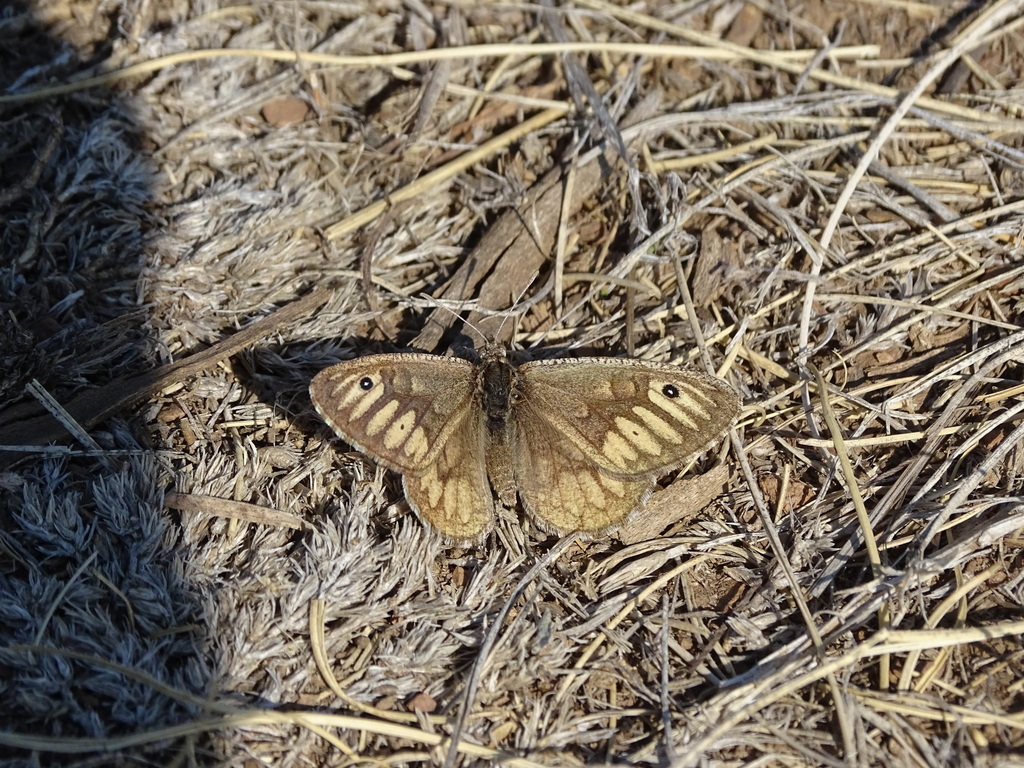
(c) Christoph Moning, some rights reserved (CC BY) · licence
Family: Nymphalidae · Class: Insecta · Order: Lepidoptera
Neominois ridingsii (Ridings' Satyr) is a California animal in the Nymphalidae family.
Ridings' satyr is a medium-sized butterfly with a wingspan ranging from 38 to 51 millimeters (1.5 to 2.0 inches). The dorsal wing surfaces are light brown to tan with subtle darker markings, while the ventral hindwings display a distinctive pattern of pale gray-brown coloration with small eyespots. Males typically exhibit more pronounced wing patterns than females. The forewings are elongated with rounded tips, and the hindwings feature small tails or projections. The butterfly's body is covered in pale brown scales, and the antennae are clubbed with orange tips. Ridings' satyr has a broad distribution across western North America, extending from southern Alberta east to southwest Manitoba, south to central Arizona and central New Mexico, and west to eastern California. Within California, the species occurs primarily in the eastern regions, including the Modoc Plateau and portions of the Sierra Nevada. The species inhabits areas where its host plant, blue grama grass (Bouteloua gracilis), is present. This butterfly occupies grassland and prairie habitats, typically at elevations ranging from 1,200 to 2,400 meters (4,000 to 8,000 feet). Ridings' satyr prefers open areas with scattered shrubs and well-drained soils where blue grama grass grows abundantly. The species is closely associated with shortgrass prairie ecosystems and mountain grasslands. Adults are often found in areas with gentle slopes and southern exposures where blue grama grass forms dense stands. Ridings' satyr has a single generation per year, with adults typically emerging from late June through August, depending on elevation and local climate conditions. Males patrol territories in search of females, flying close to the ground in areas where blue grama grass is present. Females lay eggs singly on or near the host plant. Larvae feed exclusively on blue grama grass, developing through five instars before pupating. The species overwinters as partially grown larvae. Adults exhibit a slow, bobbing flight pattern and frequently rest on vegetation or bare ground. Males are more active during midday hours, while females tend to be more secretive. Ridings' satyr is not federally listed, and its conservation status varies across its range. The species is considered secure in most of its distribution, though local populations may face threats from habitat conversion, overgrazing, and altered fire regimes. In California, populations are limited by the availability of suitable grassland habitat containing blue grama grass. Urban development and agricultural conversion have reduced some habitat areas. The butterfly's dependence on a single host plant species makes it vulnerable to changes in grassland composition. Climate change may affect the species through alterations in precipitation patterns and temperature regimes that influence blue grama grass growth and distribution.
Classification
Class: Insecta · Order: Lepidoptera · Family: Nymphalidae
Frequently asked questions
How is Neominois ridingsii classified?
Neominois ridingsii belongs to class Insecta, order Lepidoptera, family Nymphalidae.
What family does Neominois ridingsii belong to?
Neominois ridingsii is in the Nymphalidae family.
What is Neominois ridingsii?
Ridings' satyr is a medium-sized butterfly with a wingspan ranging from 38 to 51 millimeters (1.5 to 2.0 inches).
Is Neominois ridingsii found in California?
Yes. Neominois ridingsii is recorded in California in The California Species Project's catalogue.
Related species
Other California species in the same genus, family, or bioregion.
Data from The California Species Project — 14,000+ California species with verified data from CNPS, CDFW, USFWS, and more.