Neoscona crucifera
Spotted Orbweaver
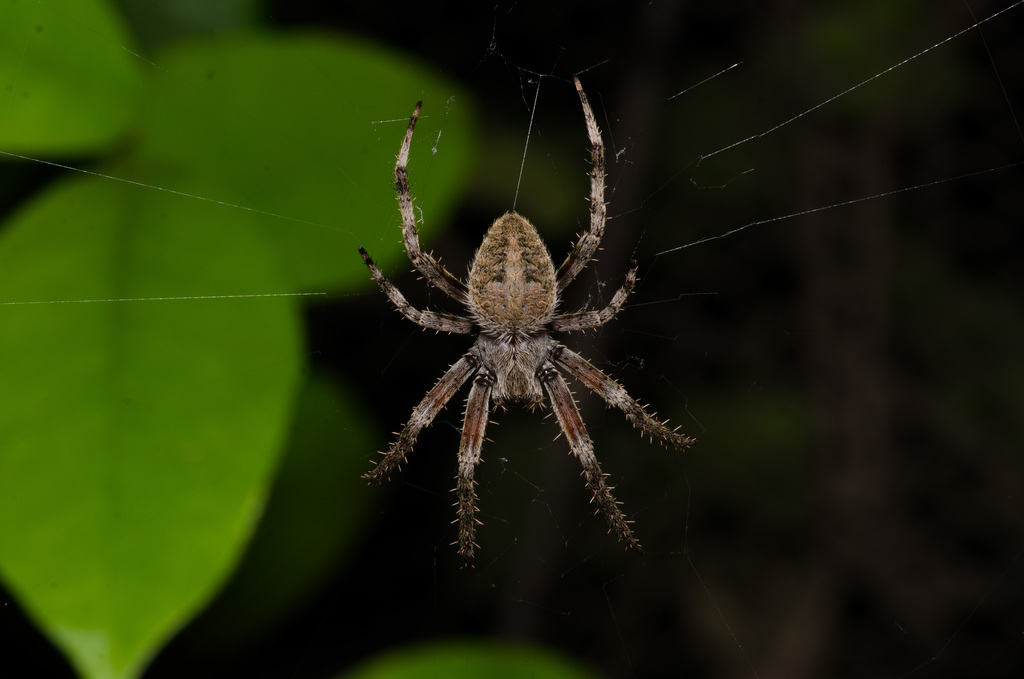
(c) Justin Williams, some rights reserved (CC BY) · licence
Family: Araneidae · Class: Arachnida · Order: Araneae
Neoscona crucifera (Spotted Orbweaver) is a California animal in the Araneidae family.
The Spotted Orbweaver (Neoscona crucifera) is a medium-sized orb weaver spider in the family Araneidae. Females measure 11 to 17 millimeters (0.43 to 0.67 inches) in body length, while males are notably smaller at 5 to 12 millimeters (0.20 to 0.47 inches) (BugGuide). The species displays sexual dimorphism typical of orb weavers, with females significantly larger than males. The abdomen typically shows variable coloration ranging from brown to orange-brown, often with darker markings on the sides and a distinctive folium pattern on the dorsal surface. The range of Neoscona crucifera extends across much of the eastern and central United States, including Alabama, Arkansas, Arizona, Connecticut, Florida, Georgia, Iowa, Illinois, Indiana, Kansas, Kentucky, Louisiana, Massachusetts, Maryland, Michigan, Minnesota, Missouri, Mississippi, North Carolina, Nebraska, New Jersey, New Mexico, New York, Ohio, Oklahoma, Pennsylvania, South Carolina, South Dakota, Tennessee, and Texas (BugGuide). However, the species' occurrence in California is questionable, with BugGuide experts noting that "California is quite out of the range for crucifera" and suggesting misidentifications may occur with the morphologically similar Western Spotted Orbweaver (Neoscona oaxacensis). Spotted Orbweavers inhabit a variety of environments where they can construct their characteristic orb webs. They typically build webs in open areas including gardens, forest edges, and around human structures. The species shows preference for locations with adequate anchor points for web construction, such as vegetation, fences, and building eaves. Web sites are usually selected in areas with good flying insect traffic. Neoscona crucifera constructs the typical orb web characteristic of the Araneidae family, featuring a circular sticky capture spiral supported by non-sticky radial threads. The spider typically remains at the web center or retreats to a nearby shelter connected to the web by a signal line. These spiders are primarily nocturnal hunters, often dismantling and rebuilding their webs daily. Females typically mate in late summer or early fall, after which they produce egg sacs containing hundreds of eggs. The species overwinters in egg stage, with spiderlings emerging the following spring. Adults are most commonly observed from late summer through fall, with peak activity occurring in August and September according to observational data. Neoscona crucifera is not listed under any federal or state conservation programs and appears to maintain stable populations throughout most of its documented range. The species is considered common where present and faces no significant conservation threats. However, taxonomic uncertainty exists regarding its presence in California, where similar-appearing species like Neoscona oaxacensis may be misidentified as N. crucifera. This highlights the need for careful morphological examination and potentially genetic analysis to confirm species identification in areas where multiple Neoscona species overlap. The species demonstrates adaptability to both natural and anthropogenic environments, suggesting resilience to moderate habitat modification.
Classification
Class: Arachnida · Order: Araneae · Family: Araneidae
Frequently asked questions
How is Neoscona crucifera classified?
Neoscona crucifera belongs to class Arachnida, order Araneae, family Araneidae.
What family does Neoscona crucifera belong to?
Neoscona crucifera is in the Araneidae family.
What is Neoscona crucifera?
The Spotted Orbweaver (Neoscona crucifera) is a medium-sized orb weaver spider in the family Araneidae.
Is Neoscona crucifera found in California?
Yes. Neoscona crucifera is recorded in California in The California Species Project's catalogue.
Related species
Other California species in the same genus, family, or bioregion.
Data from The California Species Project — 14,000+ California species with verified data from CNPS, CDFW, USFWS, and more.