Neotamias alpinus
Alpine Chipmunk
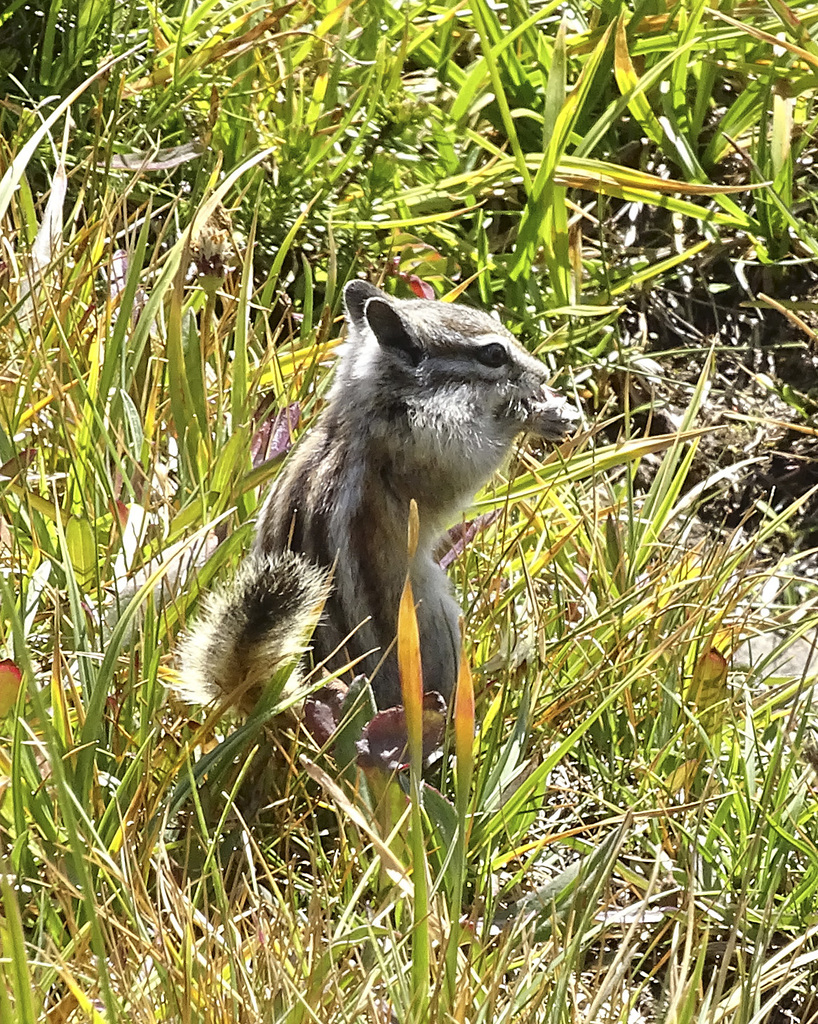
(c) Nancy Overholtz, some rights reserved (CC BY-SA) · licence
Family: Sciuridae · Class: Mammalia · Order: Rodentia
Conservation status: G4 S3
Neotamias alpinus (Alpine Chipmunk) is a California animal in the Sciuridae family.
The Alpine chipmunk is a small rodent endemic to the high-elevation regions of the Sierra Nevada mountains in California and Nevada. Adults measure 85 to 105 mm (3.3 to 4.1 inches) in head and body length, with tails ranging from 75 to 95 mm (3.0 to 3.7 inches). Body weight typically ranges from 28 to 45 grams (1.0 to 1.6 ounces). The dorsal surface is grayish-brown with five distinct dark stripes alternating with four lighter stripes extending from the head to the base of the tail. The central dark stripe is the most prominent, while the outer stripes are often less defined. The underside is pale gray to white, and the tail is bushy with alternating dark and light bands. Alpine chipmunks occur exclusively in the Sierra Nevada range, from Tulare County north to Placer County in California, with populations extending into western Nevada. The species inhabits elevations from approximately 2,290 to 3,960 meters (7,500 to 13,000 feet), making it one of the highest-dwelling chipmunk species in North America. Historical records indicate the species was more widely distributed at lower elevations before the 20th century. This species occupies alpine and subalpine habitats characterized by rocky outcrops, talus slopes, and areas with scattered whitebark pine, limber pine, and mountain hemlock. Alpine chipmunks show strong preference for granite formations and boulder fields that provide abundant crevices for shelter and food storage. The species is typically found in areas with sparse vegetation cover, including alpine meadows adjacent to rocky terrain and krummholz formations near treeline. Alpine chipmunks are diurnal and remain active during the brief alpine growing season from late May through September. The species enters torpor during winter months, relying on cached food stores. Diet consists primarily of seeds from conifers, particularly whitebark pine and limber pine, supplemented by green vegetation, fungi, and occasionally insects. Breeding occurs from May to July following emergence from winter dormancy. Females produce a single litter annually of 2 to 5 young after a gestation period of approximately 30 days. Young reach sexual maturity at one year of age. The Alpine chipmunk is ranked G4 S3, indicating the species is apparently secure globally but vulnerable within California. Population trends are difficult to assess due to the species' remote habitat and naturally low densities. Climate change poses the primary long-term threat, as warming temperatures may force populations to higher elevations with increasingly limited suitable habitat. Whitebark pine decline due to white pine blister rust and mountain pine beetle outbreaks affects food availability. The species' restricted elevation range and specialized habitat requirements make it particularly vulnerable to environmental changes. Current populations appear stable, but long-term monitoring is needed to assess climate change impacts on this high-elevation specialist.
Classification
Class: Mammalia · Order: Rodentia · Family: Sciuridae
Conservation status
G4 S3
Frequently asked questions
How is Neotamias alpinus classified?
Neotamias alpinus belongs to class Mammalia, order Rodentia, family Sciuridae.
What family does Neotamias alpinus belong to?
Neotamias alpinus is in the Sciuridae family.
Is Neotamias alpinus protected or of conservation concern?
Neotamias alpinus carries the following status: G4 S3.
What is Neotamias alpinus?
The Alpine chipmunk is a small rodent endemic to the high-elevation regions of the Sierra Nevada mountains in California and Nevada.
Is Neotamias alpinus found in California?
Yes. Neotamias alpinus is recorded in California in The California Species Project's catalogue.
Related species
Other California species in the same genus, family, or bioregion.
Data from The California Species Project — 14,000+ California species with verified data from CNPS, CDFW, USFWS, and more.