Neotamias merriami
Merriam's Chipmunk
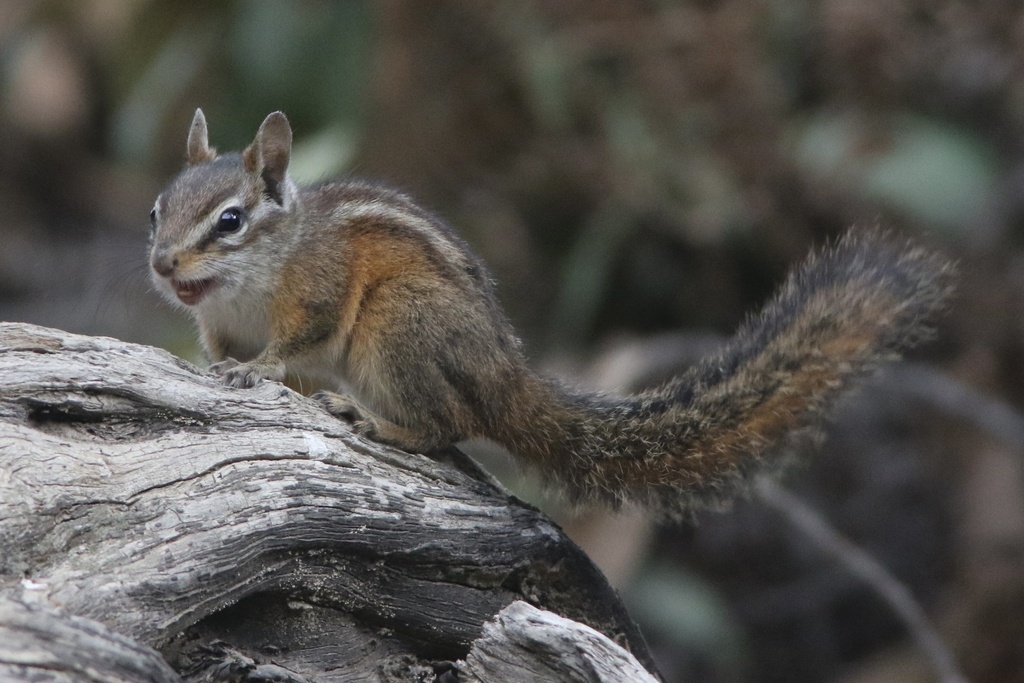
(c) Cricket Raspet, some rights reserved (CC BY) · licence
Family: Sciuridae · Class: Mammalia · Order: Rodentia
Neotamias merriami (Merriam's Chipmunk) is a California animal in the Sciuridae family.
Merriam's chipmunk is a medium-sized member of the squirrel family endemic to southern California and Baja California, Mexico. Adults measure 215 to 245 millimeters (8.5 to 9.6 inches) in total length, with the tail comprising approximately half of this measurement. Body weight ranges from 50 to 85 grams (1.8 to 3.0 ounces). The dorsal pelage displays alternating dark and light stripes, with five distinct dark stripes separated by four pale stripes extending from the head to the rump. The central dark stripe is typically the most prominent, while lateral stripes may be less defined. The tail is bushy with dark and light banding. Distinctive white patches occur behind the ears, and the underparts are pale gray to white. Merriam's chipmunk occurs in the mountains of southern California, including the San Bernardino, San Jacinto, Santa Rosa, and Peninsular Ranges. The species extends southward into Baja California, Mexico. In California, populations are documented in Riverside, San Bernardino, and Imperial counties. The elevational range spans from approximately 1,200 to 2,400 meters (3,900 to 7,900 feet), though most populations occur between 1,500 and 2,100 meters (4,900 to 6,900 feet). This species inhabits chaparral, pinyon-juniper woodland, and mixed coniferous forest communities. Preferred habitat includes areas with dense shrub cover, rocky outcrops, and fallen logs that provide shelter and foraging opportunities. Merriam's chipmunk shows strong association with manzanita, ceanothus, and oak woodlands, often utilizing rock crevices and hollow logs for den sites. The species constructs burrow systems in well-drained soils beneath shrubs or rocky areas. Merriam's chipmunk is diurnal and primarily terrestrial, though individuals readily climb shrubs and small trees when foraging. The diet consists of seeds, nuts, berries, and green vegetation, with acorns and pine seeds forming important components when available. Food caching behavior is prominent, with individuals storing seeds and nuts in multiple cache sites throughout their territory. Breeding occurs from April through June, following emergence from winter dormancy. Females produce a single annual litter of three to five young after a gestation period of approximately 30 days. Young remain in the natal burrow for four to six weeks before dispersal. Merriam's chipmunk is not federally or state listed under endangered species legislation. However, habitat fragmentation from urban development and fire management practices may affect local populations. The species' restricted range in southern California mountains makes it potentially vulnerable to climate change impacts, including shifts in vegetation zones and altered precipitation patterns. Wildfire can temporarily reduce habitat quality but may benefit the species long-term by maintaining open shrubland communities. Current population trends are not well documented, though the species appears stable within its limited range.
Classification
Class: Mammalia · Order: Rodentia · Family: Sciuridae
Frequently asked questions
How is Neotamias merriami classified?
Neotamias merriami belongs to class Mammalia, order Rodentia, family Sciuridae.
What family does Neotamias merriami belong to?
Neotamias merriami is in the Sciuridae family.
What is Neotamias merriami?
Merriam's chipmunk is a medium-sized member of the squirrel family endemic to southern California and Baja California, Mexico.
Is Neotamias merriami found in California?
Yes. Neotamias merriami is recorded in California in The California Species Project's catalogue.
Related species
Other California species in the same genus, family, or bioregion.
Data from The California Species Project — 14,000+ California species with verified data from CNPS, CDFW, USFWS, and more.