Neotamias speciosus callipeplus
Mount Pinos Chipmunk
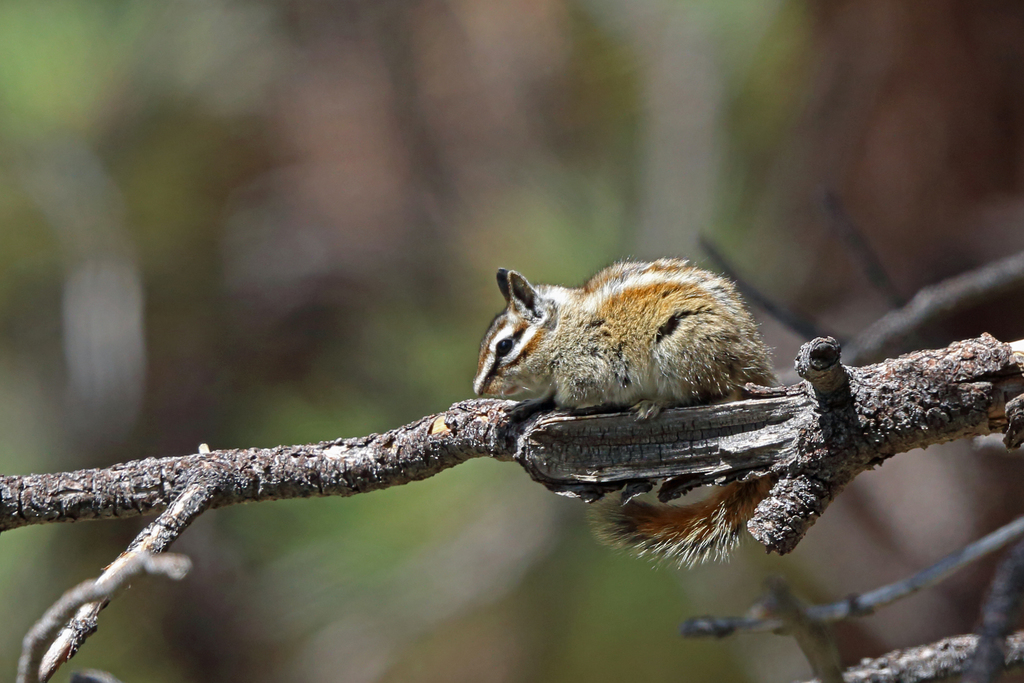
(c) Nigel Voaden, some rights reserved (CC BY) · licence
Family: Sciuridae · Class: Mammalia · Order: Rodentia
Conservation status: G4T2 S2
Neotamias speciosus callipeplus (Mount Pinos Chipmunk) is a California animal in the Sciuridae family.
The Mount Pinos chipmunk (Neotamias speciosus callipeplus) is a subspecies of the lodgepole chipmunk endemic to the Mount Pinos region of southern California. This small mammal exhibits the typical chipmunk morphology with alternating dark and light stripes along its back and sides. Adults typically measure 200-250 mm (7.9-9.8 inches) in total length, including a bushy tail that comprises approximately half the body length. The dorsal surface displays five dark brown to black stripes separated by four lighter grayish-brown to whitish stripes, while the ventral surface is typically pale gray to white. The Mount Pinos chipmunk has an extremely restricted range, occurring only in the Mount Pinos area and adjacent peaks of the Transverse Ranges in Ventura and Kern counties, California. According to NatureServe, habitat for this subspecies is extremely limited, which increases the vulnerability of the population to even small losses of suitable habitat. The subspecies is found primarily on Mount Pinos itself and surrounding high-elevation areas within this isolated mountain system. This subspecies inhabits rocky areas within chaparral and woodland communities, typically occurring below 3,000 feet in elevation according to California Department of Fish and Wildlife records. The habitat consists of mixed coniferous and oak woodlands with substantial rocky outcrops and boulder fields that provide essential denning and foraging sites. The rocky substrate is particularly important for cache storage and thermal regulation, while the associated vegetation provides food resources and cover from predators. Like other chipmunk species, the Mount Pinos chipmunk is primarily granivorous, feeding on seeds of grasses, forbs, and woody plants, as well as fruits, fungi, insects, and occasionally carrion (NatureServe). The species forages both in shrubs and on the ground, storing food in small pits and caches for winter survival. Breeding typically occurs in early spring following emergence from winter torpor, with females producing a single litter of 2-6 young per year. The species exhibits semi-fossorial behavior, using rock crevices and burrows for shelter and food storage. The Mount Pinos chipmunk is assigned a Global/State Rank of G4T2 S2, indicating that the subspecies is imperiled both globally and within California. The extremely limited habitat range makes this subspecies particularly vulnerable to habitat loss, fragmentation, and climate change impacts. The isolated nature of the Mount Pinos region means that recolonization from other populations would be unlikely if local extirpation occurred. Primary threats include habitat modification from recreational activities, fire management practices, and potential climate-induced shifts in vegetation communities. The restricted range and small population size make this subspecies one of California's most geographically constrained mammalian taxa, requiring careful monitoring and habitat protection to ensure long-term persistence.
Classification
Class: Mammalia · Order: Rodentia · Family: Sciuridae
Conservation status
G4T2 S2
Frequently asked questions
How is Neotamias speciosus callipeplus classified?
Neotamias speciosus callipeplus belongs to class Mammalia, order Rodentia, family Sciuridae.
What family does Neotamias speciosus callipeplus belong to?
Neotamias speciosus callipeplus is in the Sciuridae family.
Is Neotamias speciosus callipeplus protected or of conservation concern?
Neotamias speciosus callipeplus carries the following status: G4T2 S2.
What is Neotamias speciosus callipeplus?
The Mount Pinos chipmunk (Neotamias speciosus callipeplus) is a subspecies of the lodgepole chipmunk endemic to the Mount Pinos region of southern California.
Is Neotamias speciosus callipeplus found in California?
Yes. Neotamias speciosus callipeplus is recorded in California in The California Species Project's catalogue.
Related species
Other California species in the same genus, family, or bioregion.
Data from The California Species Project — 14,000+ California species with verified data from CNPS, CDFW, USFWS, and more.