Neotamias speciosus speciosus
Lodgepole Chipmunk
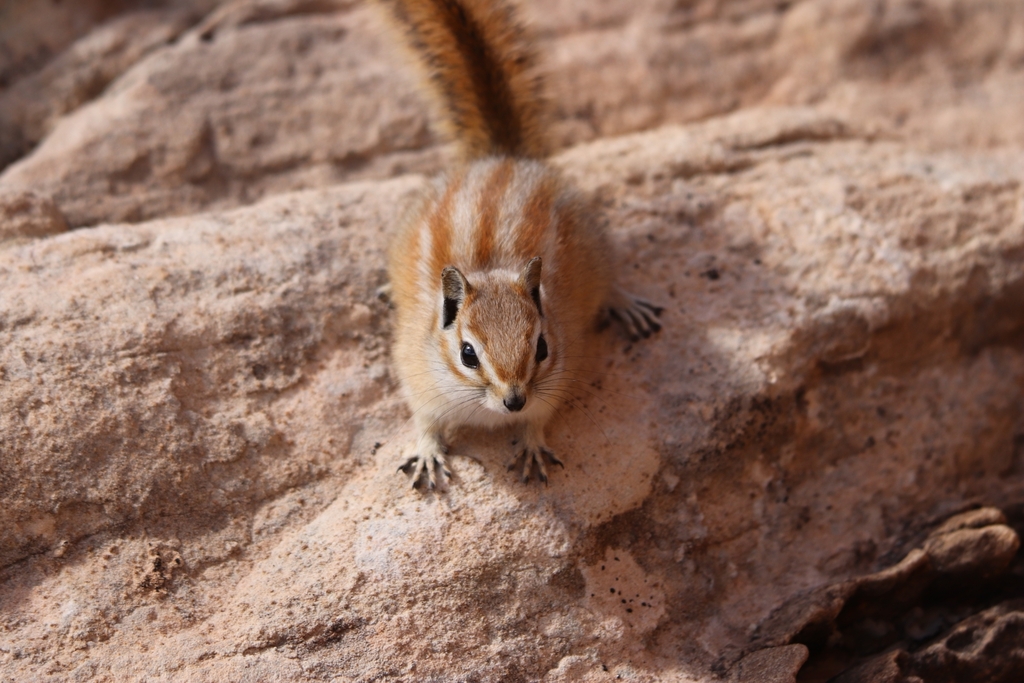
(c) Roland Godon, some rights reserved (CC BY) · licence
Family: Sciuridae · Class: Mammalia · Order: Rodentia
Conservation status: G4T3T4 S2
Neotamias speciosus speciosus (Lodgepole Chipmunk) is a California animal in the Sciuridae family.
The lodgepole chipmunk is a small rodent species endemic to the high-elevation forests of California's southern mountains. Adults typically measure 190-230 mm (7.5-9.1 inches) in total length, including a bushy tail of 80-110 mm (3.1-4.3 inches). Body weight ranges from 40-70 grams (1.4-2.5 ounces). The species exhibits the characteristic chipmunk coloration pattern with five dark longitudinal stripes alternating with four light stripes along the back and sides. The dorsal surface is grayish-brown, while the ventral surface is whitish to pale gray. The tail is dark above and rusty-orange below with black-tipped hairs. This subspecies has a very limited distribution within California's southern mountain ranges. According to NatureServe, it occurs primarily in the San Bernardino Mountains, San Gabriel Mountains, and San Jacinto Mountains at elevations typically ranging from 2,000 to 3,500 meters (6,600-11,500 feet). The range represents a significant geographic restriction compared to other chipmunk species in California. Lodgepole chipmunks inhabit open-canopy coniferous forests, particularly those dominated by Jeffrey pine, lodgepole pine, and limber pine communities (NatureServe Explorer). They also occur in mixed conifer forests at high elevations. The species shows a strong association with areas containing fallen logs, rock outcrops, and dense understory vegetation that provide cover and foraging opportunities. These chipmunks prefer areas with moderate to steep slopes where drainage is good and snow accumulation is not excessive. These chipmunks are primarily granivorous, feeding on conifer seeds, particularly those of pines and firs. They also consume nuts, berries, green vegetation, and occasionally insects during the breeding season. Lodgepole chipmunks are excellent climbers and spend considerable time foraging both on the ground and in trees. They cache seeds and nuts in underground burrows and tree cavities for winter survival. The species typically hibernates from November through March, though this varies with elevation and local weather conditions. Breeding occurs from April to July, with females producing one litter per year of 3-5 young after a gestation period of approximately 30 days. The lodgepole chipmunk subspecies has a NatureServe global rank of G4T3T4, indicating the subspecies is vulnerable to moderately vulnerable, with a California state rank of S2, meaning it is imperiled in California due to rarity. While not federally or state listed, the subspecies faces significant conservation challenges from habitat loss and fragmentation. Climate change poses a particular threat as warming temperatures push suitable habitat to increasingly higher elevations, potentially reducing available habitat area. Forest management practices, recreational development, and wildfire patterns also impact population viability. The California Department of Fish and Wildlife tracks this subspecies as a species of special concern, and monitoring efforts continue to assess population trends and habitat quality throughout its limited range.
Classification
Class: Mammalia · Order: Rodentia · Family: Sciuridae
Conservation status
G4T3T4 S2
Frequently asked questions
How is Neotamias speciosus speciosus classified?
Neotamias speciosus speciosus belongs to class Mammalia, order Rodentia, family Sciuridae.
What family does Neotamias speciosus speciosus belong to?
Neotamias speciosus speciosus is in the Sciuridae family.
Is Neotamias speciosus speciosus protected or of conservation concern?
Neotamias speciosus speciosus carries the following status: G4T3T4 S2.
What is Neotamias speciosus speciosus?
The lodgepole chipmunk is a small rodent species endemic to the high-elevation forests of California's southern mountains.
Is Neotamias speciosus speciosus found in California?
Yes. Neotamias speciosus speciosus is recorded in California in The California Species Project's catalogue.
Related species
Other California species in the same genus, family, or bioregion.
Data from The California Species Project — 14,000+ California species with verified data from CNPS, CDFW, USFWS, and more.