Neotoma cinerea
Bushy-tailed Woodrat
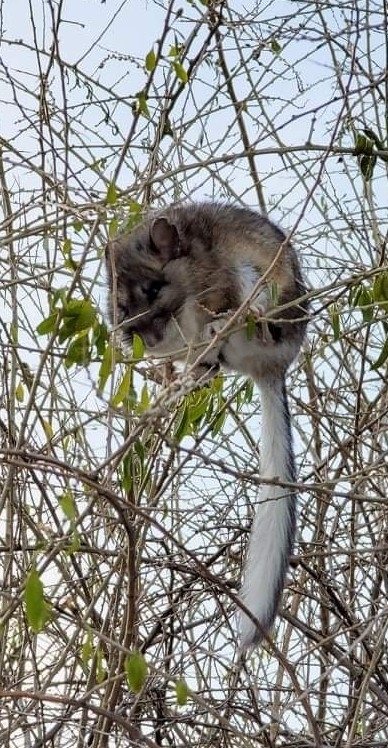
no rights reserved · CC0
Family: Cricetidae · Class: Mammalia · Order: Rodentia
Neotoma cinerea (Bushy-tailed Woodrat) is a California animal in the Cricetidae family.
The bushy-tailed woodrat is a medium-sized rodent distinguished by its notably large, squirrel-like tail covered in long, dense fur. Adults measure 280-470 mm (11-18.5 inches) in total length, with the tail comprising approximately half of this length. Body weight ranges from 200-600 grams (7-21 ounces), with males typically larger than females. The dorsal pelage is grayish-brown to brownish-gray, while the ventral surface is white or pale gray. The large, dark eyes and prominent ears are adaptations for nocturnal activity. The distinctive bushy tail is flattened dorsoventrally and serves as a rudder during climbing and jumping. In California, bushy-tailed woodrats occur primarily in the Sierra Nevada, Cascade Range, and northeastern mountains, including portions of the Warner Mountains and Modoc Plateau. The species' range extends from approximately 1,200-3,400 meters (4,000-11,200 feet) elevation, though it reaches highest densities at mid-elevations between 1,500-2,500 meters. Populations are documented in Alpine, Amador, Calaveras, El Dorado, Fresno, Inyo, Kern, Lassen, Madera, Mariposa, Modoc, Mono, Nevada, Placer, Plumas, Shasta, Sierra, Siskiyou, Tulare, and Tuolumne counties. This species inhabits rocky areas including talus slopes, cliff faces, boulder fields, and rock outcrops within coniferous forests. Preferred habitats feature a combination of rocky shelter sites and adjacent forested areas that provide food resources. Common vegetation associations include mixed conifer forests, lodgepole pine, whitebark pine, and subalpine fir communities. The species requires rock crevices or caves for den sites and rarely occurs in areas lacking substantial rock formations. Bushy-tailed woodrats are primarily nocturnal and exhibit strong territorial behavior. They are excellent climbers, using their bushy tails for balance while navigating rock faces and tree branches. Diet consists of green vegetation, twigs, bark, berries, and fungi, varying seasonally with plant availability. These woodrats are known for their habit of collecting and caching various objects in their dens, creating large stick nests called middens that may persist for centuries. Breeding occurs from April through August, with females producing 1-4 young after a gestation period of 27-32 days. Most females produce one litter annually, though two litters may occur in favorable years. The bushy-tailed woodrat is not federally or state-listed and maintains stable populations throughout most of its California range. However, some lower-elevation populations face potential pressure from habitat modification and climate change effects on montane ecosystems. The species serves as an important prey item for various predators including owls, hawks, weasels, and martens, and their extensive middens provide valuable paleontological records for researchers studying past climate conditions.
Classification
Class: Mammalia · Order: Rodentia · Family: Cricetidae
Frequently asked questions
How is Neotoma cinerea classified?
Neotoma cinerea belongs to class Mammalia, order Rodentia, family Cricetidae.
What family does Neotoma cinerea belong to?
Neotoma cinerea is in the Cricetidae family.
What is Neotoma cinerea?
The bushy-tailed woodrat is a medium-sized rodent distinguished by its notably large, squirrel-like tail covered in long, dense fur.
Is Neotoma cinerea found in California?
Yes. Neotoma cinerea is recorded in California in The California Species Project's catalogue.
Related species
Other California species in the same genus, family, or bioregion.
Data from The California Species Project — 14,000+ California species with verified data from CNPS, CDFW, USFWS, and more.