Neotoma fuscipes
Dusky-footed Woodrat
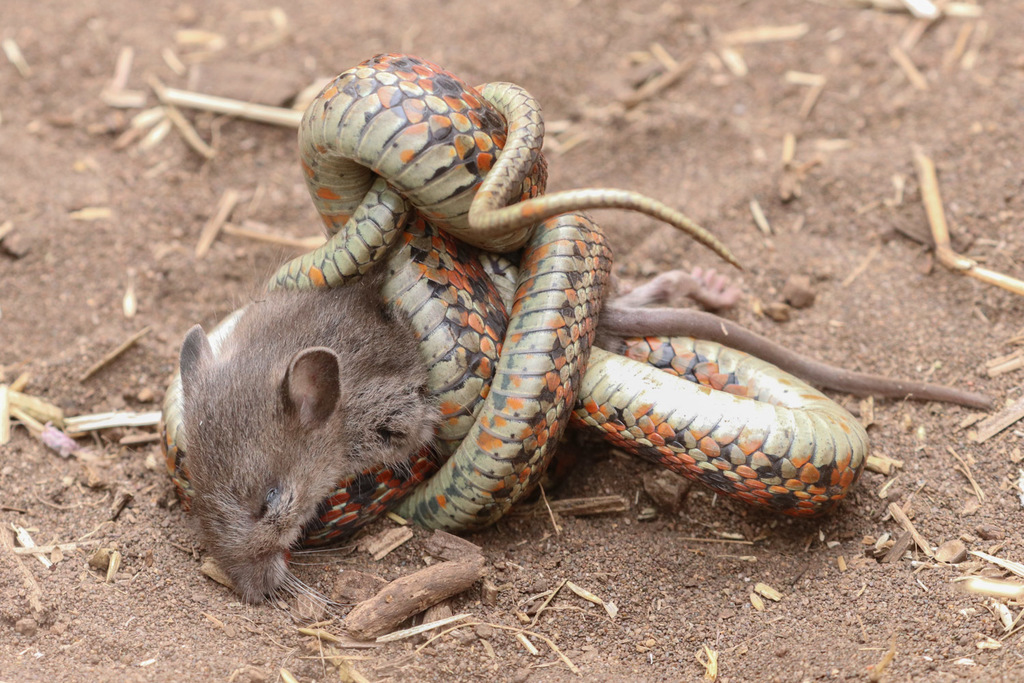
(c) avocat, some rights reserved (CC BY) · licence
Family: Cricetidae · Class: Mammalia · Order: Rodentia
Neotoma fuscipes (Dusky-footed Woodrat) is a California animal in the Cricetidae family.
The dusky-footed woodrat is a medium-sized rodent endemic to the Pacific Coast region, measuring 130 to 240 mm (5.1 to 9.4 inches) in head-body length with a tail ranging from 140 to 240 mm (5.5 to 9.4 inches). Adults typically weigh between 160 to 340 grams (5.6 to 12.0 ounces). The species exhibits grayish-brown to dark brown dorsal coloration with whitish to pale gray underparts. The tail is distinctly bicolored, dark above and lighter below, and is well-furred throughout its length. The hind feet are notably dusky in coloration, giving the species its common name, and measure 30 to 38 mm (1.2 to 1.5 inches) in length. Dusky-footed woodrats occur along the Pacific Coast from the Columbia River in Oregon south through California to northern Baja California, Mexico. In California, the species is distributed throughout most of the state except for the Central Valley floor, high Sierra Nevada, and southeastern deserts. Populations are found in the Coast Ranges, Sierra Nevada foothills, and southern California mountains, with elevational ranges extending from sea level to approximately 1,200 meters (3,900 feet). The species inhabits diverse forest and woodland communities, showing particular association with areas containing dense understory vegetation. Primary habitats include mixed evergreen forests, oak woodlands, chaparral, and riparian forests. Dusky-footed woodrats demonstrate strong preferences for areas with substantial woody debris, fallen logs, and dense shrub cover. In northern portions of their range, they frequently occupy old-growth and second-growth Douglas fir forests, while southern populations utilize oak-dominated systems and chaparral communities. Dusky-footed woodrats are primarily nocturnal and arboreal, though they also forage extensively on the ground. The species constructs elaborate stick houses or dens in trees, shrubs, or on the ground, often measuring 1 to 2 meters (3.3 to 6.6 feet) in height and width. These structures serve as shelter, food storage sites, and nurseries. Diet consists primarily of green vegetation, including leaves, stems, bark, and fruits of various woody plants. Breeding occurs from February through September, with females typically producing one to three litters annually. Gestation lasts approximately 35 to 38 days, and litter sizes range from one to five young, averaging two to three offspring. Currently, dusky-footed woodrats are not listed under federal or state endangered species acts. However, some local populations face pressure from habitat loss due to urban development, particularly in coastal and foothill regions of California. Forest management practices that reduce understory complexity and eliminate woody debris can negatively impact local populations. Climate change may affect the species through alterations to forest composition and increased wildfire frequency. The species serves as an important prey item for numerous predators, including owls, weasels, and snakes, making it a significant component of Pacific Coast forest ecosystems.
Classification
Class: Mammalia · Order: Rodentia · Family: Cricetidae
Frequently asked questions
How is Neotoma fuscipes classified?
Neotoma fuscipes belongs to class Mammalia, order Rodentia, family Cricetidae.
What family does Neotoma fuscipes belong to?
Neotoma fuscipes is in the Cricetidae family.
What is Neotoma fuscipes?
The dusky-footed woodrat is a medium-sized rodent endemic to the Pacific Coast region, measuring 130 to 240 mm (5.1 to 9.4 inches) in head-body length with a tail ranging from 140 to 240 mm (5.5 to 9.4 inches).
Is Neotoma fuscipes found in California?
Yes. Neotoma fuscipes is recorded in California in The California Species Project's catalogue.
Related species
Other California species in the same genus, family, or bioregion.
Data from The California Species Project — 14,000+ California species with verified data from CNPS, CDFW, USFWS, and more.