Nerodia sipedon
Common Watersnake
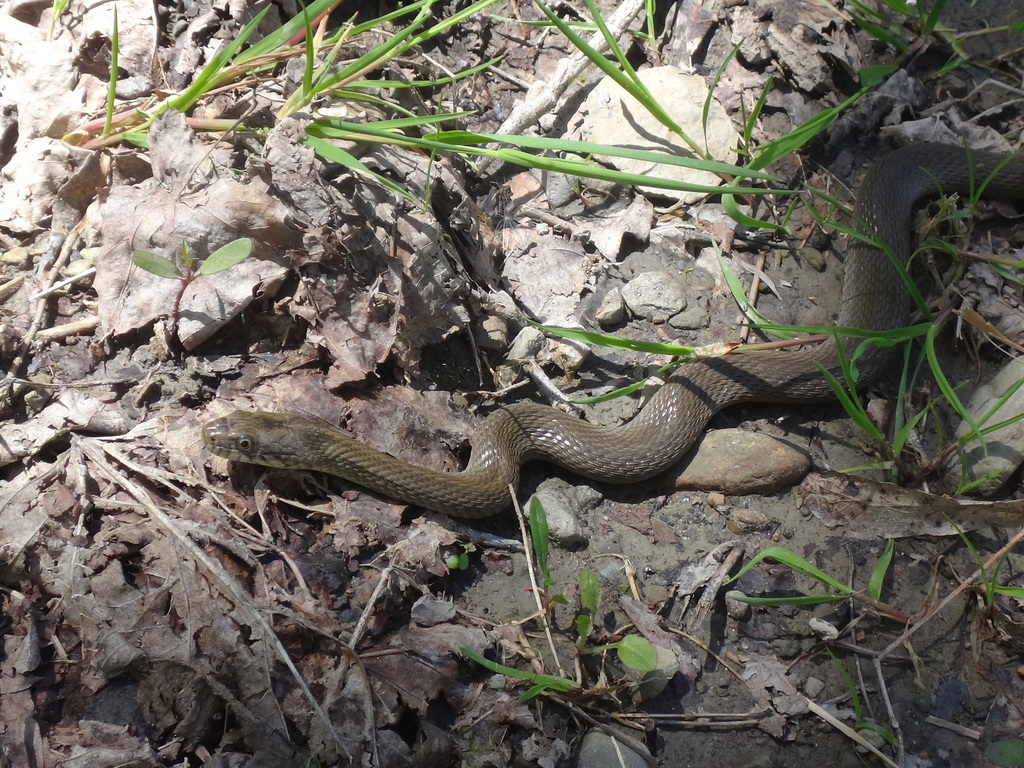
(c) Alie / C.A. Kratzer, some rights reserved (CC BY-SA) · licence
Family: Colubridae · Class: Reptilia · Order: Squamata
Nerodia sipedon (Common Watersnake) is a California animal in the Colubridae family.
The common watersnake is a medium-sized, semi-aquatic serpent native to eastern North America. Adults typically measure 61 to 107 centimeters (24 to 42 inches) in total length, with females generally larger than males. The species exhibits considerable variation in coloration and pattern, ranging from brown to gray or reddish-brown with dark crossbands or blotches along the back and sides. These markings often become less distinct with age, and older individuals may appear uniformly dark. The belly is cream to yellow with dark half-moon shaped markings. The head is distinct from the neck, and the pupils are round. Keeled scales give the snake a rough texture, and the anal plate is divided. Historically, Nerodia sipedon ranged throughout much of eastern North America from southern Canada to the Gulf Coast states. The species occurs from Maine west to Colorado and from southern Ontario south to Louisiana and Florida. However, the common watersnake is not native to California and does not occur naturally in the state. Any records from California would likely represent escaped or released captive animals, as this species requires different climatic and habitat conditions than those found in California's Mediterranean climate. Common watersnakes inhabit aquatic and semi-aquatic environments including lakes, ponds, marshes, swamps, streams, and rivers. They prefer areas with abundant vegetation and basking sites such as logs, rocks, or overhanging branches. The species is closely associated with permanent or semi-permanent water bodies and is rarely found far from water sources. They utilize both lentic and lotic systems but show preference for slow-moving or still waters with muddy or rocky bottoms. This species is primarily diurnal during cooler months and becomes increasingly nocturnal during hot summer periods. Common watersnakes are excellent swimmers and divers, capable of remaining submerged for extended periods while hunting. Their diet consists primarily of fish, amphibians, and aquatic invertebrates, including crayfish. Prey is captured underwater and swallowed whole. Mating occurs in spring after emergence from winter dormancy. Females are ovoviviparous, giving birth to 10 to 30 live young in late summer or early fall after a gestation period of approximately four to five months. Neonates measure 19 to 23 centimeters at birth and are immediately independent. The common watersnake has no federal or state conservation status in California, as it is not part of the state's native fauna. Throughout its native range, the species is generally considered secure with stable populations. However, local populations may face threats from habitat destruction, water pollution, and human persecution due to frequent misidentification as venomous water moccasins. Climate change and altered hydrology patterns may affect some populations. The species plays an important ecological role as both predator and prey in aquatic ecosystems where it naturally occurs.
Classification
Class: Reptilia · Order: Squamata · Family: Colubridae
Frequently asked questions
How is Nerodia sipedon classified?
Nerodia sipedon belongs to class Reptilia, order Squamata, family Colubridae.
What family does Nerodia sipedon belong to?
Nerodia sipedon is in the Colubridae family.
What is Nerodia sipedon?
The common watersnake is a medium-sized, semi-aquatic serpent native to eastern North America.
Is Nerodia sipedon found in California?
Yes. Nerodia sipedon is recorded in California in The California Species Project's catalogue.
Related species
Other California species in the same genus, family, or bioregion.
Data from The California Species Project — 14,000+ California species with verified data from CNPS, CDFW, USFWS, and more.