Neverita lewisii
Lewis's Moon Snail
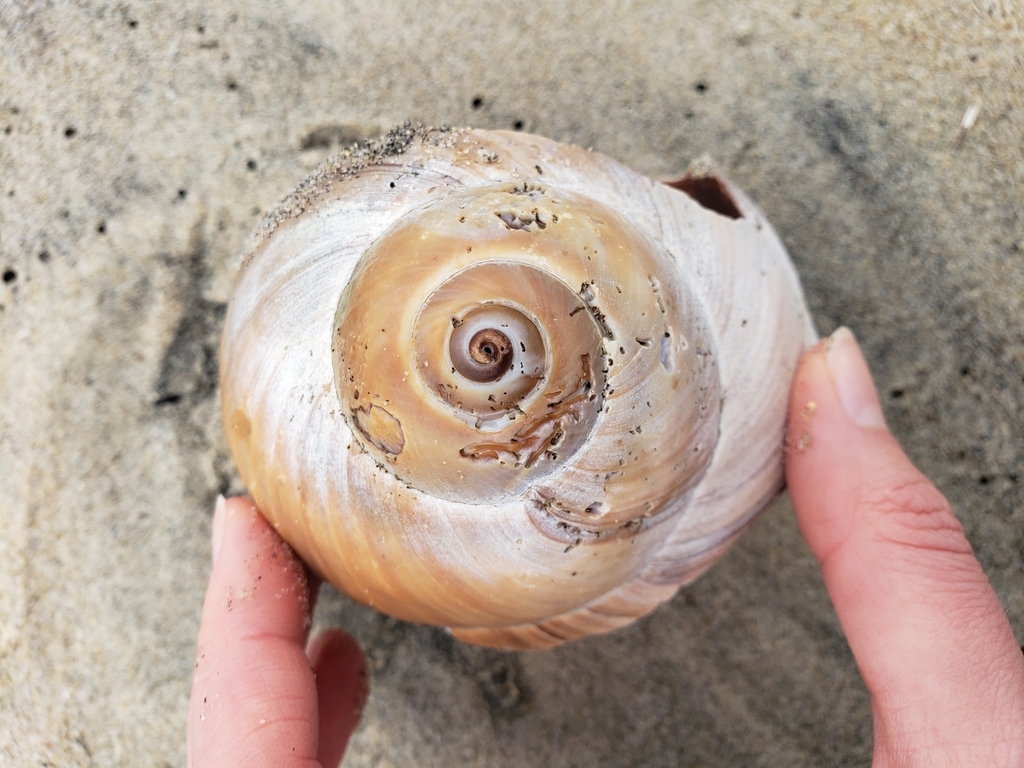
(c) kwalks146, some rights reserved (CC BY) · licence
Family: Naticidae · Class: Gastropoda · Order: Littorinimorpha
Neverita lewisii (Lewis's Moon Snail) is a California animal in the Naticidae family.
Lewis's moon snail is a large marine gastropod mollusk that can reach shell diameters of up to 140 mm (5.5 inches), making it one of the largest moon snails on the Pacific coast. The shell is globular and smooth, typically cream to light brown in coloration with a glossy surface. The animal itself is characterized by an enormous, extensible foot that can expand to several times the size of the shell, allowing it to completely envelop its shell when fully extended. The foot is typically pale yellow to cream-colored and has a gelatinous appearance. This species occurs along the Pacific coast from British Columbia south to Baja California, Mexico. In California, Lewis's moon snail is found from the intertidal zone to depths of approximately 50 meters (164 feet), with populations documented from Humboldt Bay south to San Diego Bay. The species is particularly common in protected bays and estuaries, including San Francisco Bay, Monterey Bay, and Morro Bay. Lewis's moon snail inhabits sandy and muddy substrates in marine and estuarine environments. It is most abundant in intertidal and shallow subtidal zones where it can burrow through soft sediments. The species shows a preference for areas with moderate wave action and is frequently found in eelgrass beds and other protected coastal habitats. It can tolerate a range of salinity conditions, making it well-adapted to estuarine environments where freshwater mixes with seawater. This predatory gastropod is a specialized mollusk hunter, feeding primarily on bivalves such as clams, mussels, and other gastropods. Lewis's moon snail employs a distinctive hunting technique, using its large foot to envelop prey and its radula (feeding organ) to drill precise circular holes through the shells of its victims. According to the California Department of Fish and Wildlife, this drilling behavior is particularly effective against Pismo clams and other commercially important bivalve species. The snail secretes enzymes that soften the shell, allowing the radula to penetrate more easily. Reproduction occurs through the deposition of characteristic sand collars - gelatinous egg masses mixed with sand particles that form distinctive collar-shaped structures on sandy beaches during spring and summer months. Lewis's moon snail is not federally or state-listed as threatened or endangered, and populations appear stable throughout most of its California range as of December 2025. However, the species faces localized pressures from coastal development, pollution, and habitat modification in urbanized areas. In some regions, the species is considered a pest due to its predation on commercially harvested shellfish, particularly in aquaculture operations. The species serves as an important component of marine food webs, both as a predator controlling bivalve populations and as prey for larger predators including crabs, fish, and seabirds. Its distinctive sand collar egg masses are also ecologically significant, providing food resources for various beach invertebrates and helping to stabilize sandy substrates in intertidal zones.
Classification
Class: Gastropoda · Order: Littorinimorpha · Family: Naticidae
Frequently asked questions
How is Neverita lewisii classified?
Neverita lewisii belongs to class Gastropoda, order Littorinimorpha, family Naticidae.
What family does Neverita lewisii belong to?
Neverita lewisii is in the Naticidae family.
What is Neverita lewisii?
Lewis's moon snail is a large marine gastropod mollusk that can reach shell diameters of up to 140 mm (5.5 inches), making it one of the largest moon snails on the Pacific coast.
Is Neverita lewisii found in California?
Yes. Neverita lewisii is recorded in California in The California Species Project's catalogue.
More California species
This species has no close relatives in our California data — here are other species to explore.
Data from The California Species Project — 14,000+ California species with verified data from CNPS, CDFW, USFWS, and more.