Notiosorex crawfordi
Desert Shrew
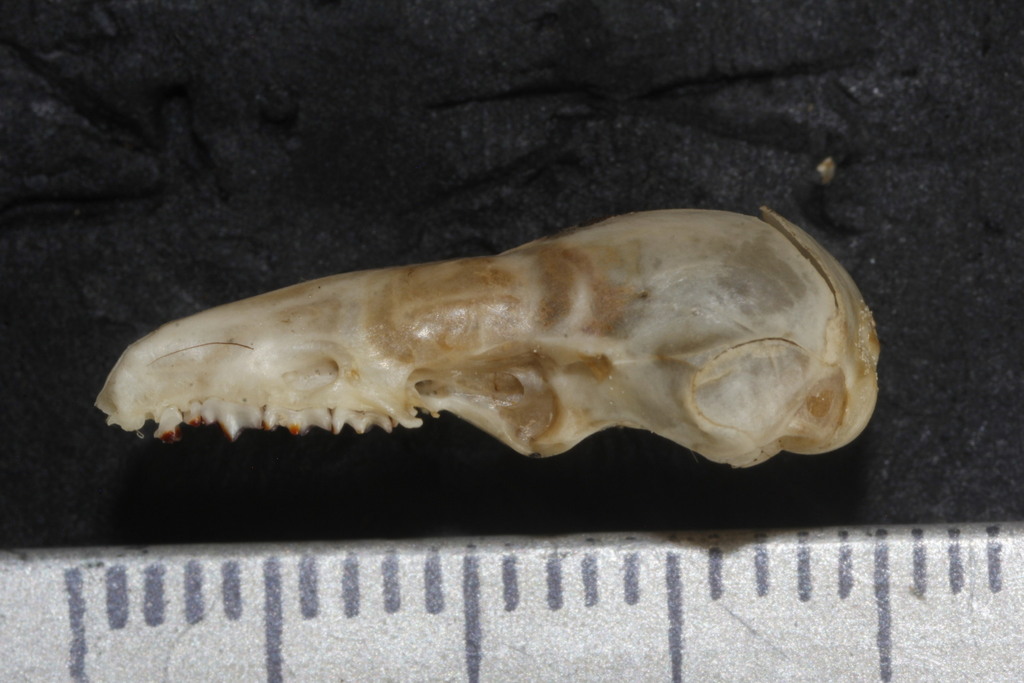
(c) Juan Cruzado Cortés, some rights reserved (CC BY-SA) · licence
Family: Soricidae · Class: Mammalia · Order: Eulipotyphla
Notiosorex crawfordi (Desert Shrew) is a California animal in the Soricidae family.
The desert shrew is one of North America's smallest mammals, measuring 80 to 105 mm (3.1 to 4.1 inches) in total length, with the tail comprising approximately half of this measurement. Adults weigh between 3 to 5 grams (0.1 to 0.2 ounces). The species displays grayish-brown to brownish-gray dorsal fur with slightly paler underparts. The ears are relatively large and prominent for a shrew, extending noticeably beyond the surrounding fur. The snout is long and pointed, adapted for probing into crevices and under debris. Unlike many shrew species, the desert shrew has a relatively long tail that is well-haired and distinctly bicolored, darker above and lighter below. The desert shrew occurs across the southwestern United States and northwestern Mexico, with its California range limited to the southeastern desert regions. In California, the species is documented from Imperial, Riverside, and San Bernardino counties, primarily in areas adjacent to the Colorado River and in the Mojave Desert's southern portions. The distribution extends eastward through Arizona, New Mexico, Nevada, and into western Texas, with isolated populations in Baja California, Mexico. This species inhabits arid and semi-arid environments, typically in desert shrubland communities dominated by creosote bush, palo verde, and various cacti species. Desert shrews show a strong association with riparian areas and desert washes where vegetation is denser and moisture levels are higher. They occur from near sea level to elevations of approximately 1,200 meters (3,940 feet). The species requires areas with adequate cover such as rock piles, fallen logs, dense shrub growth, or human-made structures that provide shelter from extreme temperatures and predators. Desert shrews are primarily insectivorous, consuming beetles, moths, caterpillars, crickets, and other small arthropods. Their high metabolic rate requires frequent feeding, with individuals consuming up to 80 percent of their body weight daily. The species is active year-round but shows reduced activity during extreme temperature periods. Breeding occurs primarily from March through October, with females producing 2 to 5 young per litter after a gestation period of approximately 28 days. Multiple litters per year are common when conditions are favorable. Desert shrews are generally solitary except during mating periods. The desert shrew is not federally listed under the Endangered Species Act and appears to maintain stable populations throughout most of its range as of December 2025. However, the species faces potential threats from habitat modification associated with urban development, agriculture, and water diversions that affect riparian corridors. Climate change may pose additional challenges through increased temperatures and altered precipitation patterns in desert ecosystems. The species' restricted California range and dependence on specific microhabitat conditions make local populations potentially vulnerable to habitat degradation, though comprehensive population monitoring data is limited.
Classification
Class: Mammalia · Order: Eulipotyphla · Family: Soricidae
Frequently asked questions
How is Notiosorex crawfordi classified?
Notiosorex crawfordi belongs to class Mammalia, order Eulipotyphla, family Soricidae.
What family does Notiosorex crawfordi belong to?
Notiosorex crawfordi is in the Soricidae family.
What is Notiosorex crawfordi?
The desert shrew is one of North America's smallest mammals, measuring 80 to 105 mm (3.1 to 4.1 inches) in total length, with the tail comprising approximately half of this measurement.
Is Notiosorex crawfordi found in California?
Yes. Notiosorex crawfordi is recorded in California in The California Species Project's catalogue.
Related species
Other California species in the same genus, family, or bioregion.
Data from The California Species Project — 14,000+ California species with verified data from CNPS, CDFW, USFWS, and more.