Nucifraga columbiana
Clark's Nutcracker
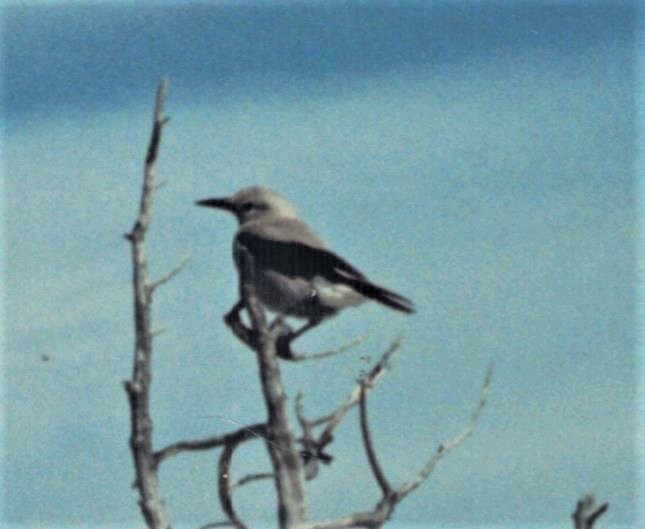
no rights reserved · CC0
Family: Corvidae · Class: Aves · Order: Passeriformes
Nucifraga columbiana (Clark's Nutcracker) is a California animal in the Corvidae family.
Clark's Nutcracker is a medium-sized corvid measuring 27-32 cm (10.6-12.6 inches) in length with a wingspan of 55-64 cm (21.7-25.2 inches). Adults weigh 106-151 grams (3.7-5.3 ounces). The species displays predominantly pale gray plumage with contrasting black wings and white outer tail feathers that are conspicuous in flight. The bill is long, straight, and sharply pointed, measuring 3-4 cm in length, adapted for extracting seeds from pine cones. Males and females appear similar, though males average slightly larger. Clark's Nutcracker ranges throughout western North America from southern Alaska to New Mexico. In California, the species occurs primarily in the Sierra Nevada, Cascade Range, and scattered high-elevation mountains including the White Mountains and San Bernardino Mountains. The distribution extends from Siskiyou and Modoc counties in the north to Kern and Inyo counties in the south. Populations are largely resident but exhibit altitudinal migrations and irruptive movements in response to cone crop failures. The species inhabits subalpine and montane coniferous forests, typically at elevations between 1,500-3,700 meters (4,900-12,100 feet). Primary habitat consists of whitebark pine, limber pine, and other five-needle pine ecosystems, though birds also utilize mountain hemlock, subalpine fir, and Engelmann spruce forests. During non-breeding periods, nutcrackers may descend to lower elevations and utilize ponderosa pine and Douglas fir forests. Clark's Nutcracker exhibits a highly specialized mutualistic relationship with large-seeded pines, particularly whitebark pine. The species possesses a sublingual pouch capable of holding 50-95 pine seeds, which are cached in thousands of locations across the landscape for winter survival and breeding. Individual birds can cache 22,000-33,000 seeds annually and retrieve up to 80% through spatial memory. Breeding occurs from February through July, with peak activity in April-May. Females construct stick nests in conifers and lay 2-4 eggs. Incubation lasts 16-18 days, with nestlings fledging after 18-28 days. Both parents provision young with cached seeds. Clark's Nutcracker is not federally or state listed and maintains stable populations across most of its range as of December 2025. However, the species faces conservation challenges related to climate change impacts on high-elevation pine ecosystems. Whitebark pine, a keystone species for nutcracker populations, has experienced significant mortality from white pine blister rust, mountain pine beetle outbreaks, and altered fire regimes. Climate change models predict upward shifts in suitable habitat that may fragment populations and reduce available nesting areas. Conservation efforts focus on whitebark pine restoration, including rust-resistant tree planting and prescribed burning to maintain ecosystem health.
Classification
Class: Aves · Order: Passeriformes · Family: Corvidae
Frequently asked questions
How is Nucifraga columbiana classified?
Nucifraga columbiana belongs to class Aves, order Passeriformes, family Corvidae.
What family does Nucifraga columbiana belong to?
Nucifraga columbiana is in the Corvidae family.
What is Nucifraga columbiana?
Clark's Nutcracker is a medium-sized corvid measuring 27-32 cm (10.6-12.6 inches) in length with a wingspan of 55-64 cm (21.7-25.2 inches).
Is Nucifraga columbiana found in California?
Yes. Nucifraga columbiana is recorded in California in The California Species Project's catalogue.
Related species
Other California species in the same genus, family, or bioregion.
Data from The California Species Project — 14,000+ California species with verified data from CNPS, CDFW, USFWS, and more.