Numenius minutus
Little Curlew
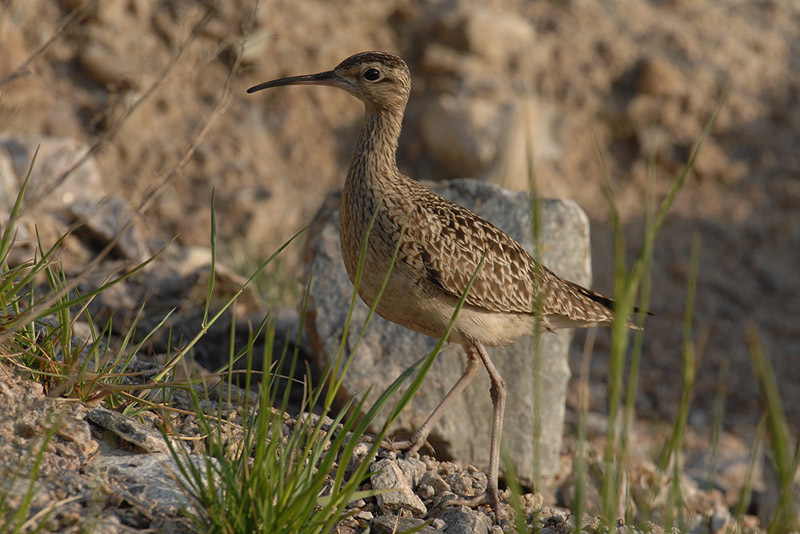
(c) Kim, Hyun-tae, some rights reserved (CC BY) · licence
Family: Scolopacidae · Class: Aves · Order: Charadriiformes
Numenius minutus (Little Curlew) is a California animal in the Scolopacidae family.
The Little Curlew is a small shorebird and the smallest member of the curlew family globally. Adults measure 28 to 32 cm (11 to 12.6 inches) in length with a wingspan of 53 to 57 cm (20.9 to 22.4 inches), weighing between 110 to 180 grams (3.9 to 6.3 ounces). The species displays brownish upperparts with dark streaking and pale underparts with fine streaking on the breast and flanks. The bill is relatively short for a curlew, measuring 3.5 to 5.5 cm (1.4 to 2.2 inches), with a slight downward curve. The legs are pale greenish-gray to yellow. In flight, Little Curlews show no white rump patch, distinguishing them from larger curlew species. The Little Curlew breeds across northern Russia and Mongolia in the taiga and forest-tundra zones. The species migrates through eastern Asia to wintering grounds primarily in northern Australia. In North America, Little Curlew is an extremely rare vagrant, with fewer than 20 documented records. California has recorded only a handful of observations, all along the coast during fall migration periods, typically between August and October. These records occur primarily at coastal mudflats, estuaries, and sandy beaches from Humboldt County south to San Diego County. During the breeding season, Little Curlews inhabit boggy areas within taiga forests, forest clearings with scattered trees, and wet meadows with low vegetation. On wintering grounds in Australia, they frequent short grasslands, agricultural fields, mudflats, and coastal areas. California vagrant records have occurred in diverse coastal habitats including tidal mudflats, sandy beaches, salt ponds, and occasionally inland at sewage treatment facilities and agricultural areas. Little Curlews are ground-foraging birds that probe soft substrates with their bills to extract invertebrates. Their diet consists primarily of insects, larvae, worms, small crustaceans, and occasionally small mollusks. During the breeding season, they consume beetles, flies, and other terrestrial arthropods. The species nests on the ground in a shallow scrape lined with vegetation, typically laying four eggs between May and June. Incubation lasts approximately 21 days, and chicks fledge after 25 to 30 days. Little Curlews are generally solitary or occur in small flocks during migration and winter. Globally, the Little Curlew is classified as Least Concern by the International Union for Conservation of Nature, with stable population trends across most of its range. However, the species faces localized threats from habitat loss due to agricultural expansion and wetland drainage in breeding areas. Climate change may affect breeding habitat availability in the Arctic and subarctic regions. In California, the species has no conservation status due to its vagrant nature, but coastal habitat preservation remains important for supporting rare migrant shorebirds. The species is protected under the Migratory Bird Treaty Act.
Classification
Class: Aves · Order: Charadriiformes · Family: Scolopacidae
Frequently asked questions
How is Numenius minutus classified?
Numenius minutus belongs to class Aves, order Charadriiformes, family Scolopacidae.
What family does Numenius minutus belong to?
Numenius minutus is in the Scolopacidae family.
What is Numenius minutus?
The Little Curlew is a small shorebird and the smallest member of the curlew family globally.
Is Numenius minutus found in California?
Yes. Numenius minutus is recorded in California in The California Species Project's catalogue.
Related species
Other California species in the same genus, family, or bioregion.
Data from The California Species Project — 14,000+ California species with verified data from CNPS, CDFW, USFWS, and more.