Numenius phaeopus
Whimbrel
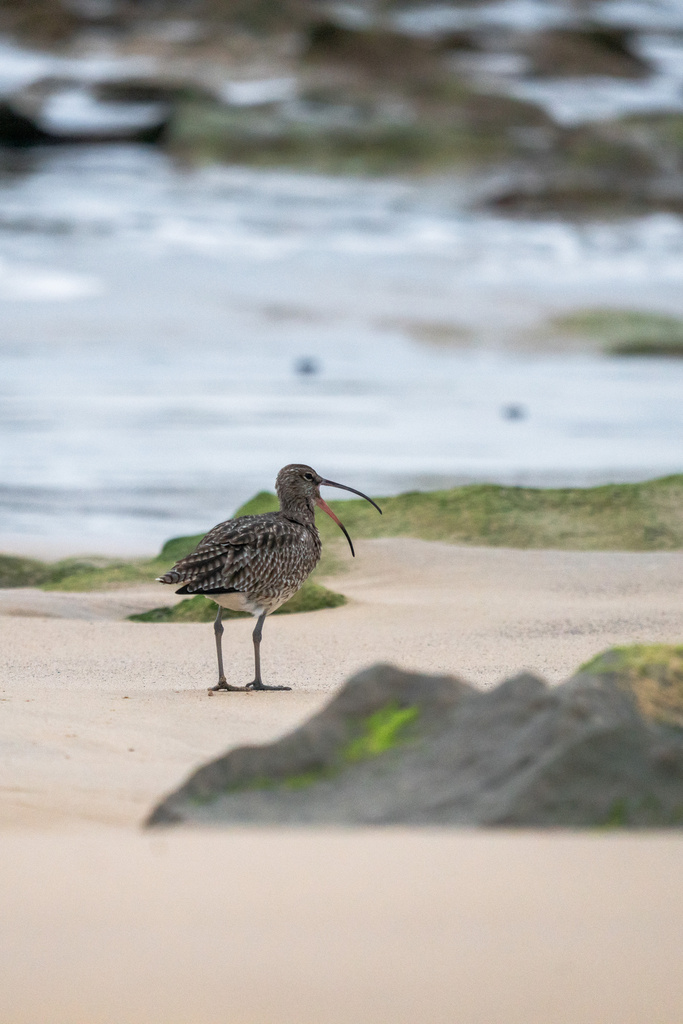
(c) Joeb, some rights reserved (CC BY) · licence
Family: Scolopacidae · Class: Aves · Order: Charadriiformes
Numenius phaeopus (Whimbrel) is a California animal in the Scolopacidae family.
The Whimbrel is a large shorebird measuring 37-47 cm (14.5-18.5 inches) in length with a wingspan of 76-89 cm (30-35 inches). Adults weigh 270-493 grams (9.5-17.4 ounces). The species displays mottled brown and buff plumage on the upperparts with darker brown streaking. The underparts are pale buff to white with brown streaking on the breast and flanks. The most distinctive feature is the long, decurved bill measuring 8-9 cm (3.1-3.5 inches), adapted for probing soft substrates. A prominent pale stripe runs through the center of the dark brown crown, with dark lateral crown stripes creating a distinctive head pattern. The legs are bluish-gray to dark gray. Whimbrels breed across the Arctic tundra of Alaska, northern Canada, and northern Eurasia. In North America, the breeding range extends from western Alaska through northern Canada to Hudson Bay. During migration and winter, Whimbrels occur along both Pacific and Atlantic coasts. In California, they are present year-round along the coast, with peak numbers during spring migration in April-May and fall migration in July-September. The species occurs from Humboldt County south to San Diego County, with concentrations in San Francisco Bay, Monterey Bay, Morro Bay, and the Salton Sea. Whimbrels inhabit coastal mudflats, sandy beaches, rocky shores, salt marshes, and estuaries during migration and winter. They also utilize agricultural fields, particularly flooded areas, and coastal grasslands. On breeding grounds, they occupy Arctic tundra with low vegetation, often near water bodies. During migration, they frequent large mudflats and shallow coastal waters where invertebrate prey is abundant. Whimbrels are opportunistic feeders, using their long bills to probe for marine worms, mollusks, crustaceans, and other invertebrates in soft substrates. They also surface-feed on small fish and aquatic insects. The diet varies seasonally and geographically, including berries during breeding season and crab larvae in coastal environments. Whimbrels are highly gregarious during migration, forming flocks of hundreds to thousands of individuals. They exhibit strong site fidelity to stopover locations during migration. Breeding occurs from May through July, with females laying 3-5 olive-brown eggs with darker markings in a ground scrape lined with vegetation. Whimbrels are not federally listed but face significant conservation challenges. The North American population is estimated at 240,000-290,000 individuals, with the Pacific Coast population showing decline. Primary threats include habitat loss at stopover sites due to coastal development, sea level rise affecting feeding areas, disturbance at roosting sites, and potential impacts from climate change altering Arctic breeding habitat timing. The species relies heavily on a network of critical stopover sites during long-distance migration, making habitat protection at these locations essential for population stability.
Classification
Class: Aves · Order: Charadriiformes · Family: Scolopacidae
Frequently asked questions
How is Numenius phaeopus classified?
Numenius phaeopus belongs to class Aves, order Charadriiformes, family Scolopacidae.
What family does Numenius phaeopus belong to?
Numenius phaeopus is in the Scolopacidae family.
What is Numenius phaeopus?
The Whimbrel is a large shorebird measuring 37-47 cm (14.5-18.5 inches) in length with a wingspan of 76-89 cm (30-35 inches).
Is Numenius phaeopus found in California?
Yes. Numenius phaeopus is recorded in California in The California Species Project's catalogue.
Related species
Other California species in the same genus, family, or bioregion.
Data from The California Species Project — 14,000+ California species with verified data from CNPS, CDFW, USFWS, and more.