Nyctanassa violacea
Yellow-crowned Night-Heron
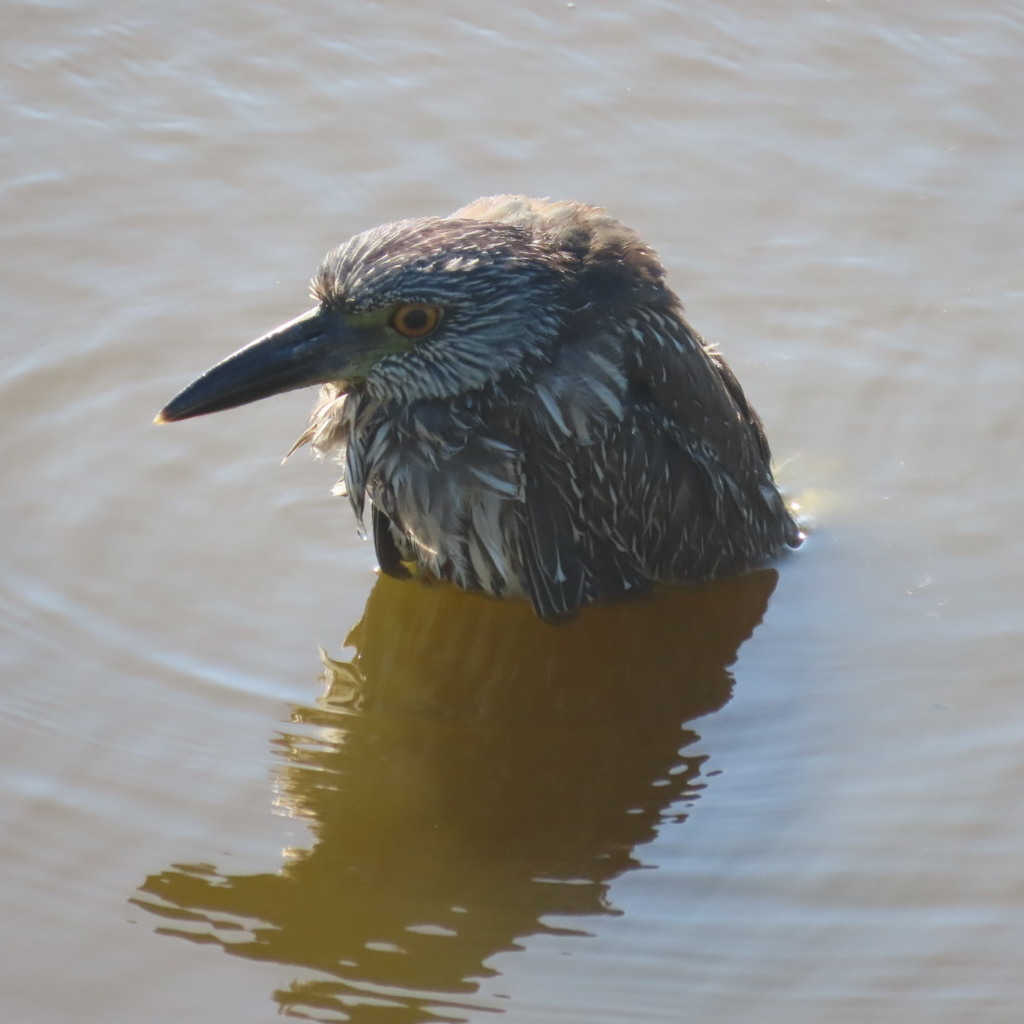
(c) Suanne Pyle, some rights reserved (CC BY) · licence
Family: Ardeidae · Class: Aves · Order: Pelecaniformes
Nyctanassa violacea (Yellow-crowned Night-Heron) is a California animal in the Ardeidae family.
The Yellow-crowned Night-Heron is a medium-sized wading bird measuring 56 to 70 cm (22 to 28 inches) in length with a wingspan of 101 to 112 cm (40 to 44 inches). Adults weigh between 650 to 850 grams. The species exhibits distinctive plumage with a black head marked by a prominent white cheek patch and yellowish-white crown stripe that extends down the back of the neck. The back and wings are blue-gray with black streaks, while the underparts are gray. During breeding season, long white plumes extend from the back of the head. Juveniles are brownish with heavy streaking and lack the distinctive head pattern of adults. The bill is thick, black, and shorter than that of other night-herons. The legs are yellow to orange-yellow. The Yellow-crowned Night-Heron has a primarily southeastern distribution in North America, extending from the eastern United States through Central America and the Caribbean. In California, the species is uncommon to rare, occurring mainly as a vagrant or occasional breeding resident in suitable habitat. The species has been documented in the Central Valley, coastal areas from San Diego County north to the San Francisco Bay Area, and occasionally in the Colorado River region. Historical breeding records exist for scattered locations throughout the state, though current breeding populations remain limited. This species inhabits diverse wetland environments including freshwater and saltwater marshes, swamps, mangroves, wooded streams, and pond edges. Unlike other herons, Yellow-crowned Night-Herons show a preference for areas with abundant crustacean populations, particularly crabs and crayfish. They utilize both natural wetlands and constructed habitats such as treatment ponds, golf course water features, and urban park ponds. The species typically requires nearby trees or shrubs for roosting and nesting. Yellow-crowned Night-Herons are primarily nocturnal and crepuscular, becoming active at dusk and dawn. Their diet consists mainly of crustaceans, particularly crabs and crayfish, which can comprise up to 60 percent of their food intake. They also consume fish, frogs, insects, small reptiles, and occasionally small mammals. The species employs a patient hunting strategy, standing motionless in shallow water before striking rapidly at prey. Breeding occurs from March through August, with peak activity in April and May. Nests are constructed of sticks and placed 3 to 12 meters high in trees or large shrubs, often over water. Females lay 2 to 5 pale blue-green eggs, which are incubated for 21 to 25 days. Both parents participate in incubation and chick-rearing duties. The Yellow-crowned Night-Heron is not federally or state listed in California. The species is considered secure globally but faces local population pressures from habitat loss, particularly wetland degradation and urban development. Climate change may affect prey availability and breeding success. In California, the species benefits from wetland restoration projects and protection of riparian corridors, though its status as a rare resident makes population monitoring challenging.
Classification
Class: Aves · Order: Pelecaniformes · Family: Ardeidae
Frequently asked questions
How is Nyctanassa violacea classified?
Nyctanassa violacea belongs to class Aves, order Pelecaniformes, family Ardeidae.
What family does Nyctanassa violacea belong to?
Nyctanassa violacea is in the Ardeidae family.
What is Nyctanassa violacea?
The Yellow-crowned Night-Heron is a medium-sized wading bird measuring 56 to 70 cm (22 to 28 inches) in length with a wingspan of 101 to 112 cm (40 to 44 inches).
Is Nyctanassa violacea found in California?
Yes. Nyctanassa violacea is recorded in California in The California Species Project's catalogue.
Related species
Other California species in the same genus, family, or bioregion.
Data from The California Species Project — 14,000+ California species with verified data from CNPS, CDFW, USFWS, and more.