Nyctelius nyctelius
Violet-banded Skipper
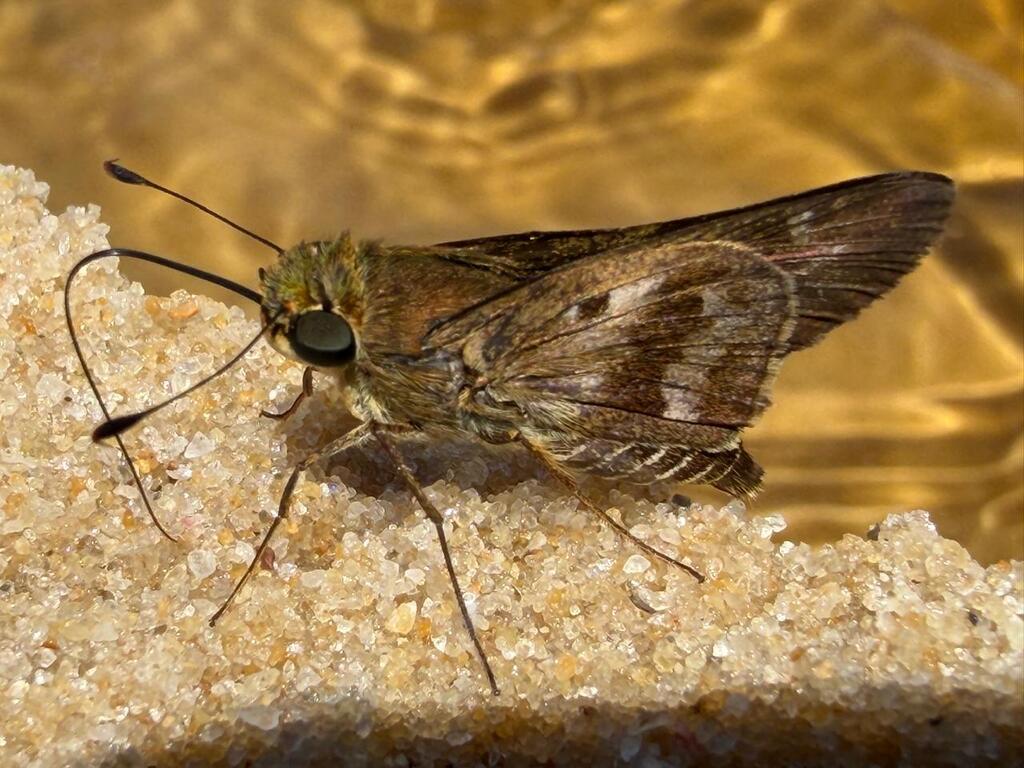
(c) lucas_rafaelle, some rights reserved (CC BY-SA) · licence
Family: Hesperiidae · Class: Insecta · Order: Lepidoptera
Nyctelius nyctelius (Violet-banded Skipper) is a California animal in the Hesperiidae family.
The Violet-banded Skipper is a small butterfly in the family Hesperiidae, characterized by distinctive violet-purple markings on its wings. Adults have a wingspan of approximately 25-32 mm (1.0-1.3 inches). The forewings are dark brown to black with violet-blue bands or patches that give the species its common name. The hindwings display similar coloration with prominent violet markings. Males typically exhibit more pronounced violet banding than females, and possess specialized scent patches called stigma on their forewings. The body is robust and covered with dark scales, typical of skipper butterflies. The Violet-banded Skipper ranges from Argentina north through Central America to Mexico and the West Indies. In the United States, it occurs as a periodic stray to the lower Rio Grande Valley in central Texas, southeastern Arizona, and southern California. Records from California are sporadic and represent temporary colonizations rather than established populations. The species is primarily tropical and subtropical, with northern records typically occurring during periods of favorable weather conditions that allow temporary range expansion. This species inhabits open areas with abundant grasses, including agricultural fields, pastures, and disturbed habitats. In its native range, it occurs from sea level to moderate elevations, typically below 1,500 meters. The butterfly favors areas with a mix of host plants and nectar sources. Adults are often observed in sunny locations near grass patches and agricultural areas where host plants are cultivated. Violet-banded Skippers utilize various grass species as larval hosts, including sugarcane (Saccharum officinarum), corn (Zea mays), and rice (Oryza sativa). This association with agricultural grasses allows the species to exploit human-modified landscapes. Larvae feed within rolled leaf shelters, creating silk-lined tubes where they develop. The species is multivoltine in tropical areas, producing multiple generations per year. Adults are active during daylight hours and feed on flower nectar from various plant species. Males establish territories and engage in patrol flights to locate females. Females deposit eggs singly on host plant leaves. The Violet-banded Skipper has no federal or state conservation listing in the United States due to its status as a non-resident stray species. In California, documented occurrences are rare and irregular, typically associated with favorable weather patterns that facilitate northward dispersal from Mexico. The species faces no significant conservation threats within its core range, where it remains relatively common in suitable habitat. Climate change may potentially affect the frequency and extent of northward strays into California and other border states. Agricultural practices that maintain host plant availability generally benefit populations in the species' primary range. Conservation efforts focus on habitat preservation in tropical regions where established populations occur.
Classification
Class: Insecta · Order: Lepidoptera · Family: Hesperiidae
Frequently asked questions
How is Nyctelius nyctelius classified?
Nyctelius nyctelius belongs to class Insecta, order Lepidoptera, family Hesperiidae.
What family does Nyctelius nyctelius belong to?
Nyctelius nyctelius is in the Hesperiidae family.
What is Nyctelius nyctelius?
The Violet-banded Skipper is a small butterfly in the family Hesperiidae, characterized by distinctive violet-purple markings on its wings.
Is Nyctelius nyctelius found in California?
Yes. Nyctelius nyctelius is recorded in California in The California Species Project's catalogue.
Related species
Other California species in the same genus, family, or bioregion.
Data from The California Species Project — 14,000+ California species with verified data from CNPS, CDFW, USFWS, and more.