Nycticorax nycticorax
Black-crowned Night Heron
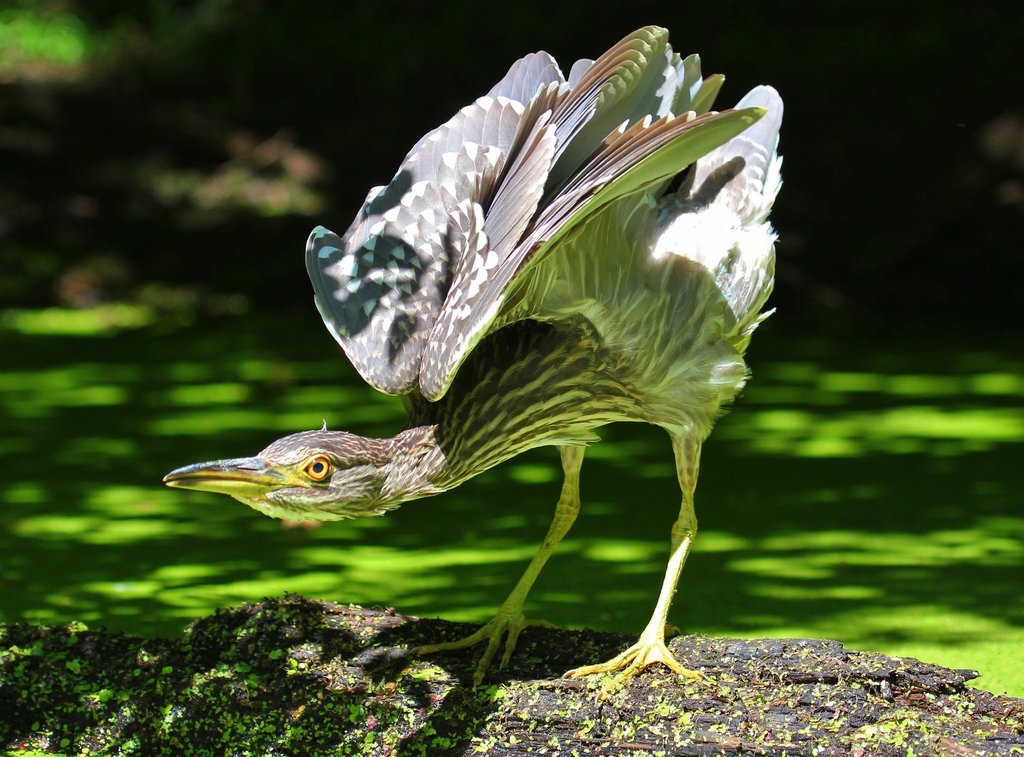
(c) Алина Урусова, some rights reserved (CC BY) · licence
Family: Ardeidae · Class: Aves · Order: Pelecaniformes
Conservation status: G5 S4
Nycticorax nycticorax (Black-crowned Night Heron) is a California animal in the Ardeidae family.
The Black-crowned Night Heron is a medium-sized wading bird measuring 58 to 66 cm (23 to 26 inches) in length with a wingspan of 105 to 112 cm (41 to 44 inches). Adults weigh between 727 to 1,014 grams (1.6 to 2.2 pounds). Breeding adults display distinctive black caps and backs contrasting with pale gray wings and white underparts. The bill is thick, black, and dagger-like, while the legs are yellow during breeding season, turning greenish-yellow outside breeding periods. Two to three long white plumes extend from the back of the head during courtship. Juveniles are heavily streaked brown and white with yellow-orange bills and greenish-yellow legs, lacking the distinctive adult coloration. Black-crowned Night Herons have one of the most extensive global distributions of any heron species. In California, they occur throughout the state in suitable habitat, from sea level to approximately 1,200 meters (4,000 feet) elevation. The species breeds in the Central Valley, San Francisco Bay Area, coastal regions, and scattered interior locations. Year-round residents are found in many areas, while others migrate seasonally between breeding and wintering grounds. This species inhabits freshwater and brackish wetlands including marshes, swamps, streams, lakes, ponds, and estuarine environments. They utilize both natural and artificial water bodies, frequently occurring in urban parks, golf course ponds, and managed wetlands. Night herons require nearby trees or tall shrubs for roosting and nesting, often selecting sites 3 to 15 meters (10 to 50 feet) above water. Dense vegetation provides critical cover during daylight hours. Black-crowned Night Herons are primarily nocturnal and crepuscular, becoming active at dusk to hunt in shallow waters. Their diet consists of fish, frogs, aquatic insects, crustaceans, small mammals, and occasionally birds and eggs. The species employs a patient hunting strategy, standing motionless before striking with rapid bill thrusts. Breeding occurs from March through August in California, with peak activity from April to June. Nests are constructed as platforms of sticks and twigs in trees or shrubs, often in colonies ranging from a few pairs to several hundred. Females typically lay 3 to 5 pale blue-green eggs, which both parents incubate for 24 to 26 days. Young fledge after 6 to 7 weeks but may remain dependent on parents for several additional weeks. The Black-crowned Night Heron maintains stable populations globally with a ranking of G5 (globally secure) and S4 (apparently secure) in California. The species is not federally or state listed and faces no immediate conservation threats. However, local populations may be affected by habitat loss through wetland development, water diversions, and urban expansion. Climate change poses potential long-term challenges through altered precipitation patterns and water availability. The species' adaptability to urban environments and artificial water sources has helped maintain population stability in many regions.
Classification
Class: Aves · Order: Pelecaniformes · Family: Ardeidae
Conservation status
G5 S4
Frequently asked questions
How is Nycticorax nycticorax classified?
Nycticorax nycticorax belongs to class Aves, order Pelecaniformes, family Ardeidae.
What family does Nycticorax nycticorax belong to?
Nycticorax nycticorax is in the Ardeidae family.
Is Nycticorax nycticorax protected or of conservation concern?
Nycticorax nycticorax carries the following status: G5 S4.
What is Nycticorax nycticorax?
The Black-crowned Night Heron is a medium-sized wading bird measuring 58 to 66 cm (23 to 26 inches) in length with a wingspan of 105 to 112 cm (41 to 44 inches).
Is Nycticorax nycticorax found in California?
Yes. Nycticorax nycticorax is recorded in California in The California Species Project's catalogue.
Related species
Other California species in the same genus, family, or bioregion.
Data from The California Species Project — 14,000+ California species with verified data from CNPS, CDFW, USFWS, and more.