Nyctinomops femorosaccus
Pocketed Free-tailed Bat
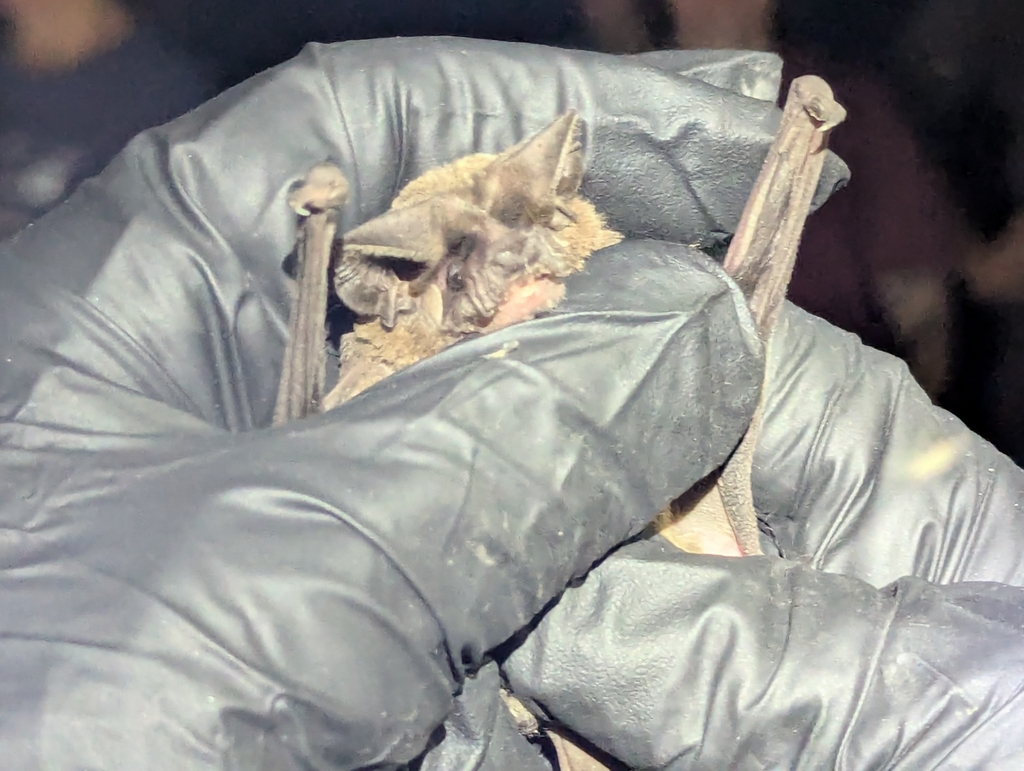
(c) Rachel Stringham, some rights reserved (CC BY) · licence
Family: Molossidae · Class: Mammalia · Order: Chiroptera
Conservation status: G5 S3
Nyctinomops femorosaccus (Pocketed Free-tailed Bat) is a California animal in the Molossidae family.
The pocketed free-tailed bat is a medium-sized insectivorous bat distinguished by its characteristic free tail that extends beyond the tail membrane. Adults measure 95-112 mm (3.7-4.4 inches) in total length with a forearm length of 44-50 mm (1.7-2.0 inches). The species weighs 10-14 grams (0.35-0.49 ounces). Dorsal fur is dark brown to blackish-brown, while ventral fur is slightly paler. The ears are large and broad, extending forward over the eyes when laid flat. The species derives its common name from the distinctive fold of skin or 'pocket' located on the throat of males, which becomes more pronounced during breeding season. Wings are long and narrow, adapted for rapid, sustained flight. The pocketed free-tailed bat occurs in the southwestern United States and northwestern Mexico. In California, the species is documented primarily in desert regions of Riverside, Imperial, San Bernardino, and Inyo counties. The range extends through the Mojave and Sonoran deserts, with scattered records from the southern Sierra Nevada. Historically, the species may have had a broader distribution in California, but current records suggest a more restricted range compared to other southwestern states. This species inhabits arid and semi-arid environments, typically below 2,000 meters (6,560 feet) elevation. Roosting sites include rock crevices in cliff faces, caves, abandoned mines, and occasionally buildings. The species shows preference for areas near water sources and tends to select roost sites that provide protection from temperature extremes. Desert scrub, Joshua tree woodland, and riparian areas provide foraging habitat. Pocketed free-tailed bats are highly aerial insectivores, feeding primarily on moths, beetles, flying ants, and other night-flying insects. They emerge shortly after sunset to forage, often flying at considerable heights above the ground. The species exhibits seasonal migration patterns, moving to warmer areas during winter months. Mating occurs in late winter or early spring, with females forming maternity colonies in suitable roost sites. Gestation lasts approximately 77-84 days, with a single pup born in late spring or early summer. Young bats are capable of flight at 5-6 weeks of age. The pocketed free-tailed bat is not federally listed but has a California state rank of S3, indicating it is vulnerable to extirpation from the state due to restricted range, few populations, recent declines, or other factors. Primary threats include habitat loss from urban development, renewable energy projects, and mining activities in desert regions. Disturbance of roosting sites, particularly caves and abandoned mines, poses additional risks. Climate change may affect prey availability and suitable roosting temperatures. Water source availability is critical for this desert-adapted species, making water diversions and drought conditions potential limiting factors. Current population trends in California are not well documented, highlighting the need for systematic surveys and monitoring programs.
Classification
Class: Mammalia · Order: Chiroptera · Family: Molossidae
Conservation status
G5 S3
Frequently asked questions
How is Nyctinomops femorosaccus classified?
Nyctinomops femorosaccus belongs to class Mammalia, order Chiroptera, family Molossidae.
What family does Nyctinomops femorosaccus belong to?
Nyctinomops femorosaccus is in the Molossidae family.
Is Nyctinomops femorosaccus protected or of conservation concern?
Nyctinomops femorosaccus carries the following status: G5 S3.
What is Nyctinomops femorosaccus?
The pocketed free-tailed bat is a medium-sized insectivorous bat distinguished by its characteristic free tail that extends beyond the tail membrane.
Is Nyctinomops femorosaccus found in California?
Yes. Nyctinomops femorosaccus is recorded in California in The California Species Project's catalogue.
Related species
Other California species in the same genus, family, or bioregion.
Data from The California Species Project — 14,000+ California species with verified data from CNPS, CDFW, USFWS, and more.