Nymphalis antiopa
Mourning Cloak
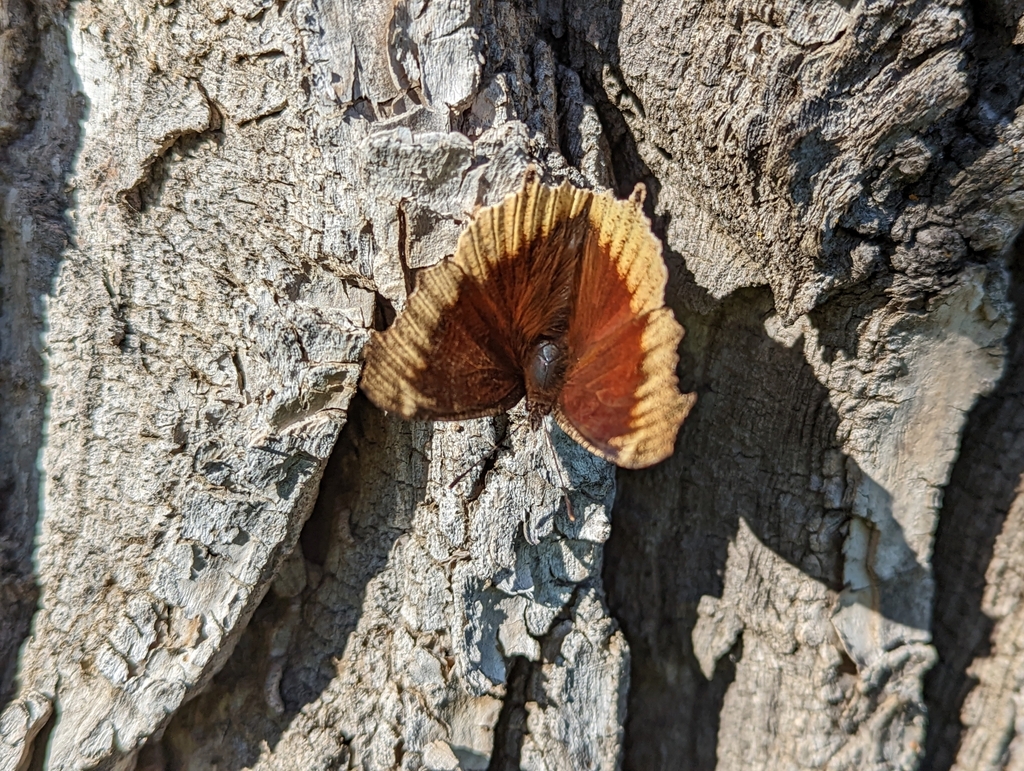
(c) Matt Muir, some rights reserved (CC BY) · licence
Family: Nymphalidae · Class: Insecta · Order: Lepidoptera
Nymphalis antiopa (Mourning Cloak) is a California animal in the Nymphalidae family.
The Mourning Cloak (Nymphalis antiopa) is a large butterfly in the family Nymphalidae with distinctive dark wings bordered by cream-colored margins. Adults measure 62-75 mm (2.4-3.0 inches) in wingspan, making them one of North America's larger butterflies. The dorsal wing surfaces are deep maroon to brownish-black with a broad pale yellow or cream border and a row of blue spots along the inner edge of the border. The ventral surfaces are dark brown to black with lighter mottling, providing effective camouflage when wings are closed. Fresh individuals display more vibrant coloration, while overwintered adults show faded borders that may appear nearly white. Mourning Cloaks occur throughout North America south of the tundra to central Mexico, though they are rarely found in the Gulf States and peninsular Florida. The species is also native to temperate Eurasia, making it one of the most widely distributed butterflies in the Northern Hemisphere. In California, they are found throughout most regions where suitable habitat occurs, from sea level to elevations exceeding 3,000 meters (9,800 feet) in mountainous areas. This species inhabits areas near water sources where host plants grow, including riparian zones, streamside vegetation, parks, gardens, and woodland edges. Adults frequently visit tree sap, rotting fruit, and occasionally flowers for nectar. They prefer partially shaded areas with access to both sunlight for basking and shelter for roosting. Mourning Cloaks have a unique life history among North American butterflies, with adults living 10-11 months, making them exceptionally long-lived for lepidopterans. Adults emerge in midsummer, feed actively to build fat reserves, then enter hibernation in late fall. They overwinter as adults in bark crevices, wood piles, or other protected locations, emerging on warm days in late winter or early spring. Mating occurs in early spring following emergence from hibernation. Females deposit eggs in clusters around twigs of host plants. Larvae are gregarious when young, feeding together in groups, but become more solitary as they mature through five instars. Host plants include various willows such as black willow (Salix nigra), weeping willow (S. babylonica), and silky willow (S. sericea). Additional hosts include American elm (Ulmus americana), cottonwood (Populus deltoides), aspen (Populus tremuloides), paper birch (Betula papyrifera), and hackberry (Celtis occidentalis). Older caterpillars may wander from their feeding sites and can be found on plants they do not consume. Mourning Cloaks are not federally or state-listed as threatened or endangered. The species appears stable across most of its range, though local populations may fluctuate based on host plant availability and weather conditions. Their broad host plant range and wide distribution contribute to their conservation stability. Climate change may affect northern populations as temperature patterns shift, but the species' adaptability and extensive range provide resilience against localized threats.
Classification
Class: Insecta · Order: Lepidoptera · Family: Nymphalidae
Frequently asked questions
How is Nymphalis antiopa classified?
Nymphalis antiopa belongs to class Insecta, order Lepidoptera, family Nymphalidae.
What family does Nymphalis antiopa belong to?
Nymphalis antiopa is in the Nymphalidae family.
What is Nymphalis antiopa?
The Mourning Cloak (Nymphalis antiopa) is a large butterfly in the family Nymphalidae with distinctive dark wings bordered by cream-colored margins.
Is Nymphalis antiopa found in California?
Yes. Nymphalis antiopa is recorded in California in The California Species Project's catalogue.
Related species
Other California species in the same genus, family, or bioregion.
Data from The California Species Project — 14,000+ California species with verified data from CNPS, CDFW, USFWS, and more.