Nymphalis californica
California Tortoiseshell
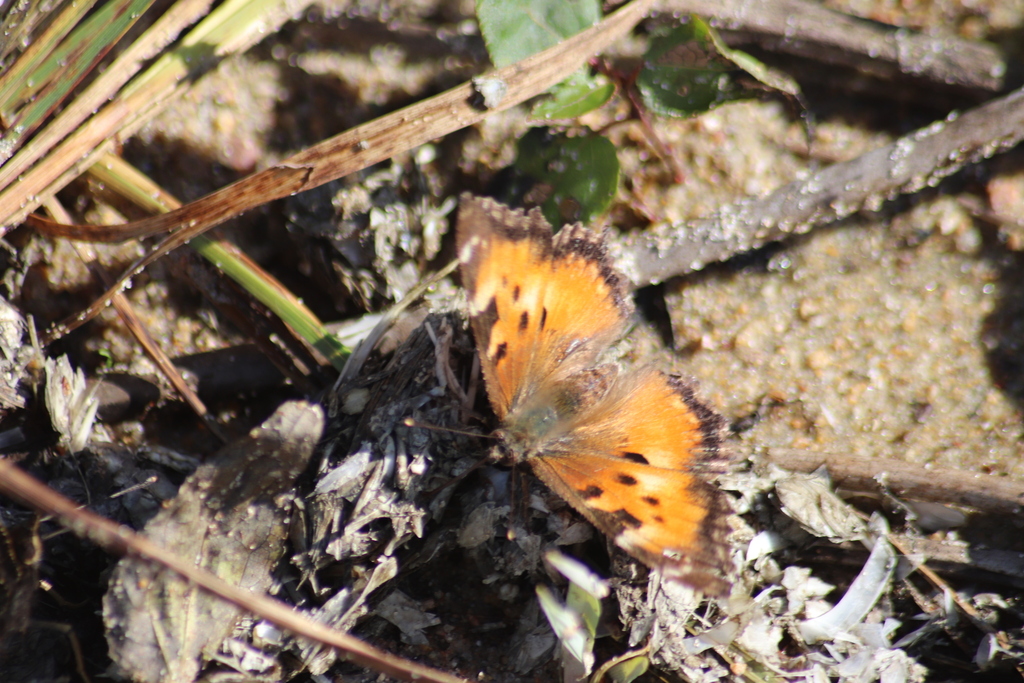
(c) Sean Frey, some rights reserved (CC BY) · licence
Family: Nymphalidae · Class: Insecta · Order: Lepidoptera
Nymphalis californica (California Tortoiseshell) is a California animal in the Nymphalidae family.
The California tortoiseshell is a medium-sized butterfly with distinctive orange and black wing patterns. Adults have a wingspan ranging from 45 to 65 mm (1.8 to 2.6 inches). The dorsal wing surfaces are primarily orange with irregular black markings and borders, while the ventral surfaces display mottled brown, gray, and orange coloration that provides camouflage when the wings are closed. The wing edges are scalloped, and males can be distinguished from females by their slightly smaller size and more pointed forewings. This species ranges from British Columbia south along the Pacific Coast to Baja California Norte, extending eastward to Montana, Wyoming, Colorado, and New Mexico. Rare migrants have been documented as far east as Michigan, Pennsylvania, New York, and Vermont following periodic population explosions. In California, the California tortoiseshell occurs throughout mountainous regions from the Oregon border south to Baja California, typically at elevations between 1,200 and 3,000 meters (4,000 to 10,000 feet). California tortoiseshells inhabit chaparral, oak woodlands, coniferous forests, and mountain slopes where their host plants occur. The species shows a strong association with areas containing various species of wild lilac (Ceanothus), which serve as the exclusive larval host plants. Adults are commonly found in clearings, along ridgetops, and in areas with abundant nectar sources including rabbitbrush, buckwheat, and composite flowers. The species exhibits distinctive population dynamics characterized by dramatic boom-and-bust cycles. During outbreak years, which occur irregularly every 8 to 15 years, populations can increase exponentially, leading to massive migrations that may carry individuals far beyond their normal range. Females deposit clusters of yellow eggs on Ceanothus leaves, and larvae develop through five instars, often defoliating entire shrubs during outbreak years. The species typically produces two broods annually in favorable conditions, with adults flying from late spring through early fall. Adults that emerge in late summer enter hibernation and overwinter as adults, resuming activity the following spring. California tortoiseshells demonstrate strong dispersal behavior, particularly during population peaks. Males engage in hilltopping behavior, establishing territories on prominent elevated locations where they patrol for females. The species plays an ecological role as both herbivore and pollinator, with larvae serving as food for various predators and parasitoids that help regulate population cycles. The California tortoiseshell currently has no special conservation status and is not listed under federal or state endangered species acts. The species appears stable across its range, though populations fluctuate dramatically due to natural boom-bust cycles rather than conservation concerns. Climate change may affect future distribution patterns, particularly at higher elevations, but the species' broad host plant range and strong dispersal abilities likely provide resilience to environmental changes. The periodic population explosions and subsequent crashes appear to be a natural evolutionary strategy rather than a conservation concern.
Classification
Class: Insecta · Order: Lepidoptera · Family: Nymphalidae
Frequently asked questions
How is Nymphalis californica classified?
Nymphalis californica belongs to class Insecta, order Lepidoptera, family Nymphalidae.
What family does Nymphalis californica belong to?
Nymphalis californica is in the Nymphalidae family.
What is Nymphalis californica?
The California tortoiseshell is a medium-sized butterfly with distinctive orange and black wing patterns.
Is Nymphalis californica found in California?
Yes. Nymphalis californica is recorded in California in The California Species Project's catalogue.
Related species
Other California species in the same genus, family, or bioregion.
Data from The California Species Project — 14,000+ California species with verified data from CNPS, CDFW, USFWS, and more.