Nymphalis vaualbum
Compton Tortoiseshell
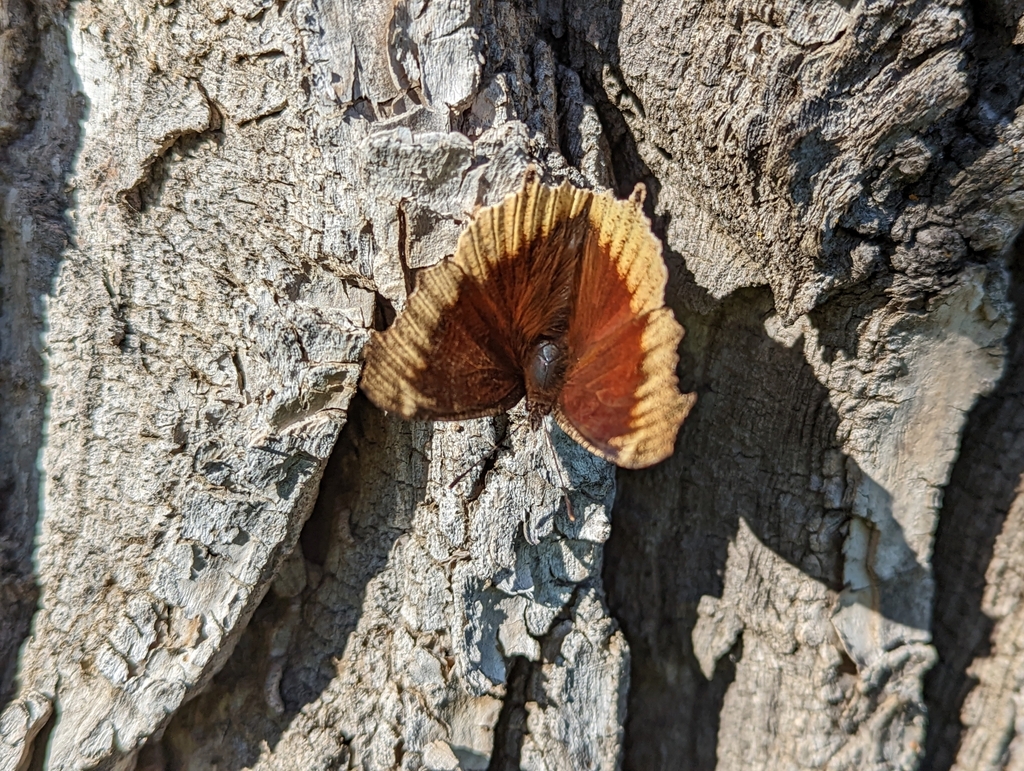
(c) Matt Muir, some rights reserved (CC BY) · licence
Family: Nymphalidae · Class: Insecta · Order: Lepidoptera
Nymphalis vaualbum (Compton Tortoiseshell) is a California animal in the Nymphalidae family.
The Compton Tortoiseshell is a medium to large butterfly in the family Nymphalidae, with a wingspan ranging from 50 to 75 mm (2.0 to 3.0 inches). The dorsal wing surfaces display a complex pattern of orange-brown base coloration with dark irregular patches and marginal borders. The forewings feature distinctive white spots near the apex, while the hindwings show a series of blue spots along the outer margin bordered by a dark band. The ventral wing surfaces are mottled gray-brown with intricate bark-like patterns that provide excellent camouflage when the butterfly rests with wings closed. The species exhibits pronounced sexual dimorphism, with females typically larger than males and displaying more subdued coloration. Nymphalis vaualbum has a vast Holarctic distribution, ranging from southeast Alaska and Canada south through the mountains to Montana and Wyoming, extending east across southern Canada and the northern United States to New England, and south to North Carolina and Missouri. The species occurs as rare migrants to Newfoundland, Nebraska, and Florida. This butterfly is also found throughout temperate Eurasia, making it one of the most widely distributed tortoiseshells. In California, the Compton Tortoiseshell is primarily found in mountainous regions at elevations typically between 1,200 and 3,000 meters (4,000 to 10,000 feet). The species inhabits deciduous and mixed forests, particularly areas dominated by its host plants. Adults frequent woodland clearings, forest edges, stream corridors, and meadow margins where nectar sources are abundant. The butterfly shows a strong association with riparian zones and areas with abundant Populus and Salix species. During winter, adults seek shelter under loose bark, in rock crevices, or in other protected locations. Compton Tortoiseshells are multivoltine in warmer areas but typically single-brooded in northern regions. Adults overwinter and become active in early spring, often emerging during warm spells in late winter. Mating occurs in spring, with females depositing clusters of eggs on host plant twigs. Larvae feed communally on aspen and cottonwood (Populus), willows (Salix), gray birch (Betula populifolia), and paper birch (B. papyrifera). The caterpillars are gregarious in early instars, creating silk webbing shelters on branch tips. Adults are strong fliers capable of long-distance dispersal and are known for irregular irruptive movements, with population numbers fluctuating dramatically between years. Adults feed on tree sap, rotting fruit, and occasionally flower nectar, particularly favoring willow catkins in spring. The Compton Tortoiseshell is not federally or state-listed in California and appears to maintain stable populations across much of its range. However, the species exhibits natural population cycles with periodic irruptions followed by years of low abundance. Climate change may affect the species' distribution, particularly at the southern margins of its range. Forest management practices that maintain diverse age classes of host plants support population stability. The butterfly's wide host plant range and strong dispersal ability contribute to its resilience, though localized populations may be vulnerable to habitat loss or alteration of riparian ecosystems.
Classification
Class: Insecta · Order: Lepidoptera · Family: Nymphalidae
Frequently asked questions
How is Nymphalis vaualbum classified?
Nymphalis vaualbum belongs to class Insecta, order Lepidoptera, family Nymphalidae.
What family does Nymphalis vaualbum belong to?
Nymphalis vaualbum is in the Nymphalidae family.
What is Nymphalis vaualbum?
The Compton Tortoiseshell is a medium to large butterfly in the family Nymphalidae, with a wingspan ranging from 50 to 75 mm (2.0 to 3.0 inches).
Is Nymphalis vaualbum found in California?
Yes. Nymphalis vaualbum is recorded in California in The California Species Project's catalogue.
Related species
Other California species in the same genus, family, or bioregion.
Data from The California Species Project — 14,000+ California species with verified data from CNPS, CDFW, USFWS, and more.