Oceanites oceanicus
Wilson's Storm-Petrel
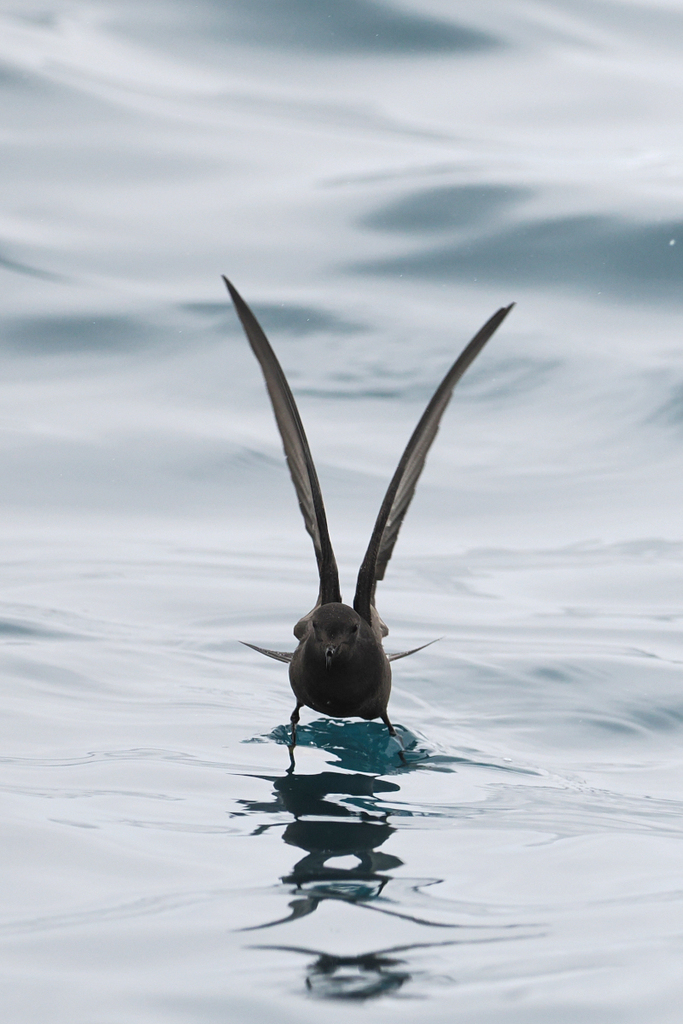
no rights reserved · CC0
Family: Hydrobatidae · Class: Aves · Order: Procellariiformes
Oceanites oceanicus (Wilson's Storm-Petrel) is a California animal in the Hydrobatidae family.
Wilson's Storm-Petrel is a small seabird measuring 16 to 19 cm (6.3 to 7.5 inches) in length with a wingspan of 38 to 42 cm (15 to 16.5 inches). Adults weigh 28 to 56 grams (1.0 to 2.0 ounces). The species displays dark brownish-black plumage above with a distinctive white rump patch that extends onto the flanks. The underparts are dark brown to black. In flight, a pale diagonal wing bar is visible across the upper wing coverts. The legs are black with yellow webbed feet that extend beyond the tail in flight, a key field mark distinguishing this species from other storm-petrels. The bill is black and slightly hooked at the tip. Wilson's Storm-Petrel has the most extensive distribution of any storm-petrel species, breeding in Antarctica and sub-Antarctic islands before migrating north across all major oceans. In the eastern Pacific, the species occurs regularly off the California coast from April through October, with peak abundance during summer months. During migration and winter, Wilson's Storm-Petrels can be observed from shore-based locations along the entire California coastline, though they are more commonly encountered in offshore waters beyond the continental shelf. The species inhabits pelagic marine environments, typically feeding in areas where upwelling creates productive waters rich in marine invertebrates. Wilson's Storm-Petrels prefer waters over the continental shelf and slope, generally found 20 to 200 kilometers offshore. They are often associated with areas of oceanic convergence and upwelling zones where prey concentrations are highest. During the breeding season in the Southern Hemisphere, they nest in colonies on rocky shores, cliff faces, and among boulder fields on sub-Antarctic islands. Wilson's Storm-Petrels are highly aerial, spending most of their lives on the wing over open ocean. They feed by pattering across the water surface with their feet while picking small prey items from the surface tension. Their diet consists primarily of small fish, squid, crustaceans, and planktonic organisms. The species exhibits a distinctive feeding behavior of hovering and pattering on the water surface while maintaining position with rapid wingbeats. They are often observed following ships and feeding in the wake disturbance. Breeding occurs during the austral summer (October to March) in the Southern Hemisphere. Pairs nest in burrows excavated in soft soil or among rock crevices. Females lay a single white egg that is incubated for approximately 40 to 48 days. Chicks fledge after 52 to 78 days in the nest burrow. Wilson's Storm-Petrel is not currently listed under the Endangered Species Act and maintains stable global populations estimated in the tens of millions of individuals. The species benefits from protection of breeding colonies in Antarctica and sub-Antarctic regions under international agreements. Primary threats include plastic pollution, climate change effects on prey availability, and potential impacts from commercial fishing operations. Oil spills pose localized risks to feeding and migrating individuals in offshore waters.
Classification
Class: Aves · Order: Procellariiformes · Family: Hydrobatidae
Frequently asked questions
How is Oceanites oceanicus classified?
Oceanites oceanicus belongs to class Aves, order Procellariiformes, family Hydrobatidae.
What family does Oceanites oceanicus belong to?
Oceanites oceanicus is in the Hydrobatidae family.
What is Oceanites oceanicus?
Wilson's Storm-Petrel is a small seabird measuring 16 to 19 cm (6.3 to 7.5 inches) in length with a wingspan of 38 to 42 cm (15 to 16.5 inches).
Is Oceanites oceanicus found in California?
Yes. Oceanites oceanicus is recorded in California in The California Species Project's catalogue.
Related species
Other California species in the same genus, family, or bioregion.
Data from The California Species Project — 14,000+ California species with verified data from CNPS, CDFW, USFWS, and more.