Oceanodroma furcata
Fork-tailed Storm-petrel
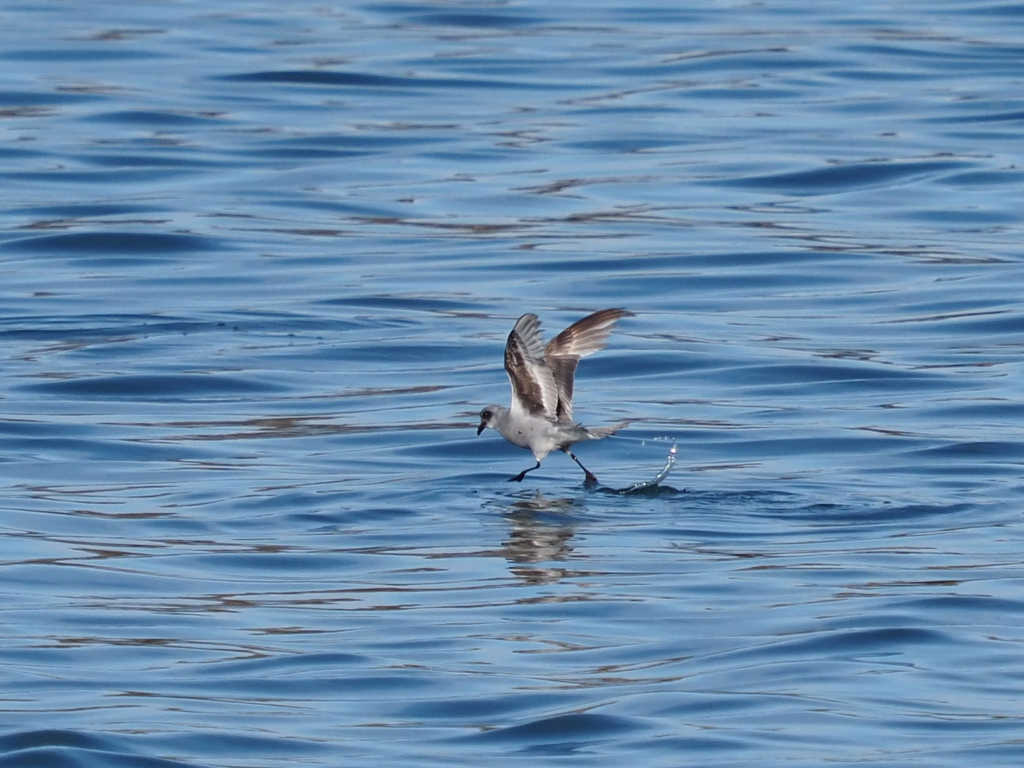
(c) Matt Muir, some rights reserved (CC BY) · licence
Family: Hydrobatidae · Class: Aves · Order: Procellariiformes
Conservation status: G5 S1
Oceanodroma furcata (Fork-tailed Storm-petrel) is a California animal in the Hydrobatidae family.
The Fork-tailed Storm-petrel is a small seabird measuring 20-23 cm (7.9-9.1 inches) in length with a wingspan of 46 cm (18 inches). Adults weigh 45-65 grams (1.6-2.3 ounces). The species displays distinctive plumage with blue-gray upperparts and white underparts, separated by a prominent dark diagonal band across the underwing. The tail is notably forked, giving the species its common name, and the bill is black and tube-shaped, characteristic of the petrel family. The legs and feet are black with yellow webbing between the toes. Historically, Fork-tailed Storm-petrels nested on islands along the California coast from the Farallon Islands south to the Channel Islands. Currently in California, the species maintains breeding colonies primarily on Southeast Farallon Island, with smaller numbers on Ano Nuevo Island and the Channel Islands. The global range extends from Alaska's Aleutian Islands south to central California, with populations also breeding in the North Pacific from Japan to the Kuril Islands. Winter distribution extends throughout the North Pacific Ocean. Breeding habitat consists of offshore islands with suitable nesting sites including rock crevices, soil burrows, and spaces under boulders or driftwood. Colonies are typically located on islands free from terrestrial predators. Outside the breeding season, Fork-tailed Storm-petrels inhabit pelagic waters over the continental shelf and beyond, generally preferring areas with upwelling that support abundant prey. Fork-tailed Storm-petrels feed primarily on small fish, squid, crustaceans, and marine invertebrates obtained through surface-seizing and shallow plunge-diving techniques. The species exhibits nocturnal activity patterns at breeding colonies to avoid predation. Breeding occurs from May through September, with pairs excavating burrows up to 1.5 meters deep or utilizing natural crevices. Females lay a single white egg, and both parents share incubation duties for approximately 50 days. The semi-altricial chick remains in the nest for 60-70 days before fledging. The Fork-tailed Storm-petrel is not federally listed but receives a California state rank of S1, indicating the species is critically imperiled in California. The global rank of G5 reflects stable worldwide populations, but California represents the southern extent of the species' range with limited breeding locations. Primary threats include habitat disturbance from human activities, introduced predators on nesting islands, oil spills, marine pollution, and climate change impacts on ocean productivity. Light pollution can disorient nocturnal adults and fledglings. Conservation efforts focus on predator control programs on nesting islands, particularly removal of introduced mammals, and protection of critical breeding habitat. The species benefits from designation of nesting islands as protected areas and monitoring programs that track population trends and reproductive success.
Classification
Class: Aves · Order: Procellariiformes · Family: Hydrobatidae
Conservation status
G5 S1
Frequently asked questions
How is Oceanodroma furcata classified?
Oceanodroma furcata belongs to class Aves, order Procellariiformes, family Hydrobatidae.
What family does Oceanodroma furcata belong to?
Oceanodroma furcata is in the Hydrobatidae family.
Is Oceanodroma furcata protected or of conservation concern?
Oceanodroma furcata carries the following status: G5 S1.
What is Oceanodroma furcata?
The Fork-tailed Storm-petrel is a small seabird measuring 20-23 cm (7.9-9.1 inches) in length with a wingspan of 46 cm (18 inches).
Is Oceanodroma furcata found in California?
Yes. Oceanodroma furcata is recorded in California in The California Species Project's catalogue.
Related species
Other California species in the same genus, family, or bioregion.
Data from The California Species Project — 14,000+ California species with verified data from CNPS, CDFW, USFWS, and more.