Oceanodroma hornbyi
Ringed Storm-Petrel
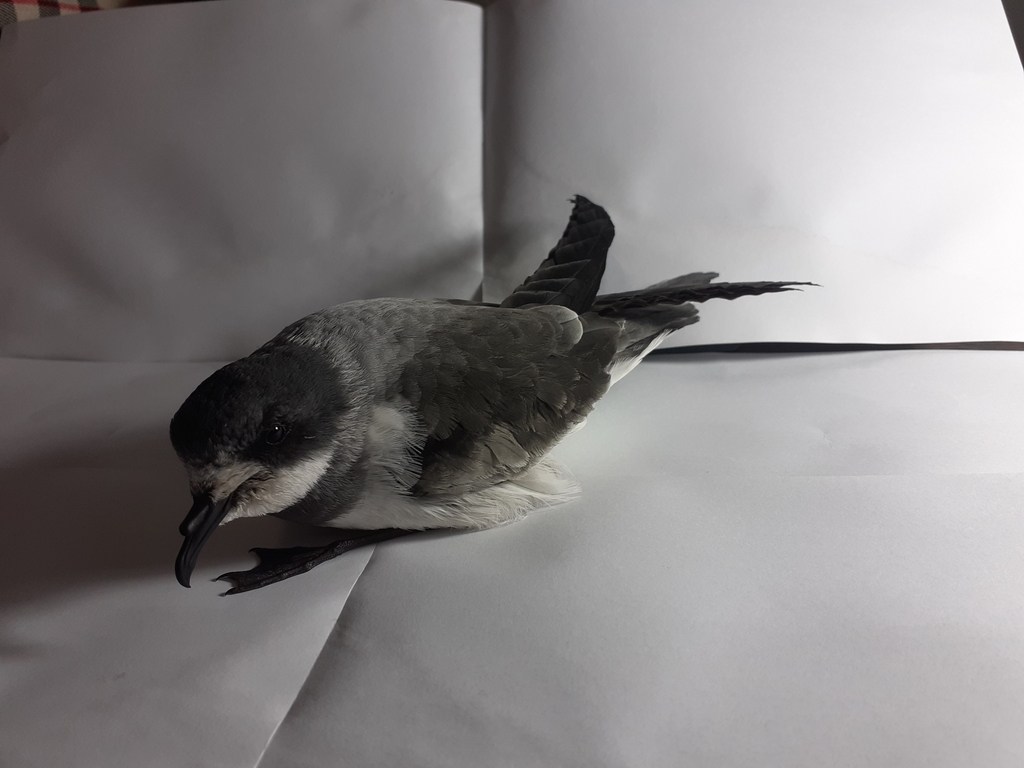
(c) Monics Paredes, some rights reserved (CC BY) · licence
Family: Hydrobatidae · Class: Aves · Order: Procellariiformes
Oceanodroma hornbyi (Ringed Storm-Petrel) is a California animal in the Hydrobatidae family.
The Ringed Storm-Petrel is a small, enigmatic seabird belonging to the family Hydrobatidae. Adults measure approximately 19-21 cm (7.5-8.3 inches) in length with a wingspan of 43-46 cm (17-18 inches). The species exhibits distinctive plumage consisting of dark brownish-black upperparts contrasting sharply with white underparts. A prominent white rump patch extends onto the uppertail coverts, and the species displays characteristic white wing patches visible during flight. The tail is forked, and the legs and feet are black with yellow webbing between the toes. Historically, the Ringed Storm-Petrel has been recorded off the coast of California, primarily in offshore waters of the eastern Pacific Ocean. The species ranges from central California south to Peru, with the core breeding range located along the coasts of Peru and northern Chile. In California waters, observations are extremely rare and typically occur far offshore, beyond the continental shelf in pelagic environments. The species inhabits open ocean environments, spending most of its life cycle in pelagic waters over deep ocean trenches and upwelling zones. Ringed Storm-Petrels are associated with areas of high marine productivity where cold, nutrient-rich waters support abundant zooplankton populations. The species rarely approaches shore except during breeding season, when it nests on remote offshore islands and rocky coastal cliffs. Ringed Storm-Petrels are highly specialized seabirds that feed primarily on small fish, squid, and marine crustaceans obtained through surface-skimming and shallow diving techniques. The species exhibits typical storm-petrel flight patterns, characterized by erratic, bat-like movements close to the ocean surface. Breeding occurs in colonies on remote islands, where pairs excavate burrows in soft soil or utilize natural rock crevices. Females lay a single white egg, with both parents sharing incubation duties for approximately 40-50 days. Chicks remain in the nest for 60-70 days before fledging. The conservation status of the Ringed Storm-Petrel remains poorly understood due to limited research and the species' remote habitat preferences. The species is not currently listed under the U.S. Endangered Species Act, nor does it have special protection status in California. However, population trends are uncertain, and the species may be vulnerable to threats common to seabirds, including marine pollution, climate change impacts on prey availability, and potential disturbance at breeding colonies. Introduced predators at nesting sites pose additional risks to reproductive success. The extreme rarity of Ringed Storm-Petrel observations in California waters makes assessment of local population status challenging. Recent research suggests the species may be more abundant in South American waters than previously recognized, but comprehensive population surveys are lacking. Long-term monitoring efforts are needed to evaluate population trends and identify potential conservation concerns for this poorly known seabird species.
Classification
Class: Aves · Order: Procellariiformes · Family: Hydrobatidae
Frequently asked questions
How is Oceanodroma hornbyi classified?
Oceanodroma hornbyi belongs to class Aves, order Procellariiformes, family Hydrobatidae.
What family does Oceanodroma hornbyi belong to?
Oceanodroma hornbyi is in the Hydrobatidae family.
What is Oceanodroma hornbyi?
The Ringed Storm-Petrel is a small, enigmatic seabird belonging to the family Hydrobatidae.
Is Oceanodroma hornbyi found in California?
Yes. Oceanodroma hornbyi is recorded in California in The California Species Project's catalogue.
Related species
Other California species in the same genus, family, or bioregion.
Data from The California Species Project — 14,000+ California species with verified data from CNPS, CDFW, USFWS, and more.